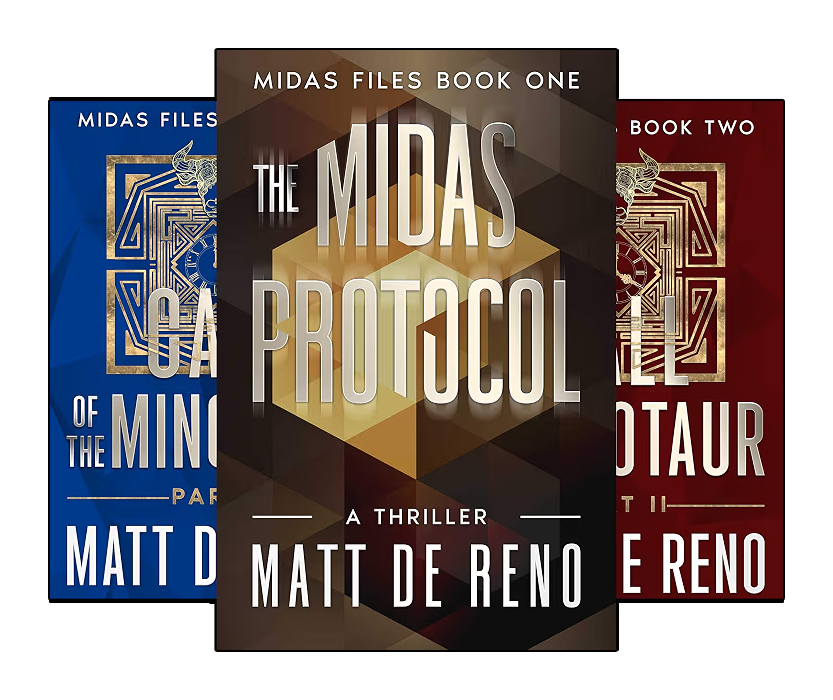


Finishing a book is supposed to create a sense of closure.
After spending years writing, revising, correcting, formatting, and finally publishing Call of the Minotaur, I expected to feel as though I had reached the end of a very long road. In some ways, I did. The book was finally out of my hands and available to readers, which still feels a little surreal after living with the story for so long.
What I did not expect was to discover that the road ahead already appears to be splitting in two.
During my recent trip to Rehoboth Beach, I tried to give myself some distance from writing. There was plenty of time for the beach, the boardwalk, family meals, and the usual vacation wandering. Still, even when I am not actively writing, some part of my mind seems to remain inside the world of the Midas Files.
Characters keep talking. Loose pieces begin connecting. Stories that once seemed like vague possibilities start insisting that they already exist.
I thought finishing Call of the Minotaur might leave me wondering what to write next. Instead, I may have the opposite problem.
Tears of Dionysus
For a long time, I have had a title in mind for the next major Midas Files novel: Tears of Dionysus.
A title does not always arrive before the story. Sometimes it appears much later, after the book has already revealed what it wants to become. In this case, however, the title came early and immediately began shaping the atmosphere around the next chapter of the series.
Dionysus is commonly associated with wine, celebration, ecstasy, and excess, but there is also something darker underneath those ideas. Release can be joyful, but it can also be dangerous. Freedom can become chaos. Pain that has been restrained for too long does not always emerge gently.
Those themes feel right for where the Midas Files must go next.
Without giving away the ending of Call of the Minotaur, I can say that the next major novel will deal with consequences. The characters have survived extraordinary events, but survival does not mean that everyone returns unchanged. Power has shifted. Old secrets have become harder to contain. Personal relationships have been strained, broken, or transformed.
Much of the story is already taking shape in my head. I know several of the central character arcs. I know some of the major conflicts. I can see certain scenes clearly enough that they already feel like memories from a book I have not written yet.
That is usually a good sign.
The Story That May Come First
The complication is that another story has begun demanding my attention.
Readers of the Midas Files already know the name Larry Bingham. His research, journals, discoveries, and ultimate fate cast a long shadow across the series. His notebook has always existed as part of the mythology, but lately I have begun imagining it as something much larger than a background artifact or collection of scattered lore.
I am beginning to see Bingham’s Notebook as a complete story.
It could explore Bingham’s life, his investigations, the people who quietly assisted him, and the discoveries that eventually placed him in terrible danger. It would allow me to move deeper into the hidden history of the Midas Files while also telling a more personal story about obsession, curiosity, loyalty, and betrayal.
The book would connect the past to the present, filling in important spaces between what readers already know and what is still waiting to be revealed.
In some ways, Bingham’s Notebook feels like a bridge. It could stand between Call of the Minotaur and Tears of Dionysus, expanding the world before the main series moves forward again. It could also give me an opportunity to tell a different kind of Midas Files story—one that leans more heavily into investigation, secret history, and the slow realization that the accepted version of reality is dangerously incomplete.
The challenge is deciding whether that story should come next or whether I should move directly into Tears of Dionysus.
I do not have the answer yet.
Learning Not to Rush the Decision
There was a time when not knowing which book came next might have made me nervous. Now, I see it as a fortunate problem.
Both stories are alive. Both seem necessary. The real decision may simply be which one is ready to be written first.
Publishing Call of the Minotaur taught me that books often develop according to their own schedules. I can outline, plan, and impose structure, but eventually the story begins pushing back. Certain characters become more important than expected. A minor detail opens a new path. An idea that once seemed central suddenly becomes less interesting than something discovered along the way.
That unpredictability is part of what makes writing worthwhile.
For now, I am allowing both books to develop. I am taking notes, arranging timelines, revisiting old characters, and listening for whichever story begins speaking the loudest.
What I know for certain is that the Midas Files are not finished.
I once imagined the series as a sequence of books I would steadily write and complete. Increasingly, it feels more like a world I discovered—one with hidden rooms, unfinished histories, and doors I did not realize were there when I began.
Somewhere beyond the Minotaur are the tears of Dionysus.
But before I reach them, I may need to open Bingham’s notebook.
About the Author
 Matt De Reno
Matt De Reno is the author of The Midas Files, a Pittsburgh-rooted science-fiction thriller series exploring UFOs, secret histories, ancient technology, and the occasional problem caused by reality folding in on itself. In The Scratching Post, he writes about the creative life behind the books—storytelling, indie publishing, AI experiments, live readings, works in progress, and whatever strange idea has wandered into his notebook that week. Email him at