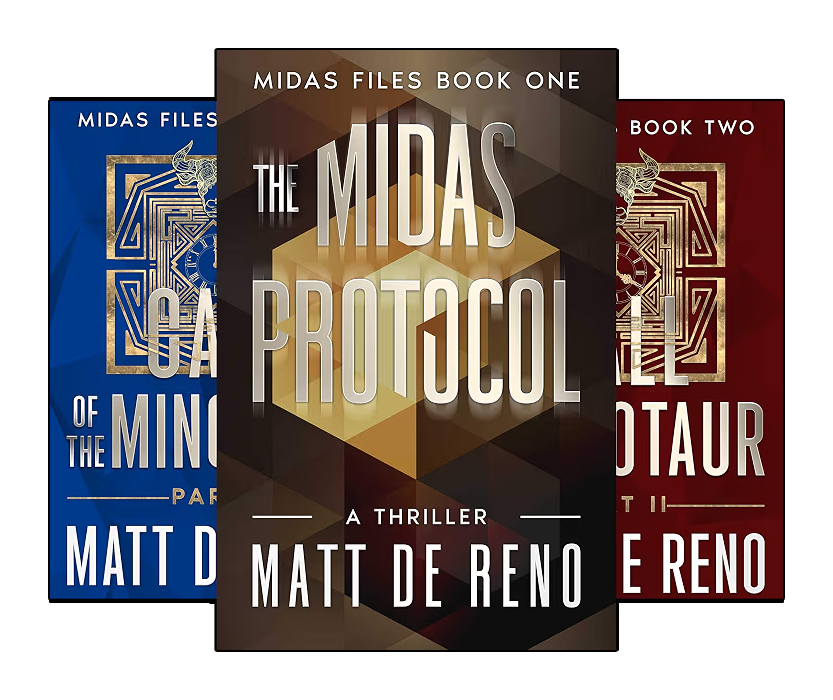

My editor Dean recently finished reading The Midas Protocol. He did much of the heavy lifting on Call of the Minotaur, and I had assumed he had read the first book years ago. Apparently, he had not. His reaction was interesting: compared with Call of the Minotaur, The Midas Protocol almost reads like a prequel.
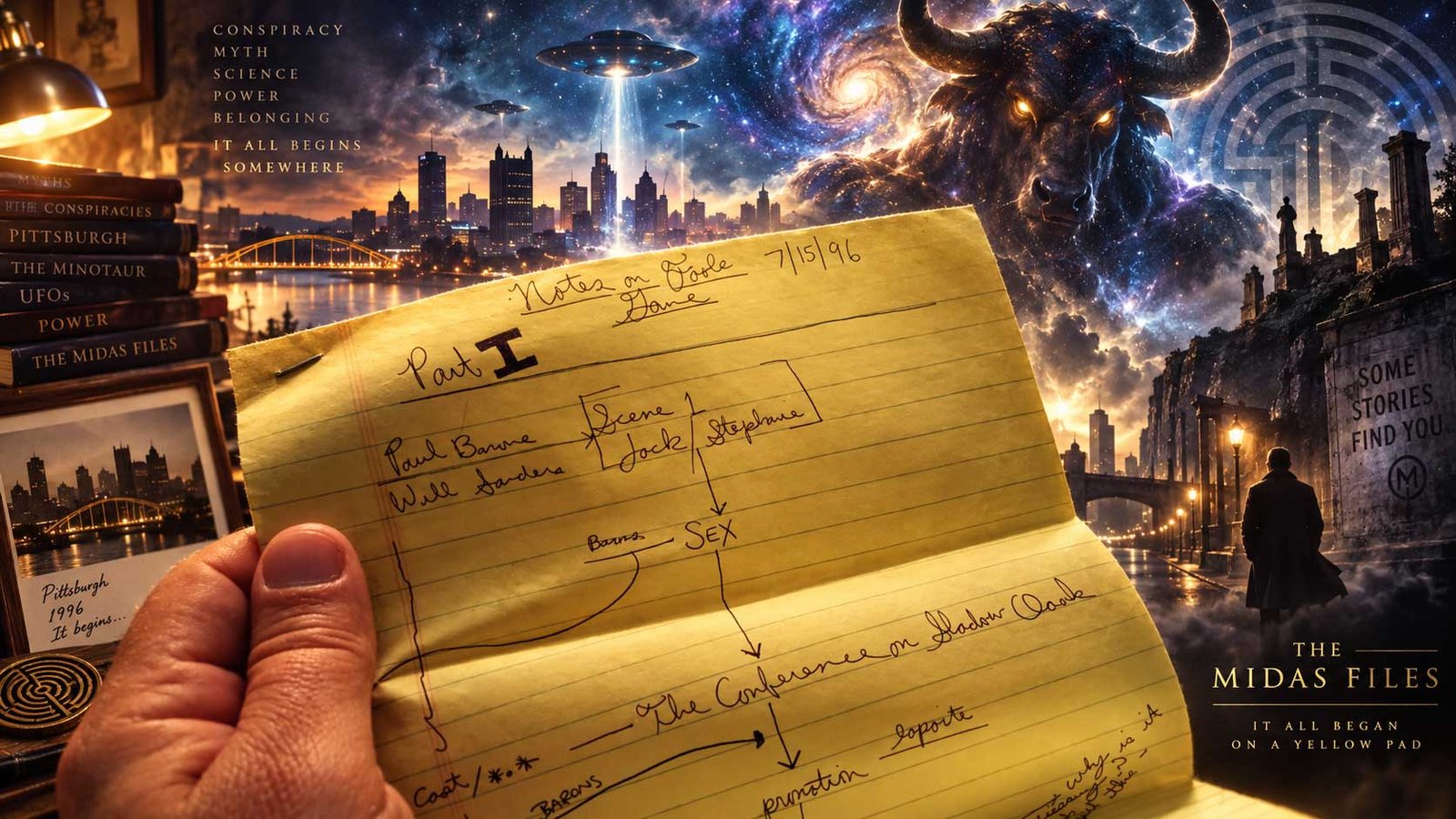
In his view, the second book is simply a level up in complexity, ambition, plot twists, and action. I understand exactly what he means. The Midas Protocol was published in 2020, but parts of it were drafted when I was in my twenties, back in the late 1990s. Some of those early chapters remain surprisingly intact.
The notes reveal a few other artifacts from the story’s evolution. Paul Barons became Jack Barons. Stephanie became Addison Moore. “The Conference on Shadow Cloak” eventually became the Global Communicators Conference. The mythology changed, the characters changed, and the story grew much larger than what I had imagined in 1996.
There is even a little Easter egg left behind in the published novel. In Chapter 5, “Book Lovers,” Hank tells Addison that he has always dreamed of writing a book. When she asks what he would call it, Hank answers:
The Fold Games.
That was my small nod to the title that almost was.
At that age, I was writing about things that mattered to me then—bar fights, rivalries, sports, romance, trying to make your way in the world. Hank was going through his twenties because, in many ways, so was I. The larger mythology of the Gold Box, the UFOs, the ancient history, and the wider machinery behind the story was not yet fully formed in my head.
Then I came back to the universe decades later and wrote Call of the Minotaur as a man in his fifties. By then, I had a much clearer sense of what the Midas Files really was. I understood the larger architecture. I
knew I wanted hidden systems behind hidden systems, technology with consequences, buried history, organizations, conspiracies, and much bigger speculative payoffs—the kind of things that now define the series more clearly. So yes, Dean’s observation lands.
The first book is, in some ways, the work of a younger writer discovering the story. The second is the work of the writer that younger guy eventually became.
Which raises the uncomfortable question: what do I do with Book One? The easiest answer is nothing, and there is a strong case for that. There is something authentic about the existing Midas Protocol. It is not merely an old manuscript I could polish into something more contemporary. It is a record of who I was when I began this whole thing. I can see the younger version of myself in those chapters, and I am not sure I want to sand all of that away. At the same time, I can imagine eventually doing a revised second edition—expanding certain sections, tightening others, perhaps planting a few cleaner bridges into Call of the Minotaur, and giving the book a new cover. Stephen King did something similar with The Gunslinger after returning to The Dark Tower years later, and that series is a useful comparison. The first book is spare and strange; later books reveal the far more expansive storyteller King became. I have always loved Wizard and Glass, and part of what makes that series fascinating is seeing the writer evolve along with the world.
The practical question may be less about rewriting and more about positioning. Maybe I do not need to insist that every new reader begin with The Midas Protocol. Maybe I promote Call of the Minotaur more aggressively as the fuller expression of what the series has become, while explaining that The Midas Protocol provides the origin story and deeper backstory but is not necessarily required homework. That might actually be more honest. After all, some of the most charming material in the first book is very much of its era—Hank wandering through snowy Pittsburgh, stopping into Waldenbooks, meeting Addison, and navigating youthful rivalries and relationships. Those things are not weaknesses. They simply belong to a different stage of both Hank’s life and mine.
For now, I am not going to overthink it. The Midas Protocol is the book that started everything, and there is value in leaving some scars visible. Maybe someday I will release a revised and expanded edition. Maybe the original copies will become charming artifacts from the early days if, dare I dream, Matt De Reno somehow becomes a bestselling author. That would be a nice problem to have. Until then, I think the right answer is to keep writing forward, let the books show the evolution, and trust readers to understand that stories—and the people who tell them—change over time. Dare I dream? Sure. Why not.
About the Author
 Matt De Reno
Matt De Reno is the author of The Midas Files, a Pittsburgh-rooted science-fiction thriller series exploring UFOs, secret histories, ancient technology, and the occasional problem caused by reality folding in on itself. In The Scratching Post, he writes about the creative life behind the books—storytelling, indie publishing, AI experiments, live readings, works in progress, and whatever strange idea has wandered into his notebook that week. Email him at