
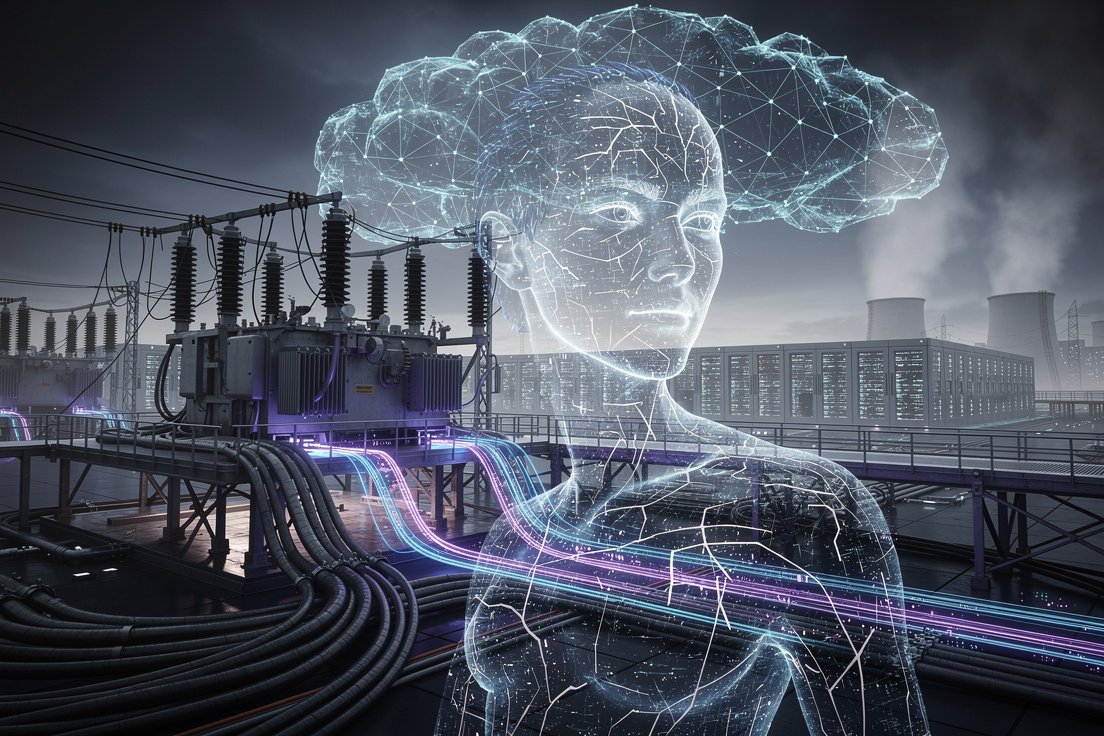
AI is often described as if it lives somewhere abstract.
It lives in the cloud. It lives in the model. It lives in the algorithm. It lives in the strange little box where we type a question and wait for the machine to answer back.
But the cloud is not a cloud. The model is not magic. The algorithm is not floating in some clean, invisible dimension of pure intelligence. The ghost in the machine needs a building. It needs cooling. It needs chips. It needs water. It needs transmission lines. It needs transformers. It needs electricity.
In other words, the ghost in the machine needs a substation.
The Signal
The International Energy Agency has been looking closely at the relationship between AI and electricity demand, and the numbers are a little startling. Data centers used about 415 terawatt-hours of electricity in 2024, around 1.5% of global electricity consumption. In the IEA’s base case, that figure is projected to more than double to about 945 terawatt-hours by 2030. AI is a major driver of that growth, especially as high-performance accelerated servers become more common.
That does not mean AI alone is going to eat the planet. The IEA is careful to put the numbers in context: even by 2030, data centers would still represent just under 3% of global electricity consumption. But the local impact is where the story gets interesting. Data centers are not spread evenly like porch lights. They cluster in specific places, and that concentration can create real pressure on regional grids.
A recent example comes from the United Kingdom, where Ofgem, Britain’s energy regulator, has been trying to deal with a jammed-up grid connection queue. Reuters reported that Ofgem launched a consultation on proposals to tighten grid-connection requirements for data center projects, including a new financial commitment fee and milestone requirements. According to Ofgem figures cited by Reuters, demand in the queue surged from 41 gigawatts to 125 gigawatts between November 2024 and June 2025, with data centers accounting for at least 80 gigawatts of that total.
The Guardian reported the issue another way: Ofgem said there were 315 data centers waiting to connect, representing 73 gigawatts of demand — almost 30 gigawatts more than the entire country’s peak energy demand of 45 gigawatts. That does not mean all those projects will be built. In fact, that is part of the problem. Grid queues can fill up with projects that are speculative, underdeveloped, or simply reserving a place in line.
So the signal is clear: AI may be software at the user level, but at the infrastructure level it is a physical industrial system.
Why It Matters
The interesting thing about AI is that it feels weightless.
You type a prompt, and words appear. You upload an image, and the system interprets it. You ask for a summary, a draft, a plan, a weird Bigfoot prompt, or a possible article angle, and the machine responds as if intelligence has become a utility.
But every utility has pipes.
Electricity changed the world because it disappeared into the walls. Most of us do not think about the grid until it fails. AI may follow the same psychological path. It will feel normal, invisible, and always available right up until the moment the physical system underneath it becomes visible.
The IEA notes that while a data center can be operational in two to three years, the broader energy system usually needs longer lead times for planning and construction. Transmission lines, transformers, cables, power generation, storage, permitting, and grid upgrades do not move at the same speed as software. That mismatch is one of the central tensions of the AI boom.
This is not an anti-AI argument. AI can be useful, creative, funny, helpful, and even humane depending on how it is designed and used. But it is an argument against pretending that digital technology has no physical footprint. The future is not only being built in code. It is being built in substations, server halls, cooling loops, power contracts, land deals, and regulatory filings.
The more intelligent the machine appears, the easier it is to forget the machine.
The TechGnosis Angle
This is where the story becomes very TechGnosis.
We tend to imagine future technology as sleek, clean, and almost mystical. The machine answers. The assistant speaks. The intelligence emerges. The interface hides the mess.
But the mess is the story.
The world’s next layer of intelligence may be limited not by imagination, but by transformers. Not by what the model can say, but by whether a regional grid can carry the load. Not by the ambition of a tech company, but by whether a local community wants a massive power-hungry facility nearby.
That is the fragile-systems angle. AI is not one system. It is a stack of systems: chips, supply chains, rare minerals, fabs, cooling systems, power plants, grids, data centers, fiber routes, software, security, labor, and regulation. The chatbot window is just the polished surface. Beneath it is an industrial organism.
There is something wonderfully strange about that. We are building machines that seem to think, and one of the great bottlenecks may turn out to be old-fashioned electrical infrastructure. The future may be delayed because the ghost cannot get a grid connection.
The Midas Files Echo
This is one of those real-world tech stories that brushes against a recurring idea in The Midas Files: impossible systems still need machinery underneath them.
In fiction, strange technology can look like magic from a distance. An artifact glows. A gateway opens. A hidden system activates. But the more interesting question is usually not what the miracle does. The better question is what feeds it, who built it, who maintains it, and what breaks when it draws too much power.
That is why the AI power story fascinates me. It reminds us that even the most abstract forms of intelligence remain tied to the physical world. Every mind needs a substrate. Every system needs a source. Every ghost needs a machine.
And apparently, every machine needs a substation.
Read the Source
The best place to start is the International Energy Agency’s Energy and AI analysis, which puts AI and data center electricity demand into a broader global energy context.
For the current grid-queue angle, Reuters’ July 29, 2026 report on Ofgem’s proposed grid-connection fees for data center projects is a useful source. The Guardian’s report adds helpful context about the scale of Britain’s data center connection queue.