


A nuclear material has a story to tell, provided you can read the light coming off it. That sounds like a convenient talent for a spy in a science-fiction thriller. In practice, it involves painstaking measurements, overlapping radiation signals and, increasingly, thermometers so cold and sensitive that a single particle of light can register as a burst of heat.
On September 10, researchers at the National Institute of Standards and Technology and their collaborators reported a new use of those quantum sensors: more precise measurements of particular X-ray emissions from uranium, neptunium and plutonium. The work, published in Physical Review Letters, could help scientists untangle radiation signatures used to assess nuclear material. A small improvement in our ability to describe an atom can have consequences far beyond the laboratory that measured it.
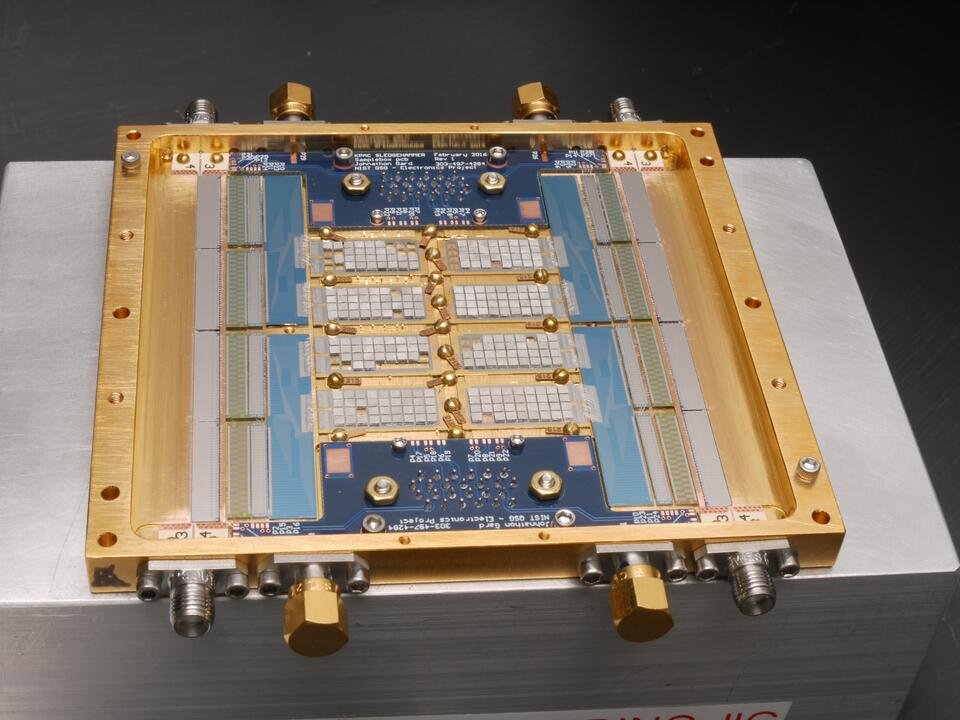
The difficulty begins with a crowded signal. Gamma rays emitted by radioactive material carry information about its composition. Scientists sort them by energy and examine the resulting pattern, rather as a reader identifies words from the arrangement of letters. But X-rays can appear in the same energy neighborhood. Their contributions overlap with gamma-ray features that analysts need to distinguish. The radiation is real; the ambiguity comes from trying to work out how much of the measured pattern belongs to each source.
In this study, the team measured the natural widths of two particular X-ray lines in each of the three elements. A spectral line is not infinitely thin: it occupies a small spread of energies. Knowing that spread more accurately helps analysts account for the X-ray contribution when it overlaps a useful gamma-ray signal. The paper reports relative uncertainties of 0.5 to 1.5 percent in those linewidth measurements, an improvement by factors of three to eight over previous values. Those numbers describe the reference measurements, not a promise that every nuclear inspection suddenly becomes eight times more accurate.
The instrument behind the result is a transition-edge sensor, a name that sounds as though it should come with an unusually dense instruction manual. Its basic trick is surprisingly easy to picture. A superconducting film is held near the boundary between superconducting behavior and ordinary electrical resistance. In that narrow temperature region, a tiny warming produces a large enough electrical change to measure. An arriving photon deposits energy as heat, and the sensor turns that almost absurdly small disturbance into a readable pulse.
This is quantum technology with a practical job. The superconducting state supplies the sensitive boundary; careful refrigeration keeps the device poised there. An array brings many sensors together so the instrument can collect useful measurements. The word quantum does not mean the machine guesses what is inside a container, or somehow knows more than the radiation tells it. It means that the behavior of matter at very low temperatures gives engineers an exceptionally delicate measuring tool.
That distinction is part of what makes the story appealing. We have become accustomed to descriptions of technology that seem to skip directly from a clever idea to a transformed civilization. Here, the achievement is more tangible. Researchers have improved the numbers used to interpret a difficult measurement. If you have ever watched a complicated system go wrong because one apparently minor assumption was wrong, you already understand why that matters.
Nuclear safeguards depend on the ability to compare declared material with independently gathered evidence. The International Atomic Energy Agency describes a process that combines records, measurements, inspections and other checks. No single instrument can supply the entire answer. Within that larger system, however, uncertainty has practical weight. Analysts need to understand what their measurements can establish and where the margins remain. Better reference data can help them make those judgments with greater confidence.
There is a useful lesson here about scientific progress. Sometimes the obstacle is an inadequate detector. Sometimes it is incomplete knowledge of what the detector is seeing. This research works on both sides of that relationship: a sensitive instrument produces better information about X-ray lines, and that information can improve the interpretation of other measurements. The benefit does not have to remain locked inside the machine that first produced it.
The hardware does impose conditions. These sensors operate only a fraction of a degree above absolute zero, and the refrigeration equipment is too bulky for a handheld device. NIST says the arrays can work where sufficient electrical power is available for cooling, or samples can be sent to a laboratory. The agency also reports that, through its partnership with Los Alamos National Laboratory, transition-edge detectors have already been installed at three Department of Energy laboratories. The new paper builds on an existing family of instruments; it is not the unveiling of a pocket-sized nuclear truth detector.
NIST sees possible benefits for the nuclear fuel cycle as well. Faster assessments of composition could shorten waits between processing steps, potentially improving efficiency. That is a prospective payoff, not a cost saving demonstrated by this particular paper. It is also a reminder that the same measurement problem can matter to people with different responsibilities: the researcher trying to characterize a signal, the operator checking material and the inspector evaluating a declaration.
What stays with me is the scale of the connection. At one end sits a photon depositing a tiny amount of heat in a chilled sensor. At the other are institutions trying to make reliable decisions about consequential materials. Between them lie calibration, reference data and the patient work of separating signals that almost run together. We tend to picture technological power as something that lets us do more. There is another kind, quieter and just as necessary: the ability to say more carefully what we actually know.
About the Author
 Matt De Reno
Matt De Reno is a writer, editor, content strategist, and technical communicator with more than 20 years of experience helping complex ideas become clear, useful, and engaging. His professional background includes technical documentation, digital publishing, UX-minded content, knowledge management, SEO, and strategic communications for technical audiences. He is also the author of The Midas Files novels, where his fascination with technology, history, fragile systems, and imagination comes together in a sci-fi thriller universe. Connect with Matt on LinkedIn for more on writing, publishing, technology, and the strange places where real ideas start to feel like fiction.