

One strange particle interaction is not a discovery. It might, however, be the most interesting knock on the door in a century-long search.
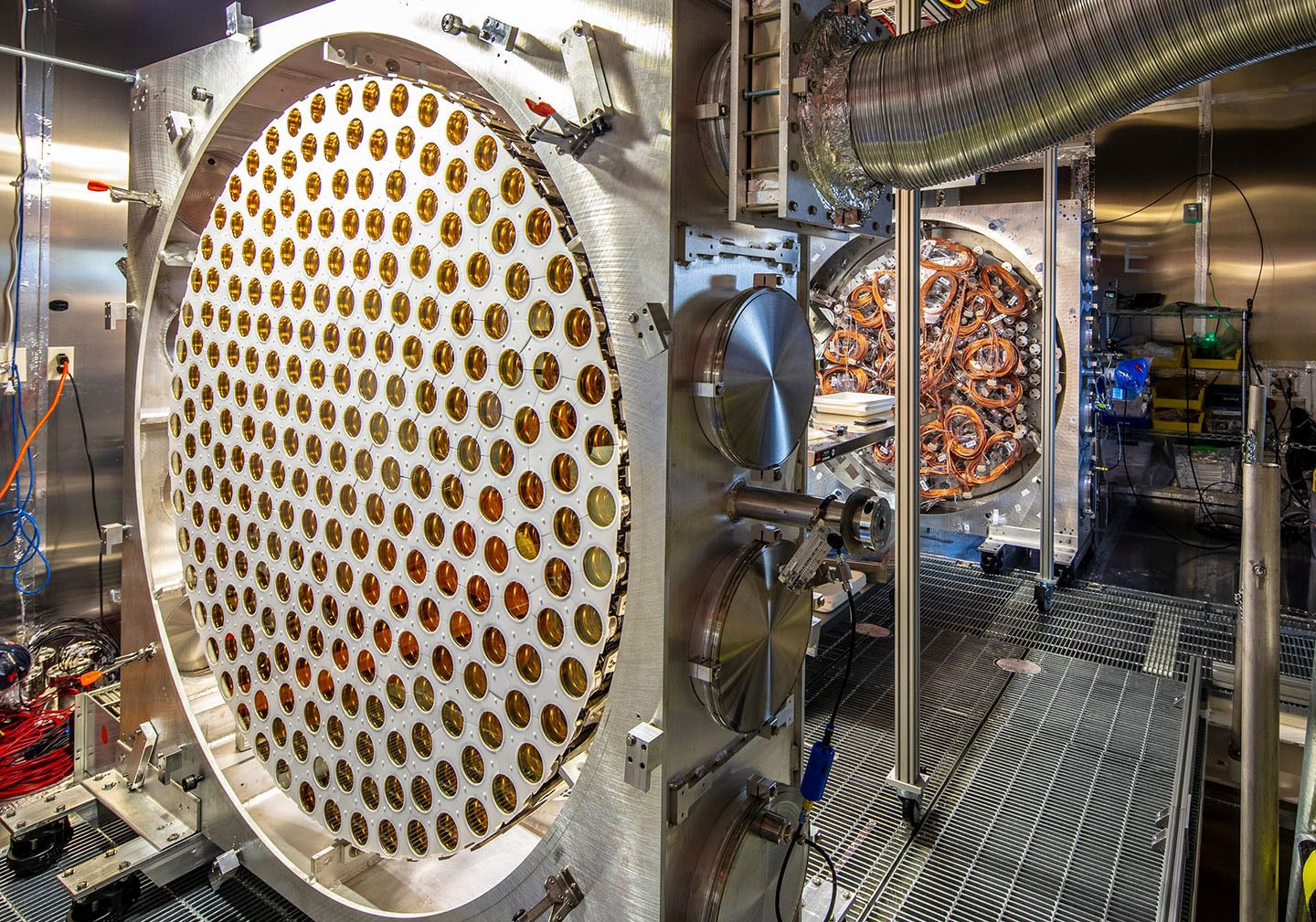
There is a wonderfully absurd quality to the way science sometimes works. If you want to look for something that may make up most of the matter in the universe, apparently one reasonable strategy is to bury ten tons of ultra-pure liquid xenon nearly a mile underground in South Dakota and wait for something invisible to bump into it. That is, more or less, what the LUX-ZEPLIN experiment has been doing. And now something may have bumped back.
On September 1, the LUX-ZEPLIN collaboration reported a single unusual particle interaction that researchers have not been able to comfortably explain as ordinary background noise. The event occurred in exactly the kind of part of the detector where a dark-matter interaction could appear. If that sounds like the opening scene of a science-fiction movie, good. Quantum Soup is built for moments like this. But the more interesting story is not that scientists found dark matter. They did not. The interesting story is that after decades of mostly silence, one detector may have heard a faint knock.
The Signal
LUX-ZEPLIN, or LZ, is one of the world’s most sensitive dark-matter experiments. The detector sits at the Sanford Underground Research Facility in Lead, South Dakota, roughly 4,850 feet below the surface. The rock overhead helps shield the experiment from cosmic rays and other interference. At its core is a chamber filled with liquid xenon. If a particle collides with a xenon nucleus, the interaction can produce tiny flashes of light and free electrons that the detector is built to record.
The newly reported analysis examined 220 live days of data collected between March 2023 and April 2024, expanding the search into a higher-energy range than some earlier LZ analyses. Researchers found one event consistent with a nuclear recoil of roughly 248 kiloelectronvolts in a region where known background events are expected to be rare. Statistically, the result reached a global significance of 2.6 sigma after accounting for the so-called look-elsewhere effect. In plain English, the team estimates roughly a 0.5 percent chance that known backgrounds could produce something this unusual.
That is intriguing. It is not proof. Particle physics generally reserves the word “discovery” for results reaching 5 sigma, a much higher standard designed to keep exciting statistical flukes from becoming premature headlines. LZ spokesperson Rick Gaitskell put the distinction plainly: the collaboration is not claiming to have seen dark matter. It has seen something interesting enough to show the scientific community and investigate further.
Why This Matters
Dark matter is one of those ideas that sounds speculative until you remember how much evidence says that something is there. Galaxies rotate as if they contain far more mass than the stars and gas we can see. Light bends around galaxy clusters more strongly than visible matter alone can explain. Cosmological measurements likewise point toward a universe in which ordinary matter is only a minority share of the material inventory. Dark matter appears to supply roughly 85 percent of the universe’s matter, yet whatever it is refuses to shine, absorb light, or announce itself in any straightforward way.
One long-standing candidate is the WIMP: a weakly interacting massive particle. WIMPs are hypothetical particles that, as the name suggests, would interact only rarely with ordinary matter. That makes them maddeningly difficult to detect, but it also explains why a detector such as LZ can operate for years waiting for a tiny handful of meaningful interactions. If this particular event were eventually shown to be a WIMP, the LZ team says the particle would likely have a mass of at least 200 GeV/c² — more than 200 times the mass of a proton — and the interaction could point toward physics beyond the simplest WIMP models.
This is where the story gets fun without getting reckless. The fact is that LZ recorded one unusual event and that known backgrounds do not currently provide a convincing explanation. The interpretation is that it could be a WIMP. The speculation is everything beyond that: whether this becomes the first direct detection of dark matter, whether it points to an entirely different particle, or whether a mundane background process will eventually explain it. Science has a long history of mysterious signals becoming less mysterious with more data. It also has a history of tiny anomalies becoming doors into new physics.
The Knock at the Door
What happens next is beautifully uncinematic: more data. LZ is still operating and is working toward a much larger exposure. If similar candidate events begin appearing with the expected characteristics, the statistical case could strengthen. If nothing else like this appears, the significance may fade. Other dark-matter experiments will also look for comparable signals, because one mysterious event in one detector is a clue; reproducible evidence across experiments is how clues become knowledge.
And that may be why I like this story so much. We tend to imagine great discoveries as fireworks — a telescope opens its eye, a machine switches on, and the universe immediately gives up a secret. Real discovery is usually quieter. It is years of calibration, discarded noise, suspicious signals, arguments over statistics and people willing to keep watching the same dark room because something in the mathematics says there should be somebody — or something — in there. Yesterday, after nearly a century of searching for the invisible scaffolding of the cosmos, the universe may have tapped the glass once. Now we get to see whether it knocks again.
About the Author
 Matt De Reno
Matt De Reno is a writer, editor, content strategist, and technical communicator with more than 20 years of experience helping complex ideas become clear, useful, and engaging. His professional background includes technical documentation, digital publishing, UX-minded content, knowledge management, SEO, and strategic communications for technical audiences. He is also the author of The Midas Files novels, where his fascination with technology, history, fragile systems, and imagination comes together in a sci-fi thriller universe. Connect with Matt on LinkedIn for more on writing, publishing, technology, and the strange places where real ideas start to feel like fiction.