
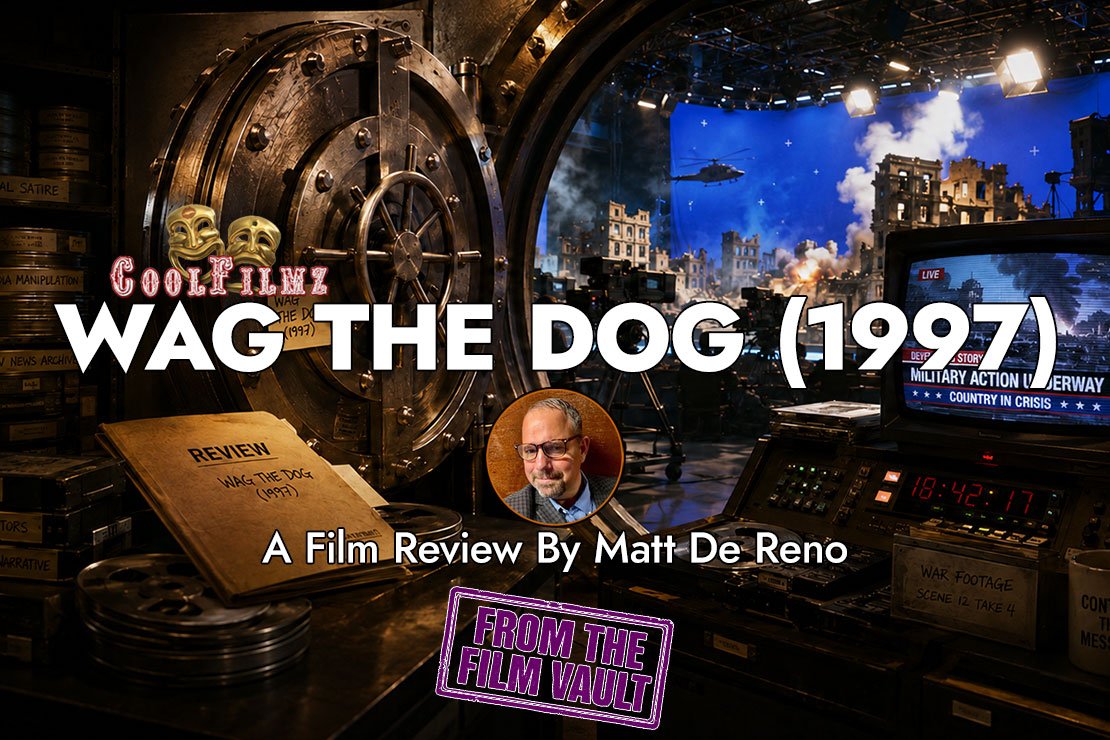
Some old movies age. Others sit patiently until the real world catches up with them. Wag the Dog belongs to the second group. Barry Levinson's political black comedy came out in late 1997, but when I reviewed it for CoverUps.com in 2007, it already felt less like a farce than a field manual for manufacturing reality. Revisiting that review now, the machinery looks dated. The idea behind it does not.
Curated from an original 2007 CoverUps.com review by Matt De Reno.

The setup is beautifully cynical. With a presidential election less than two weeks away and a sex scandal threatening to swallow the White House, professional fixer Conrad Brean, played by Robert De Niro, decides that only one story can push the scandal off the front page: a war. Albania is selected as the enemy mostly because the public knows almost nothing about it. Brean then recruits Hollywood producer Stanley Motss, played by Dustin Hoffman, to create the conflict from scratch, complete with footage, music, slogans, merchandise and eventually a war hero.
The public buys it hook, line and sinker. That is the joke, but it is also the thing that makes the movie stick. We all know politics is filled with spin. Perhaps it is the amount of political spin that powers the Earth's rotation. Wag the Dog simply asks what happens when the spin doctors stop dressing up reality and decide it would be easier to produce an entirely new one.
De Niro's Brean is the quiet master of that universe. Nothing seems to surprise him because, to Brean, facts are merely production problems waiting for a better story. Hoffman has the flashier role as Motss, a producer delighted to discover that geopolitics works remarkably like Hollywood, only with a larger budget and no screen credit. Together with Winifred Ames, played by Anne Heche, they turn foreign policy into show business and show business into foreign policy.
The movie's best gag is the fake footage of a frightened Albanian girl fleeing her village. A young Kirsten Dunst performs alone against a blue screen while technicians add smoke, ruins and danger around her. The kitten she appears to carry is actually a bag of Tostitos in the studio. The image looks authentic because authenticity is not the goal. Emotional recognition is. Give the audience the right picture, the right music and the right words, and the missing reality fills itself in.
When the manufactured war ends too soon, Brean and Motss simply write a sequel. They invent Sgt. William Schumann, an American soldier supposedly left behind enemy lines, and build a patriotic campaign around the phrase 'Old Shoe.' The plan hits one small snag when the team learns that Schumann, played by Woody Harrelson, came from the Special Prison program, not the Special Forces program. He is less a heroic prisoner of war than a dangerously unstable prisoner who happens to photograph well. Naturally, the story sells even better once he is dead.
That is where Wag the Dog becomes satire bordering on the real. The media in the film does not need to be ordered into submission. It only needs a story packaged in the forms it already understands: scandal, danger, patriotism, celebrity and redemption. Brean does not control every camera or reporter. He controls the narrative ingredients, trusting the machine to assemble and distribute the meal for him.
The timing gave the movie an eerie afterlife. It opened in December 1997, before the Monica Lewinsky scandal became public and before President Bill Clinton ordered missile strikes against sites in Afghanistan and Sudan in August 1998. Those real events invited immediate comparisons to the film. My 2007 review made that connection too, while also acknowledging the enormous difference between a fictional diversion and military action publicly presented as a response to terrorist threats. In hindsight, especially after 9/11, that distinction matters. The resemblance was uncanny; resemblance was not proof.
What has changed since then is not the appetite for spin but the size and speed of the production studio. Motss needed a Hollywood soundstage, a crew and a television network. Today, images can be synthesized, clipped, captioned and pushed into millions of personalized feeds before Brean finishes his coffee. The film's fake war now looks almost quaint. Its central question does not: if a story arrives with the right emotional cues and everybody around us appears to believe it, how much of it do we stop to examine for ourselves?
Wag the Dog is funny because the conspiracy is audacious. It is unsettling because the methods are ordinary. Public relations, entertainment, political messaging and news all speak overlapping visual languages, and the movie understands how easily those boundaries blur. The good guys and bad guys can become products of marketing, and the truth can lose simply because it did not arrive with a theme song.
That was the thought gnawing at me in 2007: How real is it? How much are we the dupes of coordinated media assaults and public-relations campaigns? And, perhaps most uncomfortably, how much do we really care as long as the story is entertaining? Conrad Brean would probably answer with the movie's most efficient argument: the war is real because it says so on TV.
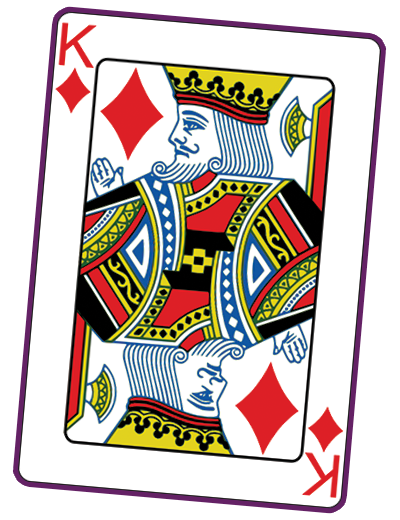
Nearly three decades after the film's release, I still think Wag the Dog is intelligent, entertaining and uncomfortably plausible. It earns a King in the Cool Filmz deck: not quite a perfect Ace, but a sharp political satire whose bite has outlived the technology it was satirizing.
About the Author
 Matt De Reno
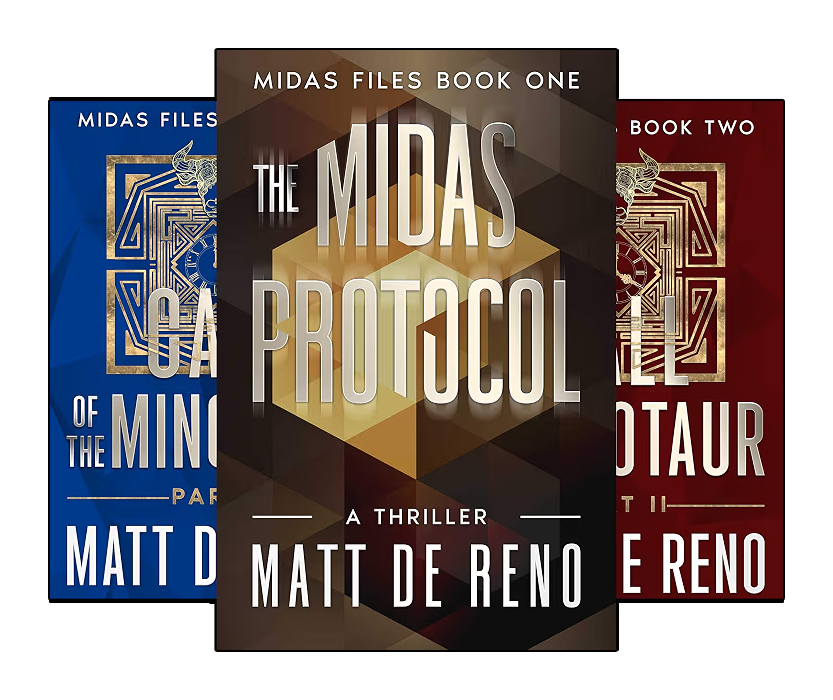
Matt De Reno has been watching, quoting, debating, and occasionally overthinking movies for most of his life. His favorites include Star Wars, The Godfather, James Bond, and a deep bench of action movies, thrillers, comedies, and cinematic oddities worthy of the CoolFilmz card table. Matt is also the author of The Midas Files, a Pittsburgh-rooted sci-fi thriller book series about hidden history, ancient power, secret technology, and whether humanity can handle the truth. Maybe one day it will become a film — and if it does, may it get dealt an Ace. Reach Matt at