
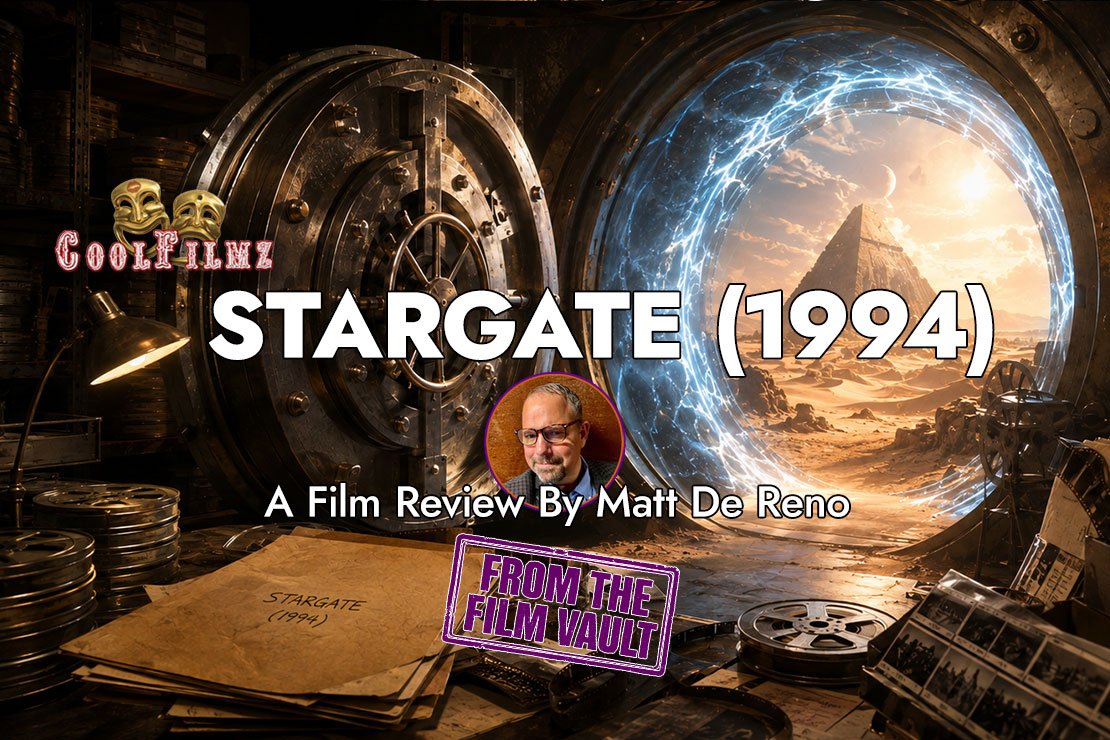
Some movies are better ideas than they are movies. Stargate may be the perfect example. When I reviewed it for CoverUps.com in 2007, I was fascinated by its premise and frustrated by what it did with it. Revisiting that review now, I still feel much the same way: the portal remains irresistible, but the adventure waiting on the other side is not nearly as imaginative as the doorway.


The big idea is exactly the kind of cosmic conspiracy that should be impossible for me to resist. What if the gods of ancient Egypt were not gods at all, but technologically advanced beings who came to Earth, enslaved early humanity and used religion as a control system? What if the pyramids were connected to an interstellar transportation network? And what if one surviving ring-shaped device could open a path to another world? That is an entire universe of possibilities before Kurt Russell even puts on his sunglasses.
Curated from an original 2007 CoverUps.com review by Matt De Reno
James Spader plays Dr. Daniel Jackson, an Egyptologist whose theory that the pyramids predate the pharaohs has made him an academic punch line. He is recruited to examine a mysterious artifact unearthed at Giza in 1928 and stored by the military in Colorado. The symbols on the device are not words but constellations: coordinates for a destination across the galaxy. Once Jackson identifies the missing seventh symbol, the Stargate opens and a military team steps through.
Russell is Col. Jack O'Neil, a grieving father sent on the mission with a purpose the rest of the team does not initially know. He is carrying a nuclear device and orders to destroy the Stargate if the world on the other side poses a threat. That gives the character more weight than I credited him with in my younger, snarkier review. Russell's silence is not merely macho glumness; O'Neil is a man who has already stopped imagining a future for himself.
On the other side is Abydos, a desert world where humans live beneath the rule of Ra, played by Jaye Davidson. The production design still has real power. Ra's pyramid ship, the metallic Egyptian armor, the monumental interiors and the Stargate itself all sell the notion that ancient religion might be the faded memory of alien technology. Davidson is especially striking: elegant, remote and unsettling in a way that makes Ra feel genuinely otherworldly.
For a while, Stargate seems ready to explore something enormous. Jackson discovers that Ra took human form to escape a dying alien body. The people of Abydos have been denied literacy so they cannot preserve the story of their enslavement or rediscover the truth. Language, myth and archaeology become tools of liberation. The movie has the pieces for a grand science-fiction story about how power turns technology into divinity and ignorance into obedience.
Then the portal to cosmic wonder leads us into a fairly ordinary action movie. The expedition's soldiers are drawn in broad strokes, Ra's guards begin to feel like interchangeable targets and the fascinating ancient-astronaut premise is pushed aside for firefights, rebellion and a ticking nuclear bomb. The stakes get louder precisely when the ideas should be getting deeper.
That was the heart of my 2007 complaint, and it still holds. Stargate gives us a machine that can cross the galaxy in seconds, a false god who has manipulated human civilization for millennia and an oppressed culture rediscovering its own history. Yet much of the climax comes down to whether O'Neil can blow something up before the countdown reaches zero. The movie does not fail because it becomes an adventure. It disappoints because its adventure is less daring than its premise.
Spader remains the movie's strongest human element. Daniel is awkward, curious and genuinely delighted by discovery. His ability to communicate with the people of Abydos gives the story warmth that the military plot often lacks, and his romance with Sha'uri gives him a reason to remain on the planet after the mission ends. Russell and Spader also make an effective odd couple: one man has lost his desire to live, while the other cannot stop looking for new worlds to understand.
The television franchise later demonstrated how fertile the idea really was. Stargate SG-1 ran for ten seasons, beginning on Showtime and later moving to the Sci Fi Channel, and used the gate as a weekly engine for civilizations, alliances, enemies and mythology. I had seen enough of the series by 2007 to believe that television had surpassed the film, and the franchise's endurance only strengthens that judgment. The original movie found the door; the series understood that the fun was in continuing to walk through it.
None of this makes Stargate forgettable. Quite the opposite. The imagery, the premise and David Arnold's sweeping score helped launch a franchise because audiences could see the larger movie hiding inside the one they were given. It is difficult to dislike a film that leaves you wanting to explore its universe. It is equally difficult not to wish the first trip had gone farther.
Stargate earns a Queen in the Cool Filmz deck. Its central idea is an Ace, its visual world still has flashes of grandeur and Spader gives the adventure a curious heart. But the film surrounding those strengths settles too quickly for familiar action-movie machinery. The gate opens onto infinity; the story travels only part of the way there.
About the Author
 Matt De Reno
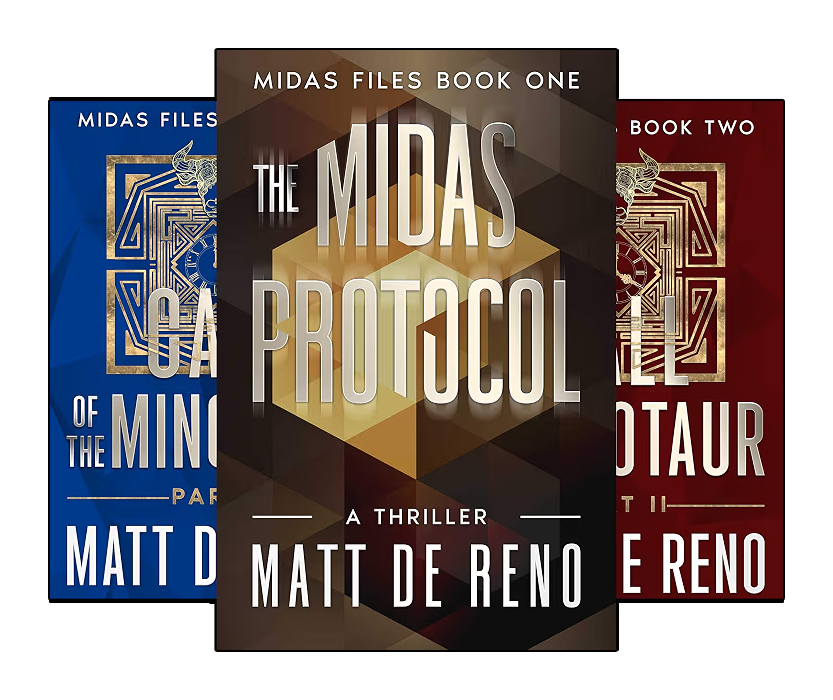
Matt De Reno has been watching, quoting, debating, and occasionally overthinking movies for most of his life. His favorites include Star Wars, The Godfather, James Bond, and a deep bench of action movies, thrillers, comedies, and cinematic oddities worthy of the CoolFilmz card table. Matt is also the author of The Midas Files, a Pittsburgh-rooted sci-fi thriller book series about hidden history, ancient power, secret technology, and whether humanity can handle the truth. Maybe one day it will become a film — and if it does, may it get dealt an Ace. Reach Matt at