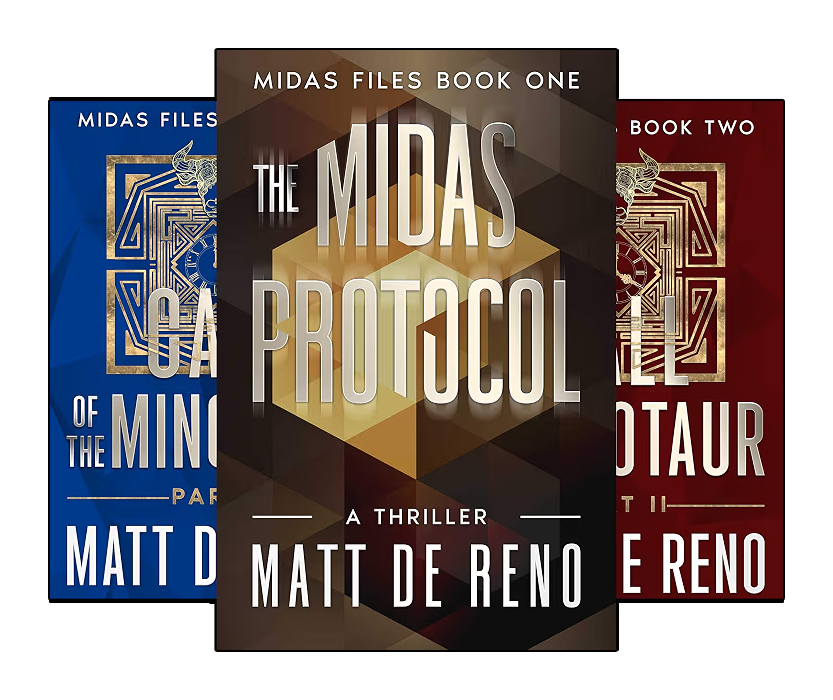


Before the Gold Box, before the Axiom, before the impossible machinery of The Midas Files fully reveals itself, Hank Raglan’s life changes because of an unfinished alloy.
That alloy is Evium.
Spoiler Advisory: This entry discusses lore connected to The Midas Protocol and later implications developed in Call of the Minotaur.
In Chapter 2 of The Midas Protocol, Hank Raglan sits inside Tony Laporte’s corner office at Unalco World Headquarters, looking out over the Allegheny River and the Pittsburgh skyline. It is a long way from the windowless cubicle farm of the Unalco Technical Center. It is also a long way from the life Hank thought he was living.
At first, the meeting seems like a career break. Hank has written a report on an old unfinished alloy project left behind by Dr. Lawrence J. Bingham, and Tony Laporte, Unalco’s CEO, is impressed. Very impressed. Hank has solved problems that senior engineers could not solve. He has filled in missing information. He has visualized the final alloy in his mind and connected pieces of Bingham’s research that others had failed to complete.
That is the official version.
The deeper version is more dangerous.
Evium is not merely the project that gets Hank promoted. It is the first sign that Hank Raglan may be able to see what others cannot. It is the first major clue that Bingham’s unfinished work has found a new mind capable of understanding it.
And it is the moment Unalco begins moving Hank upstairs.
What Is Evium?
In its earliest human-facing form, Evium appears to be an advanced alloy connected to the research of Dr. Lawrence J. Bingham, one of Unalco’s founders and the company’s great lost scientific mind.
Inside Unalco, Evium is treated as a difficult materials-science problem. It is unfinished. It is dusty. It is too advanced for the company’s researchers to complete. It has been sitting in the background like one of those old corporate projects nobody fully understands but nobody quite wants to throw away.
Then Hank Raglan takes a crack at it.
Hank is only a junior materials science researcher. He is young, recently out of college, and still close enough to his intern years that he is grateful to have a full-time job, an apartment, a used Jeep Cherokee, and enough money to buy beers on the weekend. He is not supposed to be the person who solves Bingham’s unfinished work.
That is exactly what he does.
What makes Hank unusual is not merely that he is smart. It is how he thinks. When Tony asks about his methodology, Hank explains that he visualized the whole thing in his mind. He could see how the science fit together. The missing parts of the report became easier to connect once he could imagine the final alloy.
That ability matters.
In a world where impossible machines, higher-dimensional structures, and exotic materials are all part of the hidden architecture of reality, Hank’s ability to visualize the whole may be more than professional aptitude.
It may be resonance.
Bingham’s Unfinished Legacy
Evium matters because it belongs to the long shadow of Dr. Lawrence J. Bingham.
Tony Laporte does not describe Bingham as merely a co-founder of Unalco. He calls him a brilliant engineer, an inventor, and a limitless innovator. Without Bingham, Tony says, there would be no Unalco.
That gives Evium a special place in the company’s mythology. It is not just another product development effort. It is part of Bingham’s unfinished work — a remnant of the man whose genius built the foundation of Unalco and whose death left more than one mystery behind.
When Hank completes the Evium report, Tony hears an echo.
He tells Hank that he reminds him of Larry Bingham.
That is not casual praise.
In the world of The Midas Files, being compared to Lawrence Bingham is both a compliment and a warning. Bingham was the kind of mind that could open doors others did not know existed. He was also the kind of man whose discoveries attracted powerful people, dangerous institutions, and violent consequences.
So when Tony sees something Bingham-like in Hank, he is not only recognizing talent.
He may be recognizing the return of a problem he thought the world had lost.
The Alloy That Changed Hank’s Career
From Hank’s perspective, Evium begins as a professional breakthrough.
His report gets him noticed by Tony Laporte. It pulls him out of the basement-level anonymity of the Unalco Technical Center and into the top-floor executive world of Unalco’s headquarters. It puts him in a leather guest chair across from the CEO. It leads to a major assignment: presenting Evium at the Global Communicators Conference, where Unalco intends to explain how the alloy will change the aluminum business.
For a young researcher, this is enormous.
Hank is not just being praised. He is being elevated. He is being given visibility, responsibility, and access. He is being asked to coordinate with Addison Moore, Unalco’s Global Media Relations Manager, which brings him into the orbit of someone who will matter personally and professionally.
Chapter 2 works because Hank does not yet understand the size of the room he has entered.
He thinks he is getting a career opportunity.
Tony knows it is more than that.
The reader may not know it yet, but Evium is one of the first threads pulling Hank toward the central machinery of the series.
The Evium Family
At this stage of The Midas Protocol, Evium can reasonably be understood as an unfinished alloy. That is how Unalco approaches it. That is how Hank studies it. That is the language of the corporate and scientific world surrounding him.
Later lore complicates that picture.
By Call of the Minotaur, Evium is better understood not as one simple alloy, but as a broader family of exotic materials with different forms, properties, and mythological significance. Evium Silver, Evium Blue, and Evium Gold each suggest that humanity’s first understanding of the material was incomplete.
That is not a contradiction.
It is escalation.
Early Unalco researchers were looking at Evium through the lens of industrial materials science. They saw alloy. They saw production. They saw application. They saw Davenport Works and corporate announcements and global industry coverage.
But the deeper mythology suggests Evium is something stranger: a class of material connected to impossible machines, alien technology, and reality-bending artifacts.
The most important form is Evium Gold, the material associated with the Gold Box itself.
That makes Hank’s Chapter 2 report more important in retrospect. He is not merely completing a formula for a new industrial alloy. He may be taking the first human steps toward understanding a material family tied to the most important object in the series.
In corporate language, Evium is a product.
In Bingham’s language, it may have been a key.
Tony Laporte’s Hope
Tony Laporte is warm with Hank. He is paternal, encouraging, funny, and generous with praise. He jokes about engineers, college immaturity, keg stands, and the expanding janitorial department at the Unalco Technical Center. He appears, for most of the chapter, to be the rare powerful executive who is both accomplished and human.
Then Hank leaves.
And Tony changes.
The jovial expression vanishes. He picks up Hank’s Evium paper, rolls it in his hand, paces the room, and speaks quietly to Larry Bingham, as if addressing his dead friend through the glass and silence of the office.
“Hank has raw gifts, no doubt about it, Larry, but he is a young man. Still, he might be our last hope.”
That line recontextualizes the entire meeting.
Tony was not simply offering a promotion. He was testing Hank. He was measuring him against Bingham’s memory. He was deciding whether this young researcher might be capable of carrying forward something far heavier than a product launch.
The phrase “last hope” is doing a lot of work.
Hope for what? Maybe hope for the following:
- For Unalco?
- For Bingham’s research?
- For understanding Evium?
- For stopping something already in motion?
- For surviving the consequences of work that began long before Hank entered Tony’s office?
The chapter does not answer all of that.
It simply lets the door open a crack.
Addison Moore and the Public Face of Evium
Addison Moore’s entrance in Chapter 2 is brief but important.
She walks into Tony Laporte’s office carrying a manila folder, polished, professional, and serious beyond her years. Hank notices her immediately. He knows her name because it appears on Unalco communications: news releases, internal announcements, external communications, and industry updates.
That is important because Addison represents the public language of Unalco.
If Hank is being brought in to explain Evium scientifically, Addison is part of the machinery that will explain Evium publicly. She belongs to the world of messaging, conferences, announcements, and perception. With her help, Hank will present Evium at the Global Communicators Conference.
That means Evium is not staying in the basement.
It is moving into the light.
Or at least into a carefully managed version of the light.
In The Midas Files, communication is never neutral. What the public is told, what executives know, what researchers suspect, and what powerful men conceal are rarely the same thing. Addison’s role matters because Evium is not only a scientific development. It is about to become a story Unalco tells the world.
And stories can be engineered too.
The Other Corner of the Sixth Floor
While Hank is being elevated by Tony Laporte on one side of Unalco’s executive world, another young man is waiting in a different corner of the same floor.
Jack Barons.
This is one of the most interesting structural moves in Chapter 2. Hank and Jack are both young men at Unalco. Both are ambitious. Both are talented. Both are being noticed by older, powerful men. Both are being pulled into projects that will shape their futures.
But the nature of that recognition could not be more different. There are a number of reasons why:
- Hank is recognized for seeing the hidden structure of an impossible alloy.
- Jack is recognized for seeing the hidden structure of money.
- Hank is called upstairs by Tony Laporte, whose warmth masks worry.
- Jack is summoned by Connor Wallrose, whose intimidation masks appetite.
- Hank’s path begins with Bingham’s unfinished science.
- Jack’s path begins with creative accounting.
The chapter places them in parallel without forcing the reader to understand the full design yet. One young man is being drawn toward the scientific and mythological heart of Unalco. The other is being drawn toward its corporate shadow.
At the time, both meetings look like opportunities.
In retrospect, both look like recruitment.
Retrospective Note: The Special Project
At the end of Jack’s meeting, Connor Wallrose tells him he wants Jack to work exclusively with him on a special project.
In The Midas Protocol, that phrase is deliberately broad. Jack believes he has impressed Connor with his creative use of obscure accounting loopholes and special purpose entities. The scene reads, quite naturally, like a young accountant being pulled into high-level corporate financial manipulation. There is an Enron-like stink to it: legal technicalities, hidden losses, moved money, manufactured profits, and ambition dressed up as genius.
That reading still works.
But later revelations in Call of the Minotaur deepen the meaning of Connor’s “special project.”
The project is not merely corporate fraud.
It points toward Project Sovereign Eagle.
That development does not make the original passage wrong. It makes it more interesting. Jack’s talent for financial architecture is precisely what would make him useful to something like Sovereign Eagle. He knows how to move money, obscure losses, separate appearance from reality, and create structures that look legal from a technical standpoint while serving a darker purpose.
In Chapter 2, Jack thinks Connor understands finance.
In the larger mythology, Connor may understand something far more dangerous: Jack can help build the financial bloodstream of a hidden operation.
That is the value of rereading.
Sometimes a vague phrase in Book One becomes a loaded phrase by Book Two.
“Special project” is one of those phrases.
Unalco’s Two Futures
Chapter 2 quietly introduces two possible futures for Unalco.
One future is represented by Hank Raglan, Tony Laporte, and Evium. This is the future of invention, legacy, unfinished science, and the hope that Bingham’s work might still be understood by someone with the right mind.
The other future is represented by Jack Barons, Connor Wallrose, and the special project. This is the future of manipulation, secrecy, financial engineering, and power hidden behind corporate respectability.
Both futures are born on the same executive floor.
That matters.
Unalco is not simply a company with a good side and a bad side. It is a place where brilliance and corruption occupy the same building. One corner office looks out over Pittsburgh with paternal warmth and grief. Another office tests a young man’s appetite for risk, secrecy, and moral flexibility.
Evium sits at the center because it is the thing that makes Unalco more than an aluminum company.
It is the substance that connects corporate ambition to impossible technology.
It is Bingham’s unfinished legacy.
It is Hank’s first proof.
It is the beginning of a road that will eventually lead far beyond metallurgy.
Should Book One Be Revised?
This is an interesting lore question because later books naturally deepen earlier material.
At some point, a second edition of The Midas Protocol may make sense. Not because Chapter 2 is broken. It is not. The chapter works. The special project is vague in the way early-story secrets often need to be vague. Evium being treated as an unfinished alloy makes sense from Hank’s and Unalco’s perspective at that moment in the story.
A second edition would only be worth doing if it improves the reader experience without flattening the mystery.
Small refinements could eventually help align terminology, seed later developments more cleanly, polish prose, update back matter, and strengthen connections to Call of the Minotaur and future books. But the danger of revising too aggressively is that Book One could start overexplaining itself.
Readers do not need to know everything in Chapter 2.
Hank does not know everything.
Jack does not know everything.
That is part of the design.
The best use of Bingham’s Notebook, at least for now, is to let the original text stand while offering retrospective context for readers who want to go deeper. The novel gives the scene. The lore entry opens the hidden drawers.
That is what this channel is for.
Why Evium Matters
Evium matters because it is the first material sign that Hank Raglan is not ordinary.
Before the Gold Box finds him, Evium does.
It gives Hank a chance to reveal the way his mind works. It lets Tony see Bingham’s echo in him. It pulls him from the technical basement into the executive tower. It connects him to Addison. It places him on the path to the Global Communicators Conference. It turns him from a junior researcher into someone Unalco’s most powerful people are watching.
Evium also matters because it connects the grounded world of corporate Pittsburgh to the larger impossible world of The Midas Files.
On the surface, it is an alloy.
Below the surface, it is part of a material family tied to alien technology, higher-dimensional machinery, and the Gold Box.
That is the Midas Files pattern in miniature.
The ordinary name hides the impossible thing.
Story Function
From a storytelling standpoint, Evium performs several functions in Chapter 2.
First, it creates professional momentum for Hank. He is not randomly pulled into the story. His own talent brings him to Tony’s attention.
Second, it keeps Lawrence Bingham present even in absence. Bingham is dead, but his unfinished work still shapes the living.
Third, it introduces Unalco as more than a corporate backdrop. The company becomes a place where science, money, ambition, and secrecy intersect.
Fourth, it brings Addison Moore into Hank’s orbit through the Global Communicators Conference.
Fifth, it creates a parallel with Jack Barons. Hank is elevated through Evium. Jack is elevated through accounting. Both men are being selected.
Finally, Evium foreshadows the larger material mythology of the series, including Evium Silver, Evium Blue, Evium Gold, and the Gold Box itself.
That is a lot for one unfinished alloy to carry.
But Evium was never just an alloy.
Symbolic Significance
Evium represents unfinished inheritance.
It is Bingham’s work left behind. It is Tony’s grief. It is Hank’s opportunity. It is Unalco’s ambition. It is the first visible layer of a much deeper material mystery.
It also represents the danger of partial understanding.
Unalco wants to put Evium into production. Tony wants Hank to present it to the world. Addison will help shape the message. Engineers will study it. Executives will monetize it. Jack and Connor will operate elsewhere in the same corporate ecosystem, building financial structures that may serve darker purposes.
Everyone wants to use what they only partly understand.
That is one of the recurring dangers of The Midas Files.
A little knowledge is not harmless when the knowledge concerns things that can bend reality.
Closing Note from Bingham’s Notebook
Evium begins as a report.
That is easy to overlook.
No glowing box. No temple. No UFO. No monster in the doorway. Just a young researcher in a glass office, being praised by a CEO for solving an old materials problem.
But the deeper one looks, the more that report begins to feel like a flare sent up from the buried heart of Lawrence Bingham’s work.
Hank Raglan does not yet know what he has touched.
Jack Barons does not yet know what kind of special project he has entered.
Addison Moore does not yet know what story she may eventually have to help tell.
Tony Laporte may know more than he says.
And somewhere behind all of it is Bingham’s unfinished legacy, waiting for the next person capable of seeing the whole thing.
Evium is the alloy that brought Hank upstairs.
It may also be the first sign that the past was not finished with him.
Author’s Lore Note
As with many entries in Bingham’s Notebook, this article blends established story material with retrospective author commentary, developing mythology, and later-book context.
In The Midas Protocol, Evium is presented through Hank Raglan’s early understanding as an unfinished alloy connected to Lawrence Bingham’s research. Later lore in Call of the Minotaur expands the concept into a broader material family, including Evium Silver, Evium Blue, and Evium Gold.
Similarly, Connor Wallrose’s “special project” for Jack Barons reads in Book One as corporate financial manipulation. Later developments suggest a deeper connection to Project Sovereign Eagle. That is not a contradiction so much as a widening of the frame.
Consider this entry a page from the notebook: revealing, suggestive, and written with the benefit of knowing that the first explanation is rarely the whole truth.
Filed Under: Artifacts, Materials, Unalco, Lawrence Bingham, Hank Raglan, Project Sovereign Eagle
Related Entries: The Gold Box, Dr. Lawrence J. Bingham, Unalco World Headquarters, Tony Laporte, Jack Barons, Connor Wallrose
First Appearance: The Midas Protocol