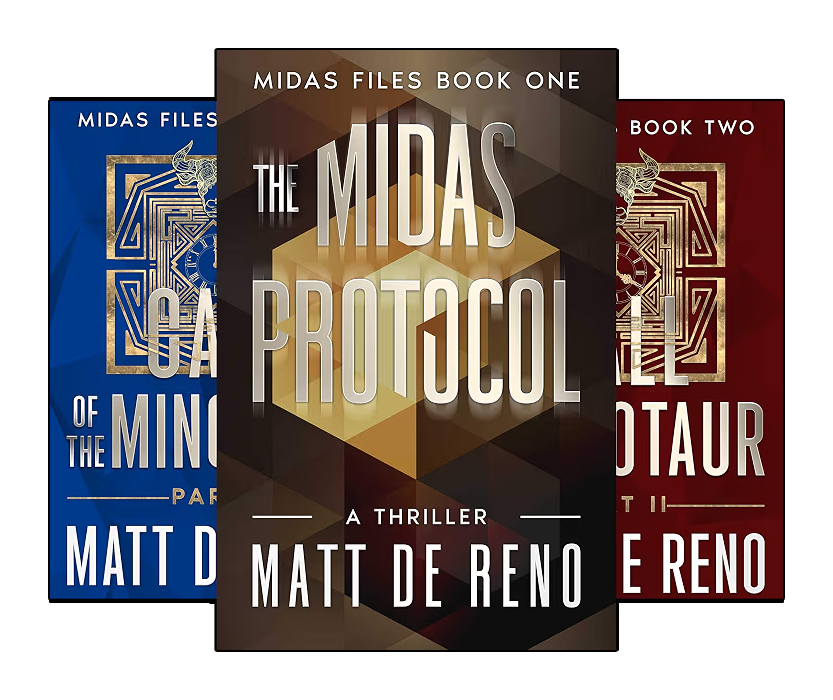


Chapter 2 of The Midas Protocol is where the major pieces of the series begin quietly moving onto the same corporate chessboard.
How Chapter 2 Builds the Corporate World of The Midas Protocol
Spoiler Advisory: This entry discusses lore connected to The Midas Protocol and later implications developed in Call of the Minotaur.
Hank Raglan arrives on the top floor of Unalco World Headquarters to meet Anthony “Tony” Laporte, the company’s paternal chief executive and the lifelong friend of the late Dr. Lawrence Bingham. In another corner of the same floor, Jack Barons waits for his first private meeting with the cunning Connor Wallrose. Addison Moore briefly crosses Hank’s path. Mortimer Vanterpool slips out of Connor’s office without acknowledging Jack at all.
Nearly every major figure in the early Midas Files mythology is here.
The one conspicuous absence is Caroline Friday. But she is not far away. As explored in last week’s Burger Empire entry, Caroline is down the street burning hamburgers, fighting with Pete Gardner, and staring toward Unalco’s gleaming headquarters from a world that feels a million miles removed from it.
The View from the Top Floor
The first half of the chapter follows Hank as he waits inside Tony Laporte’s corner office. Floor-to-ceiling windows provide a panoramic view across the Allegheny River toward downtown Pittsburgh, framed by the city’s yellow bridges.
For Hank, the office represents arrival.
He is a junior materials-science researcher who normally works from a basement office at the Unalco Technical Center in New Kensington. His department once became temporary storage for an oversupply of janitorial mops. Now he is sitting in a leather chair on the executive floor, watching Pittsburgh through walls of glass.
That upward movement is not accidental.
Chapter 2 is filled with vertical symbolism. Hank has literally been brought upstairs because he has demonstrated the ability to understand something that Unalco’s senior researchers could not: Lawrence Bingham’s unfinished work on Evium.
He believes he is attending a meeting about a technical report.
Tony knows the meeting is about Hank.
The Alloy That Makes Hank Visible
At this point in the story, Evium is presented as an unfinished advanced alloy connected to Lawrence Bingham’s research. The project has collected dust for years because Unalco’s engineers have been unable to solve its remaining problems.
Then Hank completes the report.
His explanation of how he did it is more important than the report itself. Hank says that he visualized the completed alloy in his mind and then connected the missing pieces to that final image. He did not merely work through the information sequentially. He saw the whole thing.
Tony immediately recognizes something familiar in that ability. He tells Hank that he reminds him of Larry Bingham. That comparison is the first indication that Hank’s understanding of Evium may be more than academic aptitude. He has an intuitive relationship with Bingham’s science—an ability to see structures others cannot see and finish work that has resisted years of conventional analysis. In retrospect, Evium is Hank’s first encounter with the impossible. It simply arrives disguised as corporate metallurgy.
What Evium Means at This Point
This chapter does not yet present the complete Evium mythology. Here, Evium is an unfinished alloy. That remains an accurate description of what Hank and most of Unalco understand at the time. Later, Call of the Minotaur expands Evium into a family of exotic materials that includes Evium Silver, Evium Blue, and Evium Gold. Evium Gold is especially important because it is the material from which the Gold Box is made.
That later development changes the scale of Hank’s Chapter 2 accomplishment. He is not simply solving an industrial aluminum problem. Without realizing it, he is beginning to understand a family of materials connected to alien technology, higher-dimensional machinery, and the central artifact of the series.
The early terminology therefore reflects limited human knowledge rather than a contradiction.Unalco sees an alloy. Bingham may have seen a material system. Hank sees the missing links. The larger universe may understand something else entirely.That difference between what an object is and what the characters currently believe it to be is one of the central engines of The Midas Files.
Tony Laporte and the Memory of Larry Bingham
Tony Laporte enters the story as the kind of powerful executive Hank does not expect to encounter. He is distinguished but approachable, paternal without feeling weak, and comfortable enough with his authority to joke with a young employee about engineering school, beer, and keg stands. He asks Hank to call him Tony. He praises him without making the meeting feel ceremonial or artificial.But beneath Tony’s warmth is grief.
When Hank mentions Lawrence Bingham, Tony describes his old partner as much more than Unalco’s co-founder. Larry was the inventor, the innovator, and the scientific force without whom the company would not exist.
That relationship gives Tony’s interest in Hank an emotional dimension.
Hank has not merely completed a forgotten report. He has reached into the unfinished work of Tony’s murdered friend and made it live again. The scene therefore works as both a promotion and an audition. Tony is evaluating whether Hank possesses enough of Bingham’s vision to continue something that was violently interrupted. Hank hears praise. Tony hears an echo.
Addison Moore Enters the Story
This is also the first chapter in which Hank and Addison Moore encounter one another.
Her appearance is brief. She enters Tony’s office carrying a manila folder, acknowledges Hank with a polite smile, places the folder on the executive desk, and leaves.
For Hank, it is enough. He already knows her name because Addison is Unalco’s Global Media Relations Manager. Her name appears on company announcements, news releases, industry updates, and corporate communications. Hank admires her intelligence and communication skills before he has any meaningful relationship with her.Naturally, he also notices that she is attractive.
This understated entrance is important because Addison is being introduced through her professional role, not simply as Hank’s future romantic interest. Tony plans to have Hank present Evium at Unalco’s Global Communicators Conference, and Addison will help him turn Bingham’s advanced science into a story the world can understand.
Hank represents discovery. Addison represents interpretation. Their relationship begins where those two functions meet.
A Love Triangle Before Anyone Knows It
At this stage, Hank, Addison, and Jack Barons have not yet formed the emotional triangle that will become important later. But Chapter 2 places all three inside the same environment. Hank sits in Tony’s office, earning attention because of his unusual scientific gifts. Addison crosses through that office as one of Unalco’s rising communications professionals. Jack waits elsewhere on the floor, hoping his own talents have drawn the notice of Connor Wallrose.
Each is young, ambitious, and trying to move upward. Each believes Unalco may provide the future they want. None of them yet understands what Unalco is carrying beneath its polished surface. That makes this chapter less a formal introduction to a love triangle than the moment all three sides of it arrive on the board.
The Other Corner of the Sixth Floor
The chapter’s second movement deliberately mirrors the first. While Hank meets Tony Laporte, Jack Barons waits outside Connor Wallrose’s office.
Hank is a gifted scientist trying to remain modest about what he has accomplished. Jack is a gifted accountant who knows exactly how clever he has been. Hank completes Bingham’s work by visualizing the finished alloy. Jack manipulates financial structures so that Unalco’s losses can be separated from its appearance of profitability.
Both young men are recognized for seeing systems others do not. The moral difference lies in what they do with that ability. Hank connects missing pieces to reveal the truth of a material. Jack rearranges financial pieces to conceal the truth of a company. That parallel may be the most important structural feature of Chapter 2.
Two Mentors and Two Futures
Tony Laporte and Connor Wallrose function as opposing mentors. Tony greets Hank with warmth, humor, and encouragement. He views talent as something to cultivate. His admiration for Hank is inseparable from his love for Larry Bingham and his hope that Bingham’s work might still have a future. Connor greets Jack with intimidation and psychological games. He tests Jack’s tolerance for uncertainty, impropriety, and humiliation before finally discussing business. He views talent as something to recruit and exploit.
Tony sees Hank as hope.
Connor sees Jack as an instrument.
That contrast creates two possible futures inside Unalco.
One path follows Bingham’s unfinished science. The other follows corporate power into darker territory. Both paths begin on the same floor.
Vanterpool Walks Through the Scene
Before Jack enters Connor’s office, a tall, slender, blond stranger emerges from it. Jack immediately senses that the man is not a conventional businessman. The stranger walks past without acknowledging him, as though Jack does not exist. Readers who know the series understand who just passed through the lobby:
Mortimer Vanterpool.
His appearance is brief enough to seem incidental on first reading. In retrospect, it is anything but. Vanterpool is the man responsible for the murders of Lawrence and Eva Bingham. Now he is leaving the office of Connor Wallrose, one of the most powerful men at the company Bingham helped create. The scene does not explain why Vanterpool was there.
It does not need to. His presence tells us that Connor’s operation is already connected to the violent hidden world beneath Unalco. While Tony speaks affectionately about his murdered friend in one office, that friend’s killer is walking out of another. That may be the darkest irony in the chapter.
Jack Barons and the “Special Project”
Connor is impressed by Jack’s creative accounting and offers to place him on an exclusive special project. When I wrote the scene, I did not yet know exactly what that project would become. At the time, Jack’s accounting ideas were built around the kind of special-purpose entities, displaced losses, and manufactured profits associated with large corporate fraud scandals. Connor seemed to be recruiting him to help manipulate Unalco’s finances. That reading remains valid. But two books into the series, the meaning of Connor’s offer has grown.
In Call of the Minotaur, Jack’s financial role becomes connected to laundering money for Project Sovereign Eagle. His talent is not merely making an ugly balance sheet look attractive. It is building the concealed financial infrastructure required to fund an enormous secret operation. That makes Connor’s seemingly generic sentence exponentially more significant.
“This will be our special project.”
On first reading, it sounds like corporate corruption. After Call of the Minotaur, it sounds like recruitment into Sovereign Eagle. This is one of the pleasures of writing a series. Early lines sometimes become foundations before the author fully understands what will eventually be built upon them. The important thing is that the original scene still works. Jack’s accounting skills are exactly what Connor would need. The later book does not replace the original implication. It gives it a destination.
Unalco as a Pittsburgh Place
Unalco World Headquarters is fictional, but the building and its atmosphere were inspired by a very real period in my life. In the late 1990s, I worked as a corporate communications assistant at Alcoa’s new headquarters on Pittsburgh’s North Shore. The real Alcoa Corporate Center was completed in 1998 as a six-story glass-and-aluminum headquarters on the Allegheny River.
For a young communications professional, it was an extraordinary place to work. The building looked directly across the river toward downtown Pittsburgh and the Point. Its upper floors offered the kind of panoramic view Hank admires in Tony’s office: river, bridges, skyline, and the city seemingly spread out beneath the glass. I could have been Hank Raglan in that moment. Not because I was solving an impossible alloy, unfortunately, but because I knew what it felt like to be young, relatively new to the corporate world, and suddenly working near senior executives inside a building that seemed to announce Pittsburgh’s future. That feeling became the emotional foundation of Chapter 2.
The North Shore Before the Ballpark
The Alcoa building arrived at an important moment in Pittsburgh’s North Shore redevelopment. When I worked there, the headquarters still felt new. A few years later, PNC Park opened in spring 2001 only a short distance away, bringing the Pirates to one of baseball’s most distinctive riverfront settings. Today, it is easy to think of the North Shore as a developed corridor of stadiums, restaurants, offices, river walks, and entertainment. At the time, the Alcoa headquarters felt like an early declaration that something new was beginning there. That transformation found its way into The Midas Protocol.
Unalco’s headquarters rises above an older, tired North Side. It is modern, reflective, and optimistic on the surface. Caroline looks toward it from Burger Empire and sees opportunity. Hank sits inside it and sees achievement. The building promises a new future. The irony is that it also houses very old secrets.
The Real Executive Behind Tony Laporte
Tony Laporte was not written as a direct portrait of any one person, but some of his paternal executive presence was inspired by Paul O’Neill, who led Alcoa before becoming Treasury Secretary under President George W. Bush. O’Neill served as Alcoa’s chairman and CEO from 1987 to 2001 and as the 72nd Secretary of the Treasury from 2001 to 2002.
My memory of him was of a leader who seemed comfortable speaking with people throughout the company, regardless of their position. One episode has stayed with me.
The director of global communications learned that O’Neill’s office had been sending communications to Alcoa locations around the world without including our department. I was told to contact his office and ask that we be kept in the loop. I expected a secretary to answer. Paul O’Neill picked up the telephone himself. I introduced myself, explained why I was calling, and told him our director wanted corporate communications copied on his future messages. He said, essentially, “Sure thing.”
Then his next Tuesday letter went out through the global distribution system—with Matt DeReno copied on it. Friends from the payroll department, where I had first worked, saw the message and reacted as though I had quietly joined the highest levels of the company. “Holy heck, Matt. The president CCs you on his correspondence?”
Naturally, I just smiled. I knew the truth was less impressive. But I was not going to ruin the moment.
Where Memory Becomes Fiction
That anecdote probably captures why Tony’s scene with Hank feels personally familiar to me.
There is a particular experience that comes with being young inside a large corporation and discovering that the people at the top are still people. Sometimes the intimidating name on the letterhead answers his own telephone. Sometimes a chief executive jokes with a junior employee. Sometimes a tiny interaction makes someone feel unexpectedly visible.
Tony gives Hank that experience. Of course, this is The Midas Files, so the nice meeting also contains an unfinished alien material, the legacy of a murdered scientist, a secret corporate war, and the suggestion that Hank may be humanity’s last hope. My Alcoa experience was considerably less dangerous. As far as I know.
Tony’s Final Line
After Hank leaves, Tony’s expression changes. He picks up the Evium report, looks out through the glass, and speaks to his dead friend:
“Hank has raw gifts, no doubt about it, Larry, but he is a young man. Still, he might be our last hope.”
That line reveals that the meeting has never really been about a conference presentation. Tony believes Hank may be able to finish something Bingham began. He also believes that something has progressed far enough for the word “last” to be appropriate. Meanwhile, elsewhere on the floor, Connor has recruited Jack into his special project, and Vanterpool has already passed through the building.
The chapter ends with hope, but it is hope under pressure. Tony has found a possible successor to Bingham. Connor has found a financial architect for Sovereign Eagle. Addison has entered Hank’s life. Vanterpool is already inside the walls. And Caroline Friday is still down the street flipping burgers, unaware that she will soon be pulled into the same story.
Why Chapter 2 Matters
“Misbegotten Fortune” may appear to be a corporate setup chapter, but it quietly establishes nearly the entire human architecture of the series.
- It introduces Hank’s intuitive relationship with Bingham’s science.
- It brings Addison into his orbit.
- It establishes Tony as Bingham’s friend, Hank’s mentor, and a man carrying knowledge he cannot yet reveal.
- It introduces Jack as Hank’s corporate and romantic counterpart.
- It pairs Jack with Connor Wallrose and begins the path toward Sovereign Eagle.
- It allows Mortimer Vanterpool to walk through the story almost unnoticed.
- It places Unalco at the center of Pittsburgh geography and Midas Files mythology.
- Most importantly, it creates two simultaneous acts of recruitment.
Hank is being recruited into Bingham’s legacy. Jack is being recruited into Connor’s conspiracy. Neither young man knows what his mentor is truly asking of him. That is why the chapter is called “Misbegotten Fortune.”
Both men believe fortune has finally noticed them. Neither yet understands what that fortune will cost.
Author’s Analysis Note
Chapter Files are different from the traditional codex and location entries in Bingham’s Notebook.
A codex entry asks what a person, place, object, or piece of mythology is. A Chapter File asks how a particular section of The Midas Files works: what it introduces, how it connects to later books, where it came from, and why certain details become more meaningful in retrospect. As with the other entries in Bingham’s Notebook, these analyses may include established canon, developing lore, personal memories, and observations made with the benefit of later books. The chapter remains the artifact.
This is the notebook opened beside it.
Book: The Midas Protocol
Chapter: 2, “Misbegotten Fortune”
Filed Under: Chapter Files, Unalco, Hank Raglan, Jack Barons, Tony Laporte, Connor Wallrose, Addison Moore, Evium
Related Entries: Burger Empire, Lawrence Bingham, Evium, Sovereign Eagle, Mortimer Vanterpool