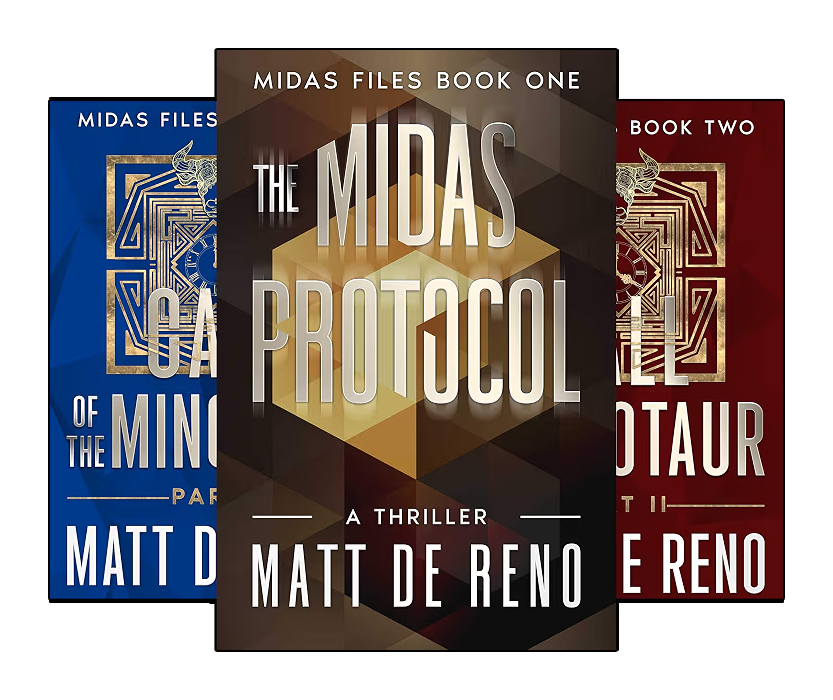

Chapter 1 of The Midas Protocol begins with a man who has just accomplished the impossible and already suspects that it may cost him his life.
Spoiler Advisory: This entry discusses lore connected to The Midas Protocol and later implications developed in Call of the Minotaur.
Dr. Lawrence “Larry” Bingham arrives home at his sprawling Sewickley estate carrying the culmination of fifteen years of secret work: a sentient golden hypercube small enough to fit in one hand. He has built something that could usher humanity into a new era—or provide the means for its complete destruction. He has also begun to distrust the Majestic Twelve, the secret organization that supplied the resources necessary to create it and promised to safeguard the result.
Within hours, Larry and his wife Eva will be dead. Their home will be torn open, the Gold Box will be stolen, and the reader will meet Mortimer Vanterpool in all his terrifying, almost incomprehensible power.
As an opening chapter, “The Gold Box” has a great deal to accomplish. It introduces the central artifact of the series, establishes the murder that haunts everything that follows, reveals the existence of Majestic Twelve, seeds the deeper Bingham family mystery, and presents a villain who does not simply kill people but violates the normal boundaries of biology, physics, and time.
It also begins with a surprisingly human problem: Larry Bingham has bought a car he does not particularly like.
That detail may seem small beside the carnage to come, but it captures what the chapter is really about. Larry has reached a point of irreversible change. The new Mercedes, the completed Gold Box, the unresolved secrets, and his decision to finally tell Tony Laporte all belong to the same emotional threshold. Larry is attempting to enter a new phase of life.
He will not survive the night.
A New Car and an Old Life
Larry Bingham’s 1983 Mercedes 380 SL is introduced as a symbol before it becomes a plot device.
He has only driven the car twice, dislikes how it handles, and is not yet emotionally attached to it. His old Volvo still ran well when he left it at the dealership. The purchase therefore seems less practical than ceremonial. Larry has spent fifteen years building the Gold Box, sacrificing time, intimacy, and much of his identity to complete it. Buying the Mercedes is his attempt to mark the end of that long private struggle.
The car reflects Larry’s state of mind. It is expensive, polished, impressive, and foreign to him. He has acquired the visible trappings of success at precisely the moment when his private success has become frightening.
That uneasiness follows him into his own driveway. Larry listens to Willie Nelson sing “Always on My Mind,” looks at the Gold Box on the passenger seat, and sees himself in the rearview mirror. He is sixty-five now. His hair has grayed and receded. The wide-eyed wonder of the fifty-year-old man who began the project has been replaced by exhaustion.
The passage gives us an inventor at the end of a long obsession. Larry has achieved what he wanted, but the achievement has consumed fifteen years of his life. His thought—It is time to undo what time had done to me—becomes painfully ironic in a series where time is not only metaphor, but machinery.
The Mercedes will later float through the destroyed foyer under Vanterpool’s control. The car Larry never learned to love becomes the hiding place for the most important machine humanity has ever produced. Its purpose in the chapter evolves from status symbol to coffin-like repository.
That, too, is part of the chapter’s design: ordinary things keep becoming containers for impossible ones.

The Man Who Built the Impossible
Larry is not merely studying the Gold Box. He has completed it.
This distinction has enormous implications for the larger mythology of The Midas Files. What extraterrestrial civilizations call a Cube of Aurelia is normally associated with ancient processes, civilizational thresholds, and powers far beyond normal human engineering. Yet Larry Bingham has manufactured one through years of work, secret resources, and guidance from an entity that communicates through dreams.
At this point in the first novel, the reader does not yet understand the full cosmic significance of that achievement. Larry himself understands only part of it. He knows the Gold Box could transform humanity, and he knows its success is more frightening than its failure. He also believes it is learning, changing, and becoming increasingly aware.
The description of the object establishes nearly all its central visual properties. It is no larger than a Rubik’s Cube, cool despite its molten appearance, and covered in plasma-like fluctuations of gold, orange, and red. At moments, Larry can see the cube within the cube. At others, its surface becomes a perfect mirror, rendering it nearly invisible. When inactive, it fades into gray.
The Gold Box is therefore introduced as both machine and organism. It hums, sings, rests, evolves, and appears to make choices about how much of itself it reveals. Larry may have engineered its physical form, but the chapter already suggests that he does not fully control what he has made.
That tension remains central to the series. Human beings build, discover, steal, and activate impossible technologies, but possession is not the same thing as mastery.
The Watcher and the Dream Trial
One of the most important pieces of mythology introduced in this chapter is the Watcher.
Larry expects the final production trial of the Gold Box to take place while he sleeps, in the dimensional space of dreams. If the device passes, great change awaits humanity. If it fails, the work will continue, as it apparently has in some form for thousands of years.
This idea quietly expands the scale of Larry’s project. He is not simply testing a laboratory prototype. His invention must be evaluated by an entity associated with another dimension of consciousness. The test is scientific, ceremonial, and metaphysical at once.
The Watcher also raises an important question about authorship. Larry believes he built the Gold Box, but he did so with help from a mentor that entered his dreams. How much of the design originated with Bingham? How much was transmitted to him? Was he inventing, remembering, receiving, or being guided toward a predetermined result?
Those questions become especially important when we consider the older Bingham family connections hinted at later in the chapter. Lawrence Bingham’s achievement may be unprecedented in one sense while still belonging to a much older chain of contact and inheritance.
The dream trial never occurs that night. Larry’s planned passage into one kind of altered state is interrupted by a far more violent intrusion from the hidden world he has entered.
Majestic Twelve and the Failure of Trust
Larry’s greatest immediate fear is not that the Gold Box will fail.
It is that Majestic Twelve will keep it.
He agreed to build the device because MJ-12 promised to convene an international meeting of world leaders and create a responsible plan for safeguarding the technology. Now that the Gold Box exists, the meeting is endlessly delayed. Every request for information produces another vague promise that an update is forthcoming.
Larry recognizes the pattern. The committee is not merely slow. It is stonewalling him.
This conflict establishes one of the central themes of The Midas Files: institutions often justify secrecy as stewardship, then gradually begin treating stewardship as ownership. Larry believed he was cooperating with powerful people who understood the danger. Instead, he suspects they intend to retain control of the very technology they promised to protect from unilateral control.
His decision to remove the Gold Box from the laboratory is therefore an act of rebellion, but also an act of conscience. He violates his agreement because he no longer trusts the people enforcing it.
The tragedy is that Larry is both correct and dangerously late.
Majestic Twelve has indeed responded to his demand for a safeguard. The entity they sent to protect—or recover—the Gold Box is Mortimer Vanterpool.
The arrangement satisfies the letter of Larry’s request while grotesquely betraying its spirit.
Larry, Eva, and the Mistress Underground
For all its cosmic machinery, Chapter 1 makes room for Larry’s guilt about his marriage.
Eva has supported him throughout the fifteen years of secret research, even as the work consumed evenings, attention, and emotional energy that might otherwise have belonged to their life together. She calls his underground research his mistress, and Larry admits the comparison is fair.
The Gold Box is not only his great invention. It is the rival relationship that has occupied his imagination for years.
This makes Larry’s intention to go inside and spend the evening with Eva emotionally important. He believes the long ordeal is finally ending. He will return to his wife, tell Tony Laporte the truth in the morning, and begin correcting the imbalance he has allowed his work to create.
That promise is devastating because the reader watches him make it only moments before the murders.
The chapter does not give Eva a long scene of her own before her death, but her presence fills Larry’s thoughts and the estate around him. Her Japanese garden borders the woods. Her flowerbeds receive the last ember of Larry’s joint. Her slippers sit in the hallway where the killers enter. Her support is part of the unseen infrastructure that made Larry’s work possible.
Later stories may deepen Eva’s life, interests, and relationship with Larry. Here, she functions as the human future Larry believes he can finally reclaim.
Vanterpool destroys that future before morning.
The Red Rose
Larry’s decision to celebrate by smoking marijuana is funny, revealing, and structurally useful.
The Red Rose strain gives the chapter a moment of warmth before it plunges into horror. Larry rummages through his golf bag with adolescent enthusiasm, finds the joints alongside scuffed golf balls, loose change, and a pair of black lace panties, and briefly allows himself to feel relaxed and triumphant.
The detail prevents Larry from becoming an untouchable saintly scientist. He is brilliant, frightened, unfaithful, secretive, exhausted, and capable of enjoying a private rebellion. His life contains compromises beyond those involving Majestic Twelve.
The marijuana also complicates his perception of danger. Larry has already heard something in the woods and felt watched. Because he knows the strain may cause paranoia, he has another reason to dismiss his instincts. The reader, however, knows that something really is present beyond the garden.
His altered state becomes a tragic source of false reassurance. The Red Rose helps him forget the implications of the Gold Box at the exact moment those implications are coming through the trees.
There is also something wonderfully absurd about the hiding place Larry eventually chooses. The most important artifact on Earth is placed in the side pocket of an old golf bag beside marijuana and underwear.
Vanterpool later describes the choice perfectly:
“Ah, it is in your car. How brilliantly stupid.”
The hiding place is ridiculous, but it works for the same reason the Gold Box works throughout the series. The extraordinary remains concealed inside the ordinary because no one expects cosmic power to be stored among mundane embarrassments.
The Decision to Tell Tony Laporte
Before entering the house, Larry decides he will reveal the truth to Tony Laporte.
This decision creates the bridge between Chapter 1 and Chapter 2.
Tony is not merely Larry’s business partner. He is his lifelong friend, trusted colleague, and virtual brother. Larry believes Tony will understand the larger stakes and help determine what should happen next. Yet telling him will also expose years of deception.
Larry has kept Tony strategically misinformed. He diverted resources from Unalco research, neglected his work on Evium, maintained a secret partnership with a dream entity, and joined an organization that officially does not exist.
The conversation would have wounded Tony, but it also might have changed everything.
Instead, Tony learns only through the absence Larry leaves behind. When he later recognizes something Bingham-like in Hank Raglan, he is responding not only to scientific promise, but to a grief rooted in this unfinished confession.
Chapter 1 therefore establishes Tony before he physically enters the novel. Larry’s faith in him tells us who Tony is supposed to be. Chapter 2 then allows us to meet the man carrying the consequences of never receiving Larry’s explanation.
The Gold Box does not only create technological mysteries.
It creates interrupted relationships.
The Door Left Open
Larry makes a series of ordinary decisions that become fatal in combination.
He leaves the Mercedes outside. He hides the Gold Box in the golf bag. He places his keys on the kitchen counter. He neglects to lock the French doors, as he has apparently done many times before.
None of these choices feels monumental as he makes it. That is what gives the sequence its dread. The killers do not defeat an elaborate security system. They enter through the relaxed habits of a man who believes he is home.
The unlocked door also embodies Larry’s central mistake. He has spent years opening intellectual and dimensional doors without fully understanding who might follow him through them.
His physical home is penetrated in the same way his life has been penetrated by Majestic Twelve, the Watcher, and forces surrounding the Gold Box. Larry believes he can manage access. The chapter proves otherwise.
Once the French doors open, the novel shifts perspective from the inventor to the intruders.
The change is immediate and brutal.
Johnny Rocco and Mortimer Vanterpool
The murder sequence introduces one of the strangest pairings in the series.
Johnny Rocco is a South Philadelphia criminal, arsonist, drug dealer, and professional killer who nevertheless possesses his own warped code. He is sloppy, racist, vulgar, overweight, and dressed in a white jogging suit intended to be burned after the job. Yet he loves dogs, believes killing should be conducted with professional standards, and finds Vanterpool’s behavior morally offensive.
Mortimer Vanterpool is his opposite in almost every visible way. Tall, lean, exact, and dressed entirely in fitted black, he moves silently and handles the fireman’s ax with impossible speed and control. His accessories are polished. His posture is disciplined. His accent and strange British expressions make him seem detached from the crude world Johnny understands.
Together, they create a dark-comic contrast before the scene becomes outright horror.
Johnny initially believes they are two professionals carrying out an ugly contract. As the night proceeds, he realizes that he and Vanterpool do not even belong to the same category of being.
Johnny is a killer.
Vanterpool is something else.
Fermi and the First Violation
The killing of Fermi, the Binghams’ Pomeranian, establishes Vanterpool’s nature before he reaches Larry and Eva.
Johnny tries to save the dog. The animal wags its tail, offers its paw, and refuses to flee. Vanterpool turns the moment into a golf joke, swinging the ax through the dog with enough force to shower Johnny in blood and entrails.
The scene is intentionally grotesque and darkly comic, but it also tells the reader several important things.
Vanterpool enjoys violating innocence. He enjoys demonstrating physical superiority. He enjoys provoking Johnny and watching him decide whether to react. His “Fore!” is not simply a joke. It reduces life to sport and murder to performance.
Johnny’s anger establishes the limit of his own depravity. He kills people and burns houses, but the dog’s death strikes him as unnecessary and unprofessional. That distinction does not redeem him, but it gives the reader a human reference point against which Vanterpool can be measured.
When a mob killer becomes the closest thing the scene has to a moral witness, the reader understands how far outside ordinary evil Vanterpool stands.
A Hit Designed to Look Like Something Else
Johnny gradually realizes that the murder is being staged.
The fireman’s ax and gasoline are not random tools. Someone wants the crime scene to resemble a brutal home invasion, mob collection, or debt-related killing. The real employers have contracted through Philadelphia crime boss Fats Castillo to create layers of distance between themselves and the Binghams’ deaths.
This is classic Majestic Twelve methodology: conceal the extraordinary beneath a recognizable human crime.
The public story will be robbery, murder, dismemberment, and arson. The truth involves a manufactured Cube of Aurelia, an immortal extraterrestrial operative, and a black triangular craft hovering over a Pennsylvania mansion.
The staged crime scene becomes an early example of the series’ central concealment mechanism. People do not necessarily fail to see strange events. They are given a more familiar explanation that absorbs the evidence.
A gruesome mob hit is easier to believe than what actually happened.
That does not make it true.
The Tesseract Photograph
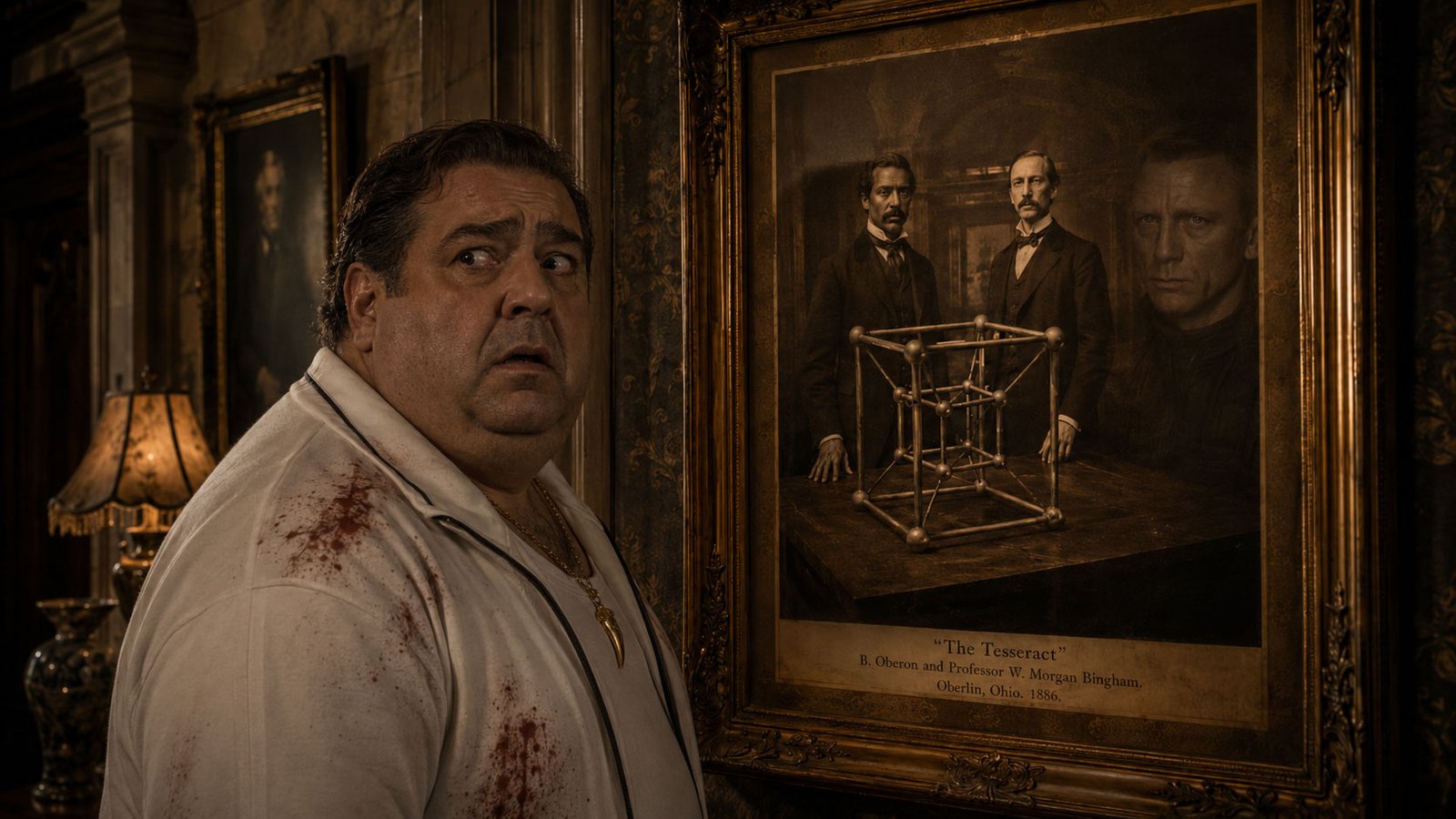
As Johnny moves through the house, he stops at an antique photograph showing two men beside a cube-within-a-cube model.
The caption identifies them:
B. Oberon and Professor W. Morgan Bingham
Oberlin, Ohio. 1886
This photograph is one of the chapter’s most important lore seeds. It suggests that Lawrence Bingham’s relationship with tesseract geometry and impossible science may belong to a family history extending back nearly a century.
The picture also introduces B’yob Oberon long before the reader can understand who or what he is. Vanterpool recognizes him immediately and claims to have killed him at the Dead Sea. That brief reaction expands the story across continents, centuries, and identities without pausing to explain any of it.
The photograph raises more questions than it answers. Who was W. Morgan Bingham? What did he understand about the tesseract? Why was Oberon beside him in 1886? How did Oberon survive Vanterpool’s earlier attempt to kill him? Did Lawrence inherit documents, designs, or knowledge from this older connection?
This is the kind of detail that rewards a Chapter File. On first reading, it is a creepy old photograph. In the wider mythology, it may be evidence that the Gold Box story began generations before Larry completed his machine.
The scene also creates one of the chapter’s best visual compositions: Johnny studies the old mystery while Vanterpool’s cold stare appears in the glass behind him.
The past is inside the frame.
The monster is in the reflection.
Well House as a Character
The Bingham residence—called Well House in the chapter—functions as more than a murder location.
Its scale, design, and objects tell us about the Binghams’ wealth, history, taste, and private mythology. The cavernous kitchen, gilded family photographs, timbered archways, Egyptian stained glass, spiral staircase, and three-story circular foyer all make the estate feel like an architectural expression of the hidden world.
The rose chandelier is the visual center of the house. Suspended beneath an Egyptian stained-glass rotunda, it resembles an enormous inverted bouquet supported by golden crossbars. Even Vanterpool pauses to admire it.
That moment of appreciation makes its destruction more effective. The chandelier is not merely scenery waiting to collapse. The chapter gives it beauty, symbolism, and presence before the energy blast tears apart the foyer and sends the stained glass raining down upon Johnny Rocco.
Well House begins the chapter as Larry’s sanctuary. By the end, its interior architecture has been transformed into a field of floating heads, severed limbs, broken glass, blue light, and antigravity.
The violence does not happen in a neutral room.
It desecrates a home.
The Murder Above the Foyer
Johnny does not witness the actual killing of Larry and Eva.
He hears it.
From the bottom of the staircase, he listens as the chandelier trembles, heavy objects strike walls, porcelain shatters, and something round rolls across the floor. His inability to see the attack makes it more disturbing because the sounds suggest strength beyond anything one man should possess.
Then Vanterpool descends with the Binghams’ severed heads tucked beneath his arm.
His composure is as frightening as the gore. He returns down the staircase with the same casual calm he displayed going up, as if the violence were no more demanding than retrieving luggage.
The chapter does not present the Binghams’ deaths as an ordinary assassination. Vanterpool has mutilated Larry’s head because he intends to extract information from his physical brain. The murder is simultaneously execution, interrogation, feeding, and theft.
That combination establishes Vanterpool’s alien logic.
He does not need Larry alive to question him.
“All of His Thoughts Shall Belong to Me”
Vanterpool’s ability to consume memory is one of the chapter’s most horrifying revelations.
He does not merely eat Lawrence Bingham’s brain for nourishment. He believes the act will grant him access to Larry’s thoughts and reveal the location of the Cube. His violence therefore attacks the final private refuge a person possesses: the contents of the mind.
This gives Larry’s earlier decision to tell Tony even greater tragic weight. Larry understands that knowledge must be shared with someone he trusts because keeping it in one mind has become dangerous. He reaches that conclusion only minutes before Vanterpool proves how literally true it is.
Vanterpool’s feeding also complicates the boundary between technology and biology in the series. The Gold Box is a sentient machine. Vanterpool is an extraterrestrial biological entity with energy manipulation, temporal control, antigravity, physical transformation, and memory acquisition through consumption.
The chapter makes no effort to give the reader a safe distinction between science fiction and supernatural horror.
Its universe contains both, and they may be different interpretations of the same underlying reality.
Johnny Rocco’s Failed Rebellion
Johnny finally draws his revolver when Vanterpool’s behavior violates even his standards.
He tells himself the partnership has become unacceptable. Fats Castillo will understand. The psycho must be stopped.
The attempt is almost touching in its futility.
Before Johnny can fire, Vanterpool sweeps his hand through the air and releases a plane of blue energy that shears away Johnny’s arm, shoulder, and part of his torso. The blast continues through the foyer and into the trees beyond the house.
Johnny should die immediately.
Vanterpool does not allow it.
Instead, Johnny remains suspended at the precise threshold between life and death. His heart is exposed and still beating. His memories disappear as stained glass penetrates his skull. He cannot move, cannot properly scream, and cannot escape the experience of his own destruction.
The moment reveals that Vanterpool’s power is not limited to killing. He can regulate the victim’s relationship to time, preserving consciousness after the body has become anatomically impossible.
Immortality has made him patient.
Cruelty has given him something to do with the time.

The Black Triangle Above the House
After Vanterpool’s energy blast tears open the mansion, the moon disappears behind an enormous black triangular craft.
In The Midas Protocol, the vehicle is presented from Johnny’s limited perspective. He sees a massive triangle with glowing orange plasma at its corners. An aperture opens in its center, flooding the foyer with blue light and producing an antigravity field.
At this point, the craft needs no name. Johnny has no language for it beyond shape, light, and terror.
Later, Call of the Minotaur identifies Vanterpool’s vessel as The Obsidian Veil. That later name gives identity to what Chapter 1 presents as an inexplicable UFO over the burning estate.
The difference illustrates how the series handles revelation. Book One provides the witnessed phenomenon. Book Two expands its history, function, and role in Vanterpool’s operations.
The Obsidian Veil’s entrance changes the physical rules of the scene. Eva’s head, Johnny’s severed arm, the gasoline can, and Larry’s ruined head float like debris suspended underwater. The car itself is drawn into the foyer as though it weighs nothing.
The house is no longer simply being invaded.
It is being subjected to another physics.
“How Brilliantly Stupid”
Once Vanterpool consumes enough of Larry’s brain to locate the Gold Box, he calls the car into the ruined house and extracts the golf bag, marijuana, and golden cube.
The juxtaposition is almost absurd: cosmic technology, illegal drugs, and private embarrassment float together under alien light.
Vanterpool recognizes the brilliance of Larry’s hiding place precisely because it is so stupid. No secure vault, military bunker, or advanced containment system protects the Cube. It is hidden in an unwanted Mercedes beside ordinary personal clutter.
Yet Larry’s improvised concealment succeeds long enough to force Vanterpool to violate his mind for the answer.
When the Gold Box strikes Vanterpool’s palm, it changes him. Energy ripples through the house. His eyes fill with golden light. His body becomes larger, his skull elongates, and golden tattoos pulse across his neck.
The artifact does not behave like inert property changing owners. Contact produces recognition, activation, empowerment, or transformation.
The Gold Box may be stolen, but the chapter leaves open whether it can ever truly be possessed.
Mortimer Vanterpool Revealed
The chapter ends by naming what Johnny cannot understand.
Mortimer Vanterpool is an extraterrestrial biological entity. He was hired by Majestic Twelve to safeguard the Gold Box. He is immortal.
That final revelation reframes Larry’s entire fear.
He repeatedly asks why MJ-12 would kill him when only he knows how to build the device. He assumes his knowledge protects him. Majestic Twelve solves that problem by sending an entity capable of taking the knowledge from his dead brain.
Larry demands protection for the Gold Box. MJ-12 sends Vanterpool.
Larry worries the organization will keep the Cube. Vanterpool takes it.
Larry decides to tell Tony in the morning. Morning arrives without him.
The chapter’s ending therefore works as both twist and indictment. Majestic Twelve has technically fulfilled Larry’s demand that someone safeguard the Gold Box. It has simply chosen a guardian whose definition of safekeeping eliminates the inventor, his wife, their dog, their home, and the human criminal hired to disguise the operation.
The organization does not fail to understand Larry’s concerns.
It reveals that his concerns were never aligned with its priorities.
Dark Comedy Inside Cosmic Horror
Chapter 1 is exceptionally violent, but it is not written in a uniformly solemn mode.
Johnny’s white jogging suit, Vanterpool’s “Fore!”, the argument about professional murder standards, Larry’s marijuana celebration, the panties in the golf bag, and the Gold Box hidden beside the dope all introduce dark humor into scenes that could otherwise become relentlessly oppressive.
That tonal mixture is important to The Midas Files. The story contains ancient power, murder, conspiracy, cosmic councils, alien entities, and apocalyptic danger, but it is also populated by flawed people who make jokes, misunderstand situations, embarrass themselves, and carry petty concerns into enormous events.
Johnny Rocco is especially useful in this regard. His internal logic is monstrous but recognizable. He thinks he is a professional surrounded by amateurs and degenerates. The fact that he is technically correct about Vanterpool being worse than he is produces much of the scene’s bleak humor.
The comedy never erases the horror.
It makes the horror stranger.
What the Chapter Plants for Later
“The Gold Box” introduces or foreshadows an extraordinary amount of series mythology.
It establishes Lawrence and Eva Bingham’s murders, the existence of Majestic Twelve, Larry’s unfinished Evium research, the Gold Box as a sentient hypercube, the Watcher, dream-based guidance, Tony Laporte’s importance, Mortimer Vanterpool’s immortality and alien nature, the Obsidian Veil, B’yob Oberon, Professor W. Morgan Bingham, the 1886 tesseract photograph, and the possibility that the Bingham family’s relationship with impossible geometry is much older than Lawrence.
It also creates several emotional debts that later chapters must pay.
Tony never gets Larry’s confession. Hank Raglan will eventually become involved in Bingham’s unfinished work. Vanterpool leaves with the Gold Box and Larry’s memories. The public will receive a false account of the murders. The estate will become a place where hidden history and official history violently diverge.
What looks at first like a prologue-style murder sequence is actually the compressed origin point of the entire series.
Nearly every major road begins here.
Why Chapter 1 Matters
“The Gold Box” tells readers what kind of series they have entered.
This is a Pittsburgh-rooted story, but its Pittsburgh contains alien vessels, secret councils, immortal operatives, dream mentors, and higher-dimensional machines. It is a conspiracy thriller, but the conspiracy is trying to control powers that may be older than human civilization. It is science fiction, but its science arrives wrapped in ritual, consciousness, mythology, and horror.
The chapter also establishes the moral question that runs through the series: what happens when humanity acquires power before it develops the wisdom to steward it?
Larry believes the Gold Box could transform the world, but he no longer trusts the people who funded it. Majestic Twelve believes it can secure the artifact through secrecy and violence. Vanterpool treats it as something to seize. The Watcher intends to test it in dreams. Later characters will assign still other meanings to it.
The object remains the same.
The struggle concerns what everyone believes it is for.
Behind the Title: “The Gold Box”
The title is direct because the artifact is the gravitational center of the chapter.
Larry’s life has been consumed by building it. Majestic Twelve wants it. Vanterpool kills for it. The Binghams’ home is destroyed because of it. Johnny Rocco loses his life while barely understanding what it is.
Yet the Gold Box remains curiously passive for much of the chapter. It glows, hums, changes states, and appears to evolve, but it does not visibly resist being taken.
That passivity is deceptive.
The Gold Box is not merely an object at the center of the action. It is the silent intelligence around which everyone else reveals themselves.
Larry sees responsibility and fear.
MJ-12 sees control.
Vanterpool sees power.
The reader sees the beginning of a mystery that will take more than one book to understand.
Closing Note from Bingham’s Notebook
Chapter 1 begins with Larry Bingham asking whether they would kill him over the Gold Box.
By the end, the answer is brutally clear.
What Larry does not yet understand is that his murder will not bury his work. It will scatter the consequences across decades. Tony Laporte will grieve him. Hank Raglan will complete pieces of what he left behind. Vanterpool will carry his stolen memories and his Cube into the hidden machinery of Majestic Twelve. The photograph in his hallway will point toward an older Bingham mystery that may have begun long before Larry was born.
The house burns, but the story survives.
That may be the first great rule of The Midas Files: secrets do not disappear when the people who hold them die. They move into notebooks, artifacts, memories, bloodlines, buildings, and the minds of those who arrive later.
Lawrence Bingham built the impossible.
His final mistake was believing he could decide who would inherit it.
Author’s Analysis Note
Chapter Files examine how individual chapters of The Midas Files function: what they introduce, what later stories add to them, where their imagery and ideas lead, and why certain details become more significant in retrospect.
A traditional codex entry defines a character, location, artifact, or concept. A Chapter File looks at the machinery of the story itself. It considers both the events on the page and the mythology growing beneath them.
As with all entries in Bingham’s Notebook, some analysis may draw upon established canon, later-book revelations, developing lore, and the author’s evolving understanding of the series.
The chapter is the evidence.
The notebook is where we examine it.
Book: The Midas Protocol
Chapter: 1, “The Gold Box”
Filed Under: Chapter Files, Lawrence Bingham, Mortimer Vanterpool, The Gold Box, Majestic Twelve, Bingham’s Estate
Related Entries: Dr. Lawrence J. Bingham, Bingham’s Estate, The Tesseract Photograph, The Obsidian Veil, B’yob Oberon
Setting: Saturday, October 15, 1983 — Sewickley, Pennsylvania