

Some places in The Midas Files are important because they contain ancient secrets. Others matter because someone finally walks out the door.
Burger Empire belongs to the second category.
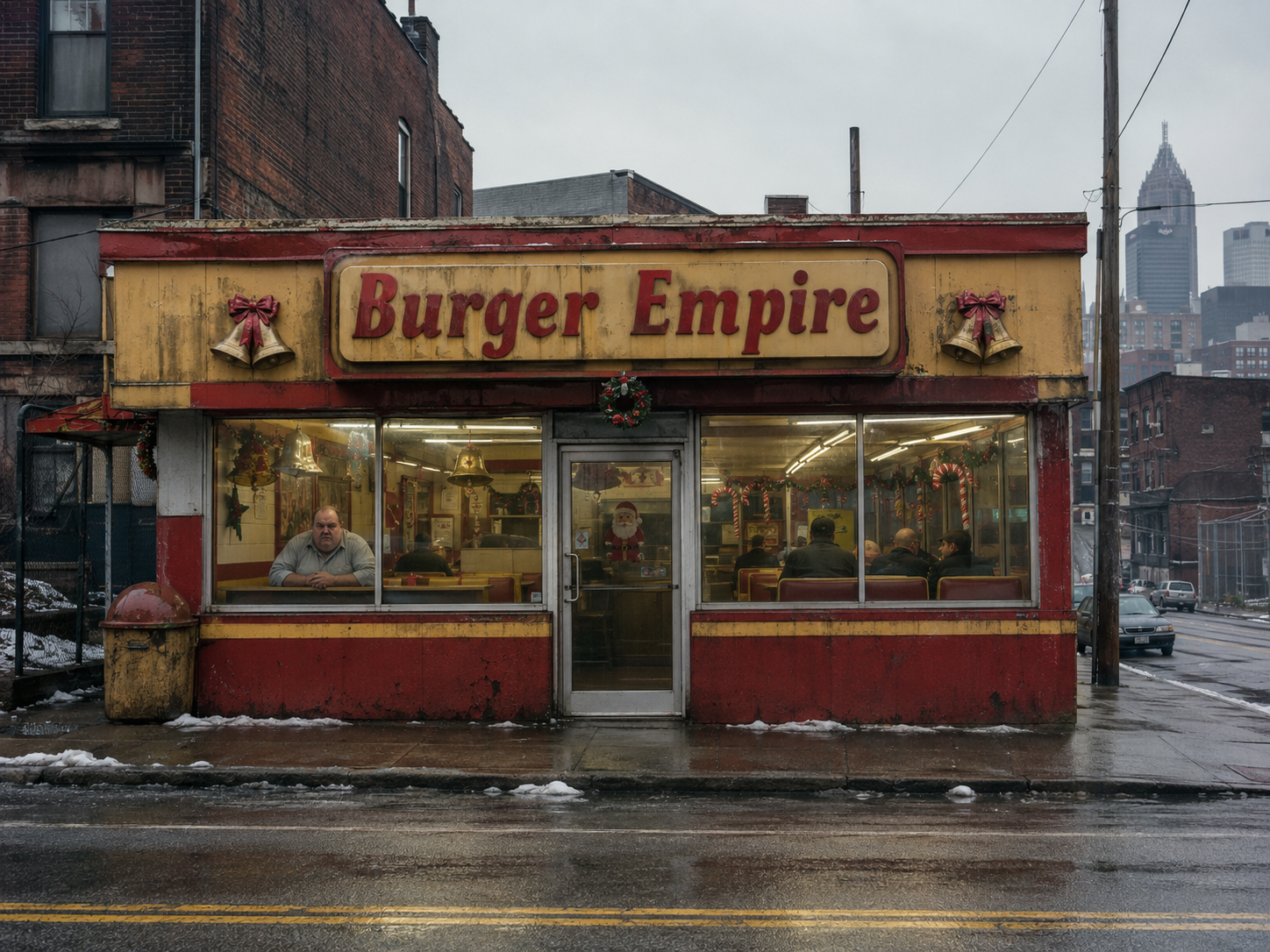
There are no glowing cubes here. No black triangles in the sky. No Axioms, Trials, temporal councils, alien bloodlines, moon bases, or impossible machines. At least not yet. Burger Empire is exactly what it appears to be: a shabby fast-food restaurant on Pittsburgh’s old North Side, full of grease, smoke, bad lighting, cheap holiday decorations, and the kind of dead-end energy that makes a young person wonder if her whole life has somehow already stalled.
That young person is Caroline Friday.
Spoiler Advisory: This entry discusses lore connected to The Midas Protocol and later implications developed in Call of the Minotaur.
Before she becomes tangled in the mysteries of The Midas Files, before Hank Raglan, before the Gold Box, before the conspiracies and cosmic machinery come crashing into her life, Caroline is twenty-one years old, broke, angry, cold, and working a miserable job she already hates.
That is what makes Burger Empire important.
It is not where the mythology begins.
It is where Caroline begins moving toward it.
The Greasy Spoon Where Caroline Friday Quit Her Old Life
Burger Empire is a two-bit fast-food restaurant located a short distance from Unalco’s world headquarters. In The Midas Protocol, it appears during a cold December afternoon in 1989, when Caroline Friday is stuck working the grill and watching her mood sink about as fast as the burgers are burning in front of her.
The restaurant is not glamorous. It is not charming. It is not the kind of place that becomes nostalgic in hindsight. It is a greasy spoon with a corporate name that sounds far bigger than the sad little kingdom it actually rules.
The details tell the story.
Six burgers sizzle on the grill. A holiday song crackles over the dining room speakers in a forced attempt to inject seasonal cheer into the place. Decorative bells on the entrance door jingle over and over until they become less festive than maddening. The kitchen is hot, filthy, and claustrophobic. The break room hallway contains the dreaded Employee of the Month board, a clipboard of schedules, and the time clock — a tiny shrine to low-wage motivation.
Burger Empire is not hell.
It is worse in a way.
It is ordinary.
And ordinary misery is exactly the kind Caroline Friday cannot tolerate for long.
Caroline Before the Conspiracy
The Burger Empire scene matters because it gives us Caroline Friday before the larger machinery of the series changes her life.
She is not introduced as a polished heroine. She is not composed, noble, or ready for destiny. She is irritated, judgmental, restless, and broke. She has purple streaks in her dark brunette hair, a nose ring, wooden bead necklaces, black boots, a flannel shirt, and a bad attitude sharp enough to cut through the grease in the air.
She is also trying.
That part matters.
Caroline needs the job. She wants to save enough money for a beater car and eventually an apartment of her own. She wants independence. She wants to prove she can survive without taking the easier path her father offered her through the family restaurant business. She wants to be moving toward something, even if she cannot yet name what that something is.
That is the emotional core of the scene. Caroline does not simply hate Burger Empire because it is gross. She hates it because it threatens to confirm her worst fear: that this is all there is. A lousy job. A stained apron. A boss she despises. A bus ride home. A future that looks suspiciously like more of the same. For a series full of secret histories and impossible technologies, this is a very human kind of terror.
The fear of getting stuck.
Pete Gardner’s Tiny Kingdom
Every empire needs an emperor.
Burger Empire has Pete Gardner.
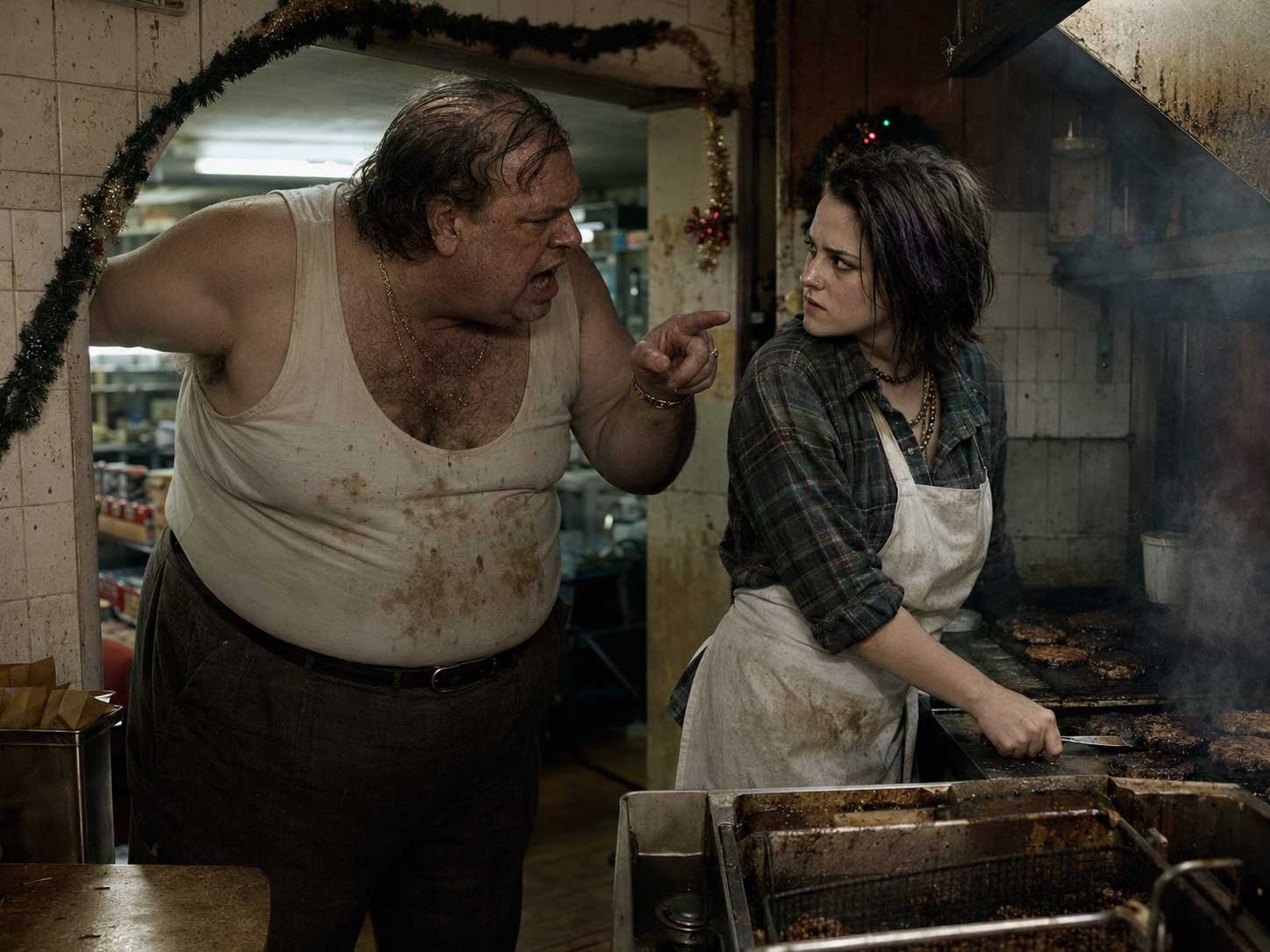
Pete is the franchise owner, and he rules his greasy domain with all the dignity of a troll under a filthy bridge. He is balding, obese, slovenly, crude, and spectacularly unworthy of the authority he possesses. His obsession with “team enthusiasm” and Employee of the Month recognition would be funny if it were not also so recognizable.
Pete represents a small but important kind of villain in The Midas Files universe.
He is not Malcolm Kane. He is not Mortimer Vanterpool. He does not command alien technology or hidden armies. But he does have power over Caroline’s afternoon, her paycheck, her dignity, and the terms of her humiliation.
That is enough.
Pete’s power is petty, but petty power can still be corrosive. He lectures Caroline about attitude. He compares her unfavorably to Demarco Cropley, November’s Employee of the Month. He turns a miserable fast-food job into a moral referendum on her character. He thinks the problem is that Caroline does not appreciate the opportunity he has given her.
Caroline knows better. The problem is Pete. The problem is the place. The problem is that she can feel herself shrinking inside it.
The Grill, the Mirror, and the Moment Before
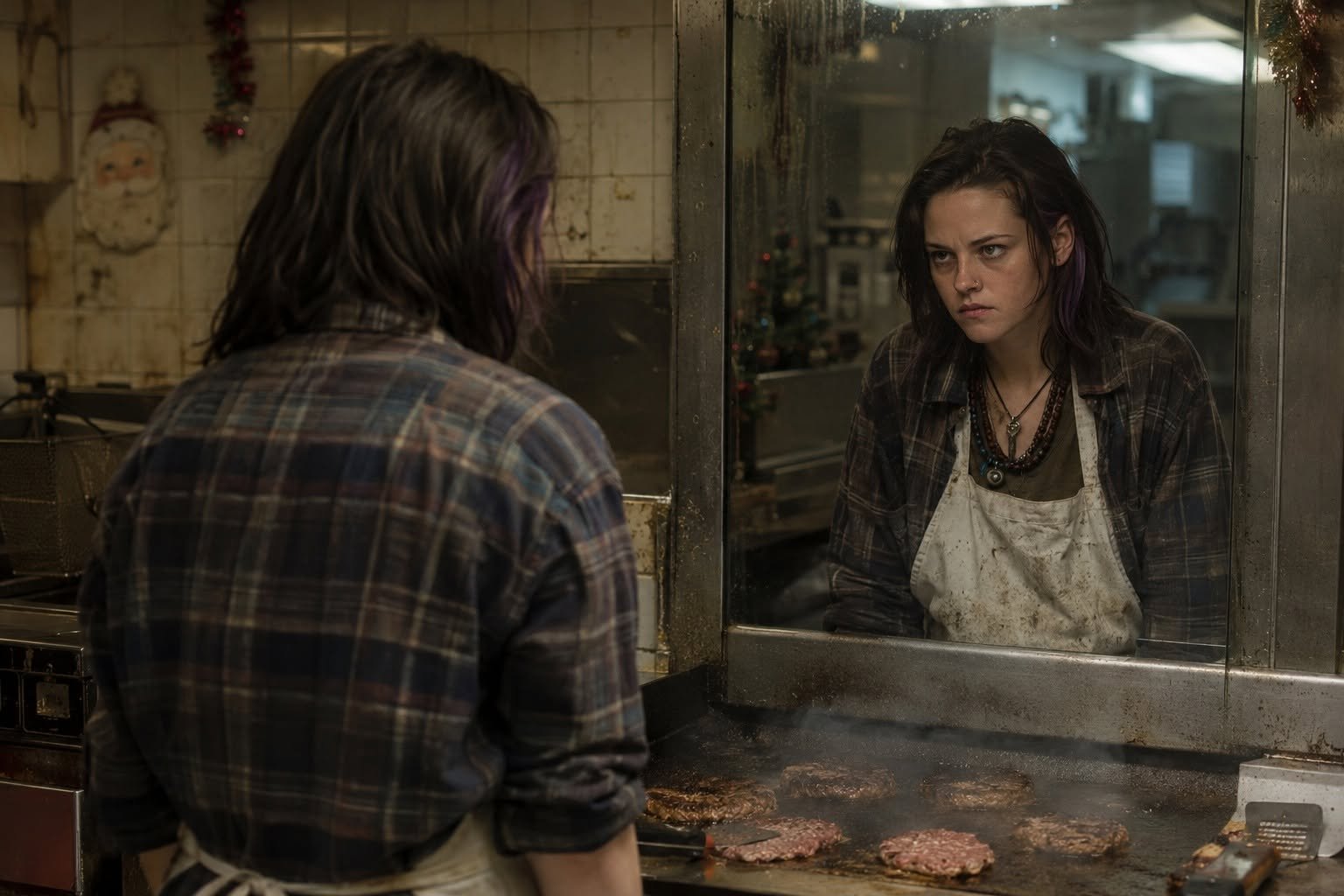
One of the best visual details in the Burger Empire sequence is Caroline catching her reflection in a grease-and-grime-streaked mirror beside the grill. This is the scene’s quietest moment and maybe its most important.
She looks at herself and realizes she has looked better.
Her necklaces feel heavy. Her nose ring feels oily. Her white apron is stained beyond recognition. She is not looking at the person she wants to become. She is looking at the person Burger Empire is trying to make her for eight dollars an hour and a little fake recognition plaque in the hallway.
That reflection is a minor image, but it carries a lot of weight.
In a more cosmic scene, a mirror might reveal another timeline, a hidden entity, or some alien distortion. Here, it reveals something more immediate: Caroline’s fear that she is wasting herself.
That is what makes the scene work. The external conflict is hamburgers and a horrible boss. The internal conflict is Caroline realizing she cannot remain where she is. The burgers burn because she is already gone in her mind. Her body is still standing at the grill, but some deeper part of her has already left the building.
The Quit Heard Round Burger Empire
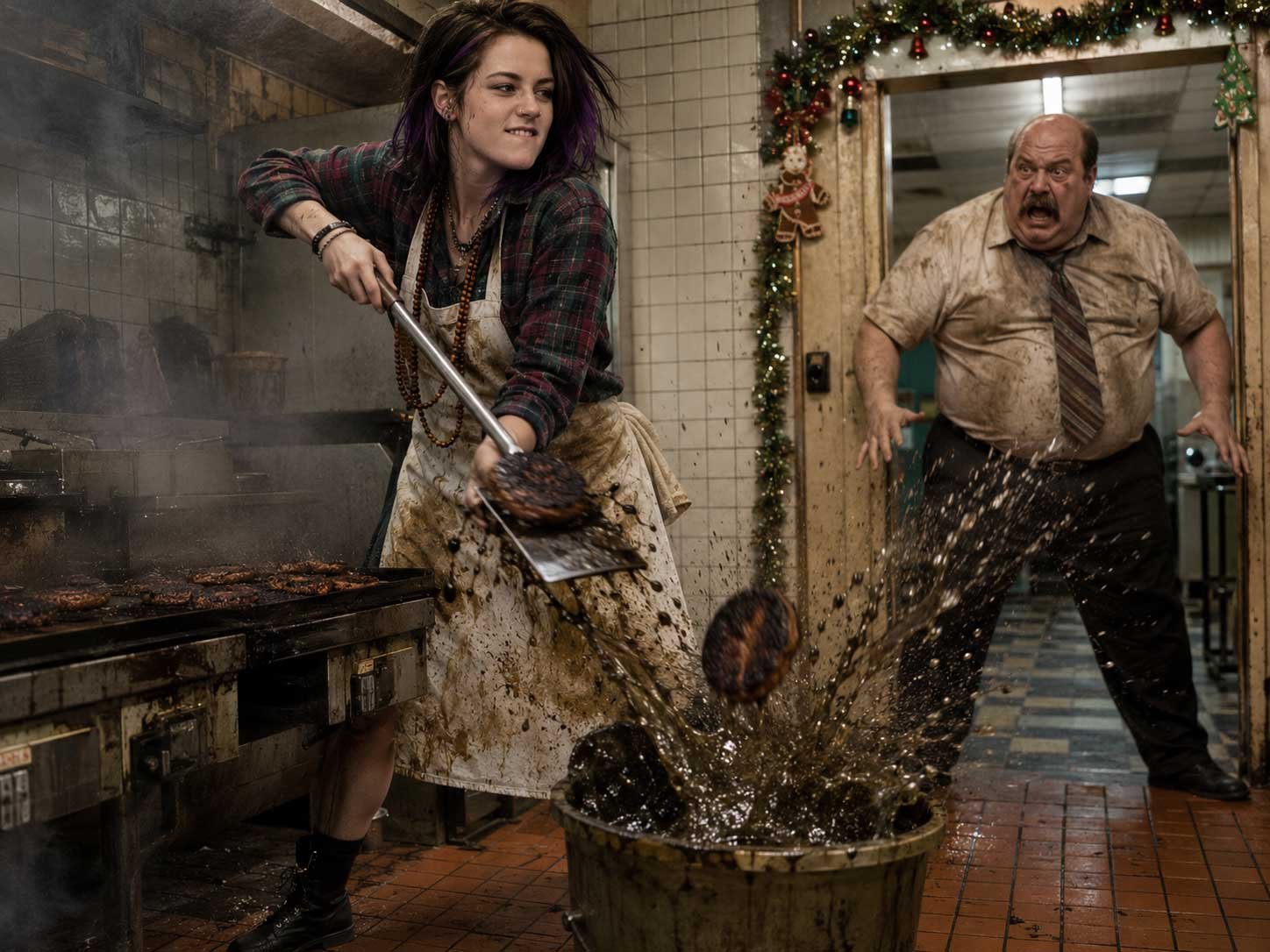
Then Pete Gardner makes the mistake of pushing her too far. The confrontation escalates fast. Pete yells about the burned burgers. Caroline corrects his grammar because even in the middle of a workplace meltdown, she cannot resist. Pete insults her. Caroline explodes. Then comes the Burger Empire moment that should be preserved in the official lore record:
Caroline flips the row of burgers into a dirty mop bucket. It is disgusting. It is ridiculous. It is glorious.
Dirty water splashes Pete in the face. Caroline smiles, removes her filthy apron, balls it up, and chest-passes it to him. Pete, still clinging to the absurd motivational hierarchy of his greasy kingdom, yells that this is not how one becomes Employee of the Month.
Caroline responds with the only appropriate resignation letter:
“Fuck you and fuck the Employee of the Month. I quit!”
It is not a subtle exit. But Caroline Friday is not built for subtle exits.

The Door and the Cold
The scene could have ended with Caroline storming through the dining room.
Instead, it follows her outside.
That is where Burger Empire becomes more than a comic workplace disaster. The holiday bells ring, and Caroline steps outside for the last time into a bitter Pittsburgh afternoon. The wind punishes her face. Her hair whips in the cold. She folds her arms around herself in her flannel shirt and glares at the world.
Then she sees Unalco World Headquarters in the distance.
The building catches rare winter sunlight, shining above the old and tired North Side. It is only about a mile away geographically, but to Caroline it feels a million miles from Burger Empire.
That contrast is the key to the entire scene.
Burger Empire is where Caroline is. Unalco is where the larger story is waiting. She does not know that yet. She only sees a modern glass-and-metal tower and thinks it must be nice to work somewhere like that. She cannot possibly understand how close she is standing to the machinery that will eventually pull her into the center of the Midas Files mythology.
That is dramatic irony at its best. The reader may not know everything either.
But the story knows.
The Bus Back to Starting Over
After quitting Burger Empire, Caroline hears the pneumatic sigh of a bus door opening and sees diesel exhaust drifting into the cold air. It is the bus back to the North Hills. The bus back to Fridellio’s Pizzeria. The bus back to starting over. That line is important because it turns an ordinary bus ride into a symbolic transition.
Caroline has not solved her life. She has no grand plan. She has just quit a job she needed, spent her last change, and boarded an empty bus while the same awful holiday song follows her from the restaurant into the next phase of her day.
But she has moved. That is the first victory. In many stories, the heroic journey begins with a call to adventure. In Caroline’s case, it begins with burned burgers, a dirty mop bucket, and a bus ride away from the worst job she has ever had. That feels right for her. Caroline Friday does not step into destiny with a sword in her hand.
She steps into the cold with grease on her clothes and rage in her lungs.
Burger Empire as Anti-Mythology
One of the reasons Burger Empire works so well as a Midas Files location is that it is almost aggressively unmythic.
The name “Burger Empire” sounds grandiose, but the actual place is small, dirty, and pathetic. That contrast makes it funny, but it also fits the series. The Midas Files often places cosmic ideas inside very grounded, very human settings: Pittsburgh streets, family restaurants, old houses, offices, diners, newsrooms, and ordinary rooms where extraordinary secrets are hiding in plain sight.
Burger Empire is part of that tradition.
It reminds us that characters do not begin as icons. They begin as people with bad jobs, family frustrations, unpaid bills, lousy bosses, and nowhere obvious to go.
That grounding matters. Without Burger Empire, Caroline’s later involvement in the larger story would feel less rooted. We need to see her before the conspiracy, before the romance, before the danger, before she becomes the person who can stand inside the storm of the Midas Files and still talk back to it.
Burger Empire gives us Caroline at the bottom.
Which makes everything after it feel earned.
The Pittsburgh Geography of Ambition
The physical placement of Burger Empire also matters.
It sits on the old North Side, near enough to Unalco’s headquarters that Caroline can see the tower from the street. That image carries a very Pittsburgh kind of class and geography tension: old neighborhoods, tired buildings, modern corporate power, buses, bridges, winter skies, and the feeling that opportunity can be close enough to see but still impossibly far away.
For Caroline, Unalco is not yet a conspiracy node. It is aspiration.
It is a clean building in the sunlight. It is what the world looks like from the outside when you are broke, cold, angry, and wearing clothes that smell like burned meat. The cruel joke, of course, is that the bright tower may not be any cleaner than Burger Empire. It is simply better at hiding the grease.
That is very much the world of The Midas Files. The low places are honest about their grime. The high places polish theirs into glass.
Why Burger Empire Matters
Burger Empire matters because it introduces Caroline Friday through action, attitude, and environment and we learn a lot:
- We learn she is sharp.
- We learn she is angry.
- We learn she is funny.
- We learn she is restless.
- We learn she hates being diminished.
- We learn she would rather blow up a bad situation than quietly accept humiliation.
- We learn she is trying to become independent, even if she is not yet good at it.
Most importantly, we learn that Caroline moves.
She may not know where she is going. She may not even know what she wants. But when a place becomes too small for her, she leaves. That instinct will matter later. In a series filled with hidden rooms, secret programs, ancient powers, and people trapped by forces they barely understand, Caroline’s first great act is simple:
She refuses to stay at the grill.
Story Function
From a storytelling standpoint, Burger Empire serves several functions. First, it gives Caroline a grounded introduction. She is not introduced through exposition, destiny, or a résumé. She is introduced through a bad day. Second, it establishes her voice. Her thoughts are sarcastic, profane, observant, and self-aware. She can be unfair, but she is rarely dull.
Third, it gives the reader a clear class and setting contrast. Burger Empire and Unalco are separated by only a mile, but emotionally they belong to different worlds. Fourth, it creates momentum. Caroline quits, steps outside, sees the larger world, and boards a bus. The scene physically moves her out of one life and toward whatever comes next. Finally, it shows that the Midas Files mythology does not only belong to secret councils and impossible artifacts. It also belongs to people who have no idea they are standing near the edge of it.
Symbolic Significance
Burger Empire represents the life Caroline refuses.
Not because honest work is beneath her. That is not the point. The point is that Burger Empire is a place where she is being reduced: to a bad employee, a stained apron, a body in a kitchen, a problem for Pete Gardner to yell at, another name not worth putting on the Employee of the Month board.
Caroline’s walkout is messy, immature, funny, and maybe financially unwise.
It is also necessary. Sometimes the first step toward a larger destiny looks irresponsible from the outside. Sometimes quitting the wrong thing is the only way to begin finding the right one. Burger Empire is the place where Caroline’s frustration becomes motion. That is why it deserves a place in the notebook.
Closing Note from Bingham’s Notebook
Burger Empire may never appear on a map of ancient power. No one is likely to excavate its fryers for Evium residue. The Universal Temporal Council is not convening an emergency session over the mop bucket. The Gold Box does not glow beneath the break room. At least, probably not.
But lore is not only about the biggest objects in a story. Sometimes lore is about the small places where characters make the choices that start changing them.
Burger Empire is one of those places.
It is greasy, ugly, funny, miserable, and deeply human. It gives us Caroline Friday before she becomes part of the larger Midas Files storm. It shows her stuck, furious, underpaid, underestimated, and one insult away from detonating.
Then she does.
And when the holiday bells ring behind her for the last time, Caroline steps out into the cold Pittsburgh air with no job, no plan, and no idea that the world waiting for her is stranger than anything inside Burger Empire. All she knows is that she is done. For Caroline Friday, that is enough.
Author’s Lore Note
As with many entries in Bingham’s Notebook, this article blends established story material with author commentary, character interpretation, and developing lore.
Burger Empire is a minor location in The Midas Protocol, but it serves an important purpose in Caroline Friday’s character introduction. It shows her before the larger mythology fully claims her, and it places her in a grounded Pittsburgh world of work, frustration, class tension, and restless ambition.
Consider this entry a page from the notebook: not every important door is hidden inside an ancient temple. Some of them are attached to greasy fast-food restaurants with holiday bells.
Filed Under: Locations, Caroline Friday, Pittsburgh, The Midas Protocol, Character Origins
Related Entries: Caroline Friday, Unalco World Headquarters, The North Side, Fridellio’s Pizzeria
First Appearance: The Midas Protocol
Spoiler Advisory: This entry discusses early character material from The Midas Protocol.
About the Author
 Matt De Reno
Matt De Reno is the author of The Midas Files, a Pittsburgh-rooted science-fiction thriller series exploring ancient power, impossible technology, hidden history, and the people caught in between. In Bingham’s Notebook, he opens the files behind the fiction—examining characters, artifacts, locations, chapter connections, and the evolving mythology of the series. Email him at