
Every once in a while, ancient technology makes modern technology look a little less impressive.
Not because the Romans had electricity, computers, satellites, AI, or anything we would recognize as modern machinery. They did not. That is not the point. The point is that they understood systems. They understood infrastructure. They understood that power is not always a weapon or a throne. Sometimes power is water arriving exactly where it needs to arrive, day after day, mile after mile, without a motor in sight.
The Roman aqueduct system fascinates me because it feels like one of those ancient technologies we think we understand until we stop and really think about it.
Water moved across valleys, through tunnels, over bridges, under cities, into fountains, baths, households, and public buildings. Not by pumps. Not by electricity. Not by some hidden engine.
Gravity did the work.
Rome simply built the machine that let gravity serve the empire.
The Signal
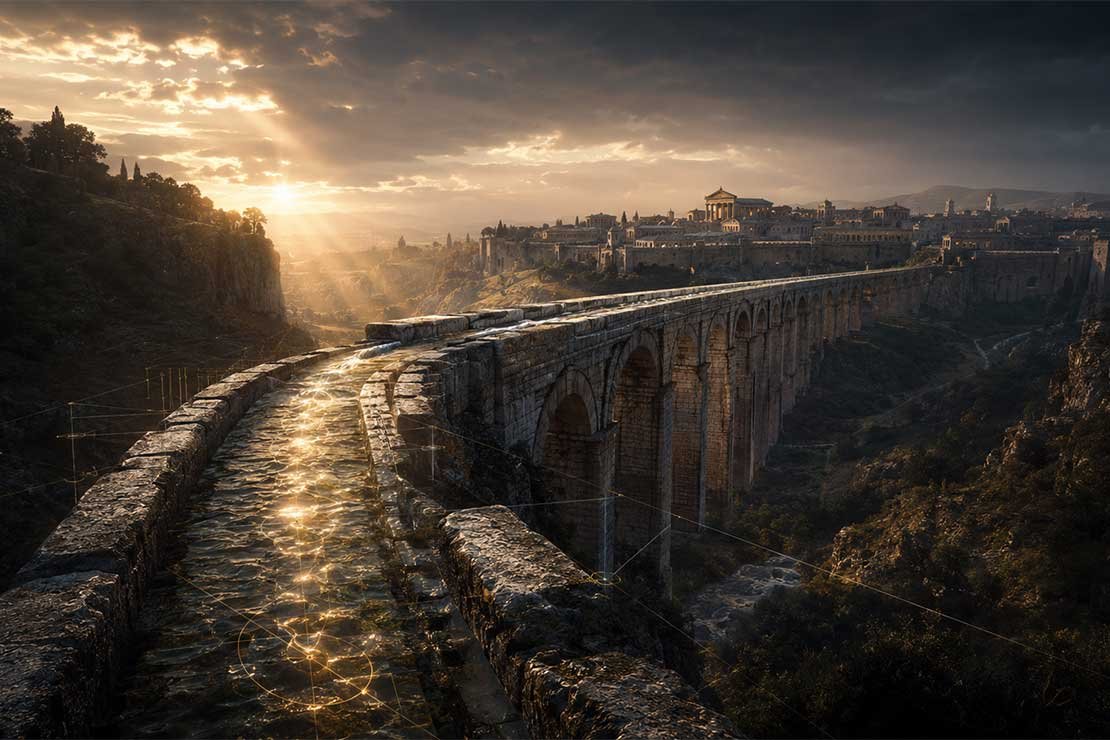
The image most of us have of a Roman aqueduct is a long line of stone arches marching across the landscape. That image is not wrong, but it is incomplete. The arches were the dramatic part, the part that survived as postcard and ruin. The real system was larger, quieter, and more precise: channels, tunnels, settling tanks, bridges, pipes, distribution basins, maintenance crews, legal controls, and carefully engineered gradients.
The aqueduct at Pont du Gard in southern France is one of the best surviving examples. UNESCO describes it as the major element of a roughly 50-kilometer aqueduct built in the middle of the first century to supply Nîmes, then the Roman colony of Nemausus, from a source near Uzès. The bridge itself rises nearly 49 meters and allowed the water channel to cross the Gardon River.
The most astonishing part may not be its height, but its restraint. The U.S. Geological Survey notes that the vertical drop from the highland source to Nîmes was only 56 feet. Over that distance, Roman engineers had to make water fall just enough to keep moving, but not so sharply that it damaged the system or became uncontrollable.
That is the hidden magic of the aqueduct: not force, but precision.
National Geographic puts the broader Roman system in perspective, noting that the city of Rome alone had around 11 aqueduct systems bringing freshwater from sources as far as 92 kilometers away. This was not a decorative achievement. It was a living network. It helped feed urban life, public baths, fountains, sanitation, and the Roman obsession with making a city feel like the center of the world.
The empire did not merely conquer territory. It engineered flow.
Why It Matters
Modern people tend to think of technology as something that hums, glows, charges, updates, or asks us to accept new terms of service.
The aqueduct reminds us that technology can also be a slope.
That sounds almost too simple, but it is not. Moving water by gravity over long distances requires surveying, mathematics, materials knowledge, labor organization, legal authority, maintenance planning, and a deep understanding of terrain. Build the channel too flat, and the water stagnates. Build it too steep, and the flow becomes destructive. Misjudge the landscape, and the whole system fails. Neglect maintenance, and mineral deposits, leaks, sabotage, storms, or theft slowly eat the machine from the inside.
A scholarly review on ancient Rome’s water supply points out that aqueduct design had to account not only for water flow, but also for human access and maintenance. In other words, the Romans did not merely build channels for water. They built systems people could inspect, repair, regulate, and keep alive.
That may be the most modern thing about them.
An aqueduct was not just an object. It was infrastructure, and infrastructure is never just construction. It is administration. It is maintenance. It is policy. It is surveillance. It is money. It is labor. It is the quiet agreement that civilization depends on things most citizens never see and only notice when they stop working.
The Romans knew this. Sextus Julius Frontinus, appointed by Emperor Nerva in 97 A.D. as curator aquarum, or head of Rome’s water supply, wrote a treatise known as De aquaeductu urbis Romae — The Water Supply of the City of Rome. Frontinus dealt not only with engineering, but also with measurement, distribution, fraud, illegal diversion, repairs, and the laws surrounding the system. One modern study notes that when Frontinus took office, he found substantial illegal diversions from the aqueducts.
That detail is wonderfully human.
Even in ancient Rome, somebody was stealing from the system.
The TechGnosis Angle
This is where aqueducts become perfect TechGnosis material.
They are not strange because they are mysterious in a supernatural way. They are strange because they reveal a kind of intelligence embedded into the landscape. Once built, the aqueduct became a silent machine stretched across miles of countryside. Hills, valleys, stone, water, law, and labor were all folded into one operating system.
The Romans did not defeat gravity. They recruited it.
That may be the deeper lesson. So much modern technology is built around overpowering nature: burning fuel, forcing pressure, extracting speed, pushing electrons, accelerating everything. The aqueduct feels different. It is technology as negotiation. It works because the engineers listened to the land carefully enough to make the land do the work.
There is something almost eerie about that. A Roman citizen might stand at a fountain in the city and see fresh water arrive as if by civic miracle. But somewhere far away, a spring had been captured. A channel had been cut. A tunnel had been bored. A bridge had crossed a valley. A maintenance crew had cleared a blockage. A magistrate had enforced a rule. A hidden gradient had quietly pulled the whole thing forward.
That is the ghost in the ancient machine.
Not electricity.
Gravity.
Fragile Systems, Ancient Edition
The more I think about Roman aqueducts, the more they feel like an ancient version of every fragile system we depend on now.
Today we talk about power grids, data centers, broadband networks, satellites, water treatment plants, and supply chains. We use them constantly and almost never think about them. The Romans had their own version of that hidden dependency. Aqueducts made urban luxury possible, but they also created a need for constant upkeep.
This is the part that makes the aqueducts more interesting than the usual “ancient engineering was amazing” story. The system was impressive because it worked, but also because it had to keep working. Infrastructure is never finished. It is either maintained or it becomes archaeology.
That is a sentence worth sitting with.
Infrastructure is either maintained or it becomes archaeology.
The ruins of aqueducts are beautiful now, but in their own time they were not meant to be romantic. They were utility. They were function. They were plumbing on an imperial scale. Their beauty came partly from the Roman refusal to separate usefulness from grandeur.
Even today, Pont du Gard does not look like a mere bridge. It looks like a statement: the empire can make water cross a valley.
The Midas Files Echo
This one naturally echoes The Midas Files for me because the series is built around the idea that hidden systems shape visible history.
The aqueduct is a perfect real-world version of that idea. It is not a magic artifact. It is not an alien machine. It is not a lost superweapon. It is something better for TechGnosis: a real ancient system that feels almost impossible when you understand the precision behind it.
In The Midas Files, ancient places and old mechanisms often carry more than symbolic weight. They are reminders that the past is not dead machinery. Sometimes it is machinery we forgot how to read.
Roman aqueducts create that same feeling. They suggest that civilization is not only made of kings, wars, speeches, and monuments. It is made of gradients. It is made of channels. It is made of maintenance crews and water rights and stone arches and the quiet confidence that tomorrow morning, the fountain will still run.
That is what fascinates me most.
The Romans built a machine out of landscape, law, and gravity.
Then they let the water prove the empire was real.
Read and Explore the Sources
For a strong visual starting point, UNESCO’s page on Pont du Gard explains the scale and significance of the aqueduct bridge and its role in the 50-kilometer system that supplied ancient Nîmes.
The U.S. Geological Survey has a short, useful explanation of how aqueducts use gravity, including the remarkable note that the source-to-destination drop for the Nîmes aqueduct was only 56 feet.
National Geographic’s overview of Roman Aqueducts is a good accessible introduction, especially for the broader point that Rome itself had around 11 aqueduct systems supplying water from distant sources.
For a deeper technical dive, the scholarly article “The Aqueducts and Water Supply of Ancient Rome” discusses sources, maintenance, distribution, and what we know from archaeological evidence and ancient writers such as Frontinus and Vitruvius.
For primary-source flavor, explore Frontinus’ De aquaeductu urbis Romae, written by the man appointed to oversee Rome’s water supply in 97 A.D. The Frontinus Society provides helpful background, and LacusCurtius hosts English translations for readers who want to go closer to the original ancient source.