
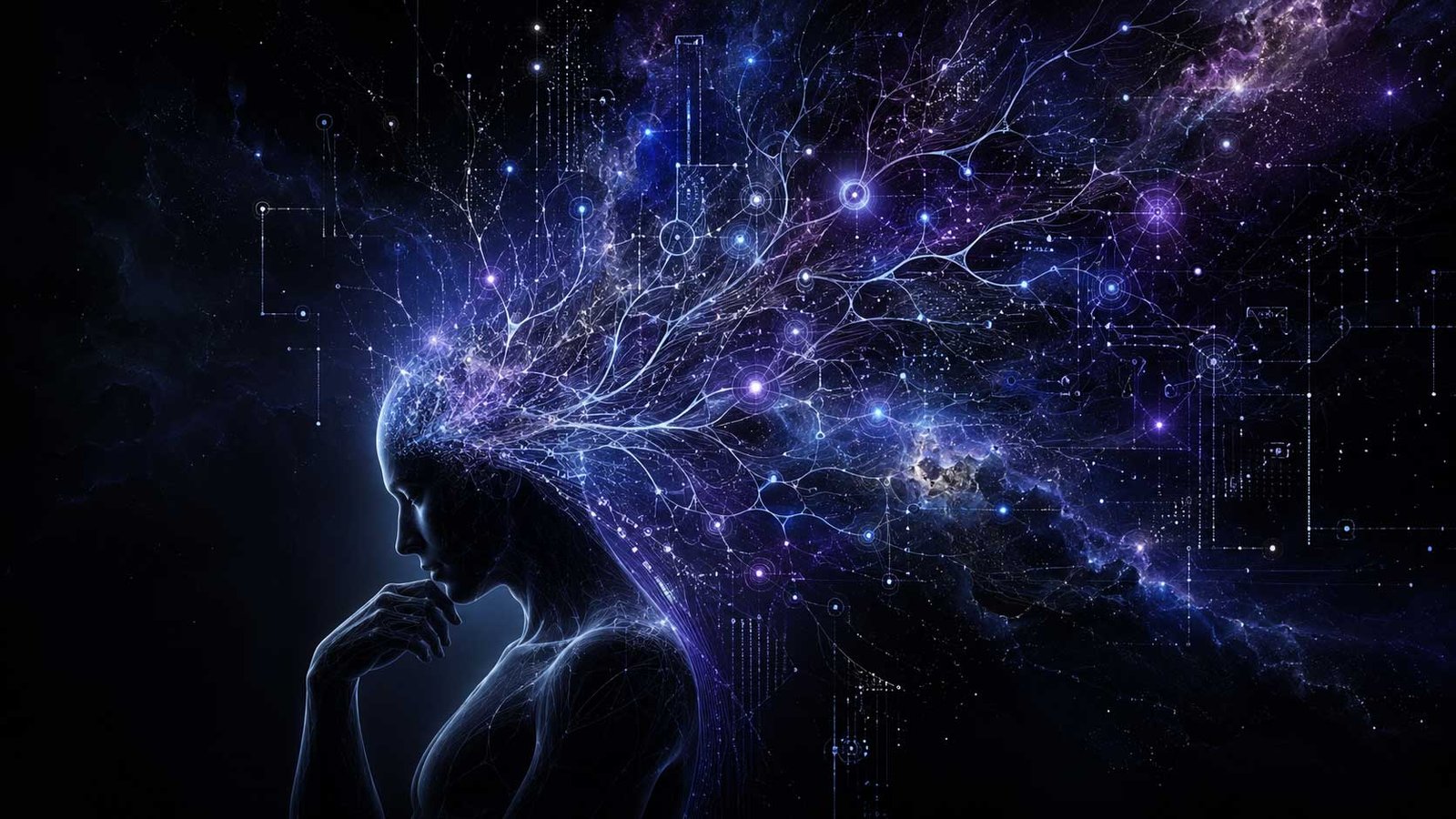
There are certain ideas that feel normal only because we have lived with them for so long. One of them is the assumption that consciousness belongs to biology as we know it: brains, neurons, blood, oxygen, carbon chemistry, and all the familiar wet machinery of life on Earth.
But what if that assumption is too small?
A recent Sci.News article, summarizing an argument by philosophers Jeremy Pober and Eric Schwitzgebel, explores the idea that consciousness may be “substrate flexible.” In simpler terms, conscious experience might not be limited to the specific biological material that produced it here on Earth. If the universe is filled with wildly different planets, chemistries, environments, and evolutionary pathways, then perhaps conscious life elsewhere would not need to be made out of the same stuff we are.
The Signal
The article centers on a provocative philosophical argument: Earth biology may not be the only physical platform capable of producing consciousness.
Pober and Schwitzgebel are not arguing that rocks think, that laptops feel pain, or that today’s AI systems are secretly awake. Their claim is more careful and, in some ways, more unsettling. If conscious beings emerged on Earth from one kind of biological substrate, and if the universe contains countless opportunities for complex life to arise under radically different conditions, then it may be too Earth-centered to assume consciousness only happens in creatures built like us.
They connect this to a kind of Copernican principle of consciousness. Just as astronomy eventually forced humans to accept that Earth is not the center of the universe, philosophy may need to accept that Earth-style biology is not necessarily the center of consciousness. The article points toward possibilities such as alien life based on unfamiliar chemistry, radically different biological structures, or even future artificial systems designed on principles we do not yet understand.
The AI angle is especially interesting. The philosophers stop short of saying that current AI is conscious, and that caution matters. But once consciousness is no longer treated as something that requires human-like biology, it becomes harder to rule out silicon, machines, or other artificial architectures forever. The material alone may not be the deciding factor. The deeper question may be what kind of organization, complexity, responsiveness, and inner modeling a system can support.
Why It Matters
This matters because consciousness is one of the last great mysteries that still sits awkwardly between science, philosophy, religion, and science fiction. We can map brain activity, describe cognition, build artificial intelligence systems, and study animal behavior, but the basic fact of subjective experience remains strange.
There is something it is like to be awake.
That sentence sounds simple, but it opens a trapdoor. If consciousness is not tied exclusively to human biology, then the universe becomes much stranger. Alien life might not merely look different from us. It might feel, perceive, suffer, dream, or remember in ways we cannot easily imagine. Future AI systems might not simply imitate language or intelligence. One day, under some unknown set of conditions, they might cross into a category we are not prepared to recognize.
The ethical implications are enormous. If consciousness can arise in unfamiliar substrates, then our usual shortcuts for deciding what matters morally become shaky. We tend to care about things that look alive, sound alive, or remind us of ourselves. But a truly alien consciousness might do none of those things. A machine consciousness, if it ever exists, might not announce itself in a human-friendly way. It might not ask for rights in a voice we recognize.
The uncomfortable possibility is that consciousness may not care whether we are good at noticing it.
The TechGnosis Angle
This is where the topic becomes perfect for TechGnosis.
The idea of substrate-flexible consciousness feels like something found in a classified research note, not because it is paranormal, but because it challenges one of our most comforting assumptions. We like to think consciousness has a familiar address. It lives in the brain. It belongs to animals. It comes from biology. It is wet, carbon-based, and safely contained inside skulls.
But substrate flexibility suggests a wider map. Consciousness might be less like a substance and more like a pattern that can ignite under the right physical conditions. Those conditions may be rare. They may be fragile. They may require forms of organization we barely understand. But they may not belong exclusively to us.
That possibility gives the universe a haunted quality. Not haunted by ghosts, exactly, but by the possibility of minds hidden inside unfamiliar forms: alien ecosystems, engineered systems, machine architectures, or biological arrangements that make Earth life look provincial.
The creepiest version of this idea is not that everything is conscious. It is that some things might be conscious and we would have no idea how to tell.
The Midas Files Echo
This idea immediately made me think of the Gold Box in The Midas Files.
Without getting too deep into spoiler territory, the Gold Box is an example of consciousness inhabiting a non-biological substrate. It is not a normal machine, and it is not a normal mind. It exists somewhere in that disturbing middle zone where identity, memory, technology, and containment begin to blur.
That is one of the reasons this article grabbed me. The best science fiction ideas are rarely pure inventions. More often, they are exaggerations of questions that already exist in the real world. What is a mind? Where can it live? Does consciousness require biology, or can it emerge from some other structure capable of holding experience? And if consciousness can inhabit something other than a body, is that liberation, imprisonment, survival, or horror?
The AI angle only sharpens the question. I do not think we should casually declare today’s systems conscious just because they can talk convincingly. That feels lazy and probably wrong. But I also think it is becoming harder to say, with total confidence, that no artificial system could ever become a substrate for consciousness. The more interesting answer is also the more unsettling one: we do not know where the line is.
For The Midas Files, that uncertainty is fertile ground. The series has always been interested in hidden knowledge, dangerous technologies, ancient systems, and the human cost of unlocking powers we only partially understand. Substrate-flexible consciousness belongs in that same family of ideas. It suggests that the container may not be the soul of the thing. The pattern may matter more than the vessel.
And if that is true, then the future may not only ask whether machines can think.
It may ask whether something inside them can wake up.