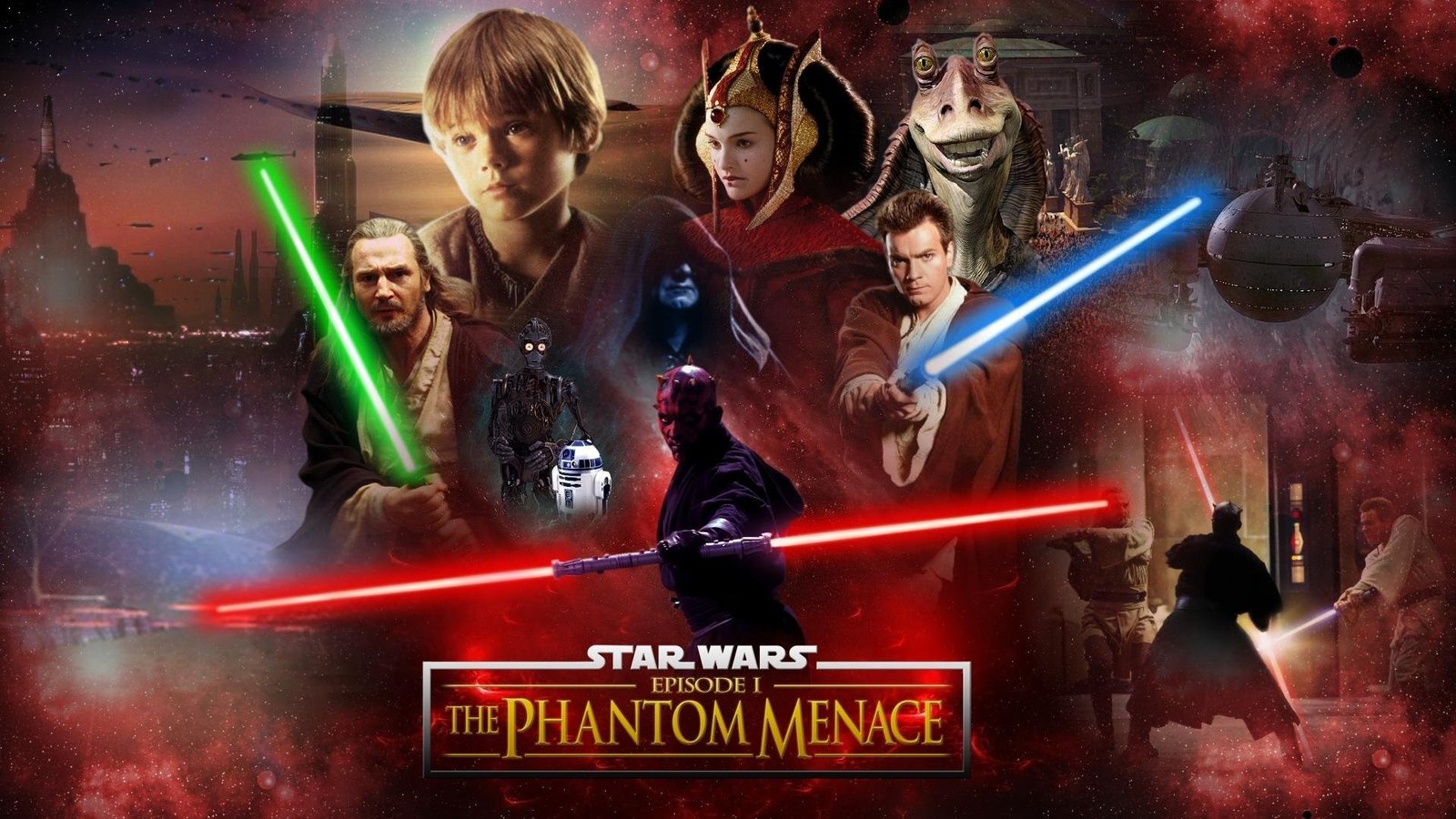
I am ready to reconsider my opinion of Star Wars: Episode I — The Phantom Menace.
When it was released in 1999, I found it deeply underwhelming. My expectations were somewhere beyond the Outer Rim. This was the first new Star Wars movie in more than a decade, and I wanted to be transported back to the feeling of the original trilogy. Instead, I got trade disputes, a lot of young Anakin Skywalker, and Jar Jar Binks.
For years, I treated The Phantom Menace as a disappointment. I would revisit it occasionally, hoping it might improve with time, but it never quite worked for me. Then something strange happened. After watching more of the broader Star Wars universe — The Clone Wars, Rebels, the Disney sequels, Rogue One, Solo, and everything that came after — I found myself seeing Episode I differently.
I still do not think it is a great movie. But I now think it is a more important and interesting movie than I gave it credit for.
Cool Filmz deals The Phantom Menace a Queen.
At a Glance
Title: Star Wars: Episode I — The Phantom Menace
Director: George Lucas
Writer: George Lucas
Cast: Liam Neeson, Ewan McGregor, Natalie Portman, Jake Lloyd, Ian McDiarmid, Ray Park
Genre: Science Fiction / Space Opera
Release Year: 1999
Cool Filmz Rating: Queen — 3 out of 5 stars
Why My Opinion Changed
The biggest reason The Phantom Menace works better for me now is context.
Back in 1999, the movie had to carry the impossible burden of being the first new Star Wars film since Return of the Jedi. It was not just a movie. It was an event, a generational expectation, and maybe no film could have survived that much pressure.
Now, with decades of additional Star Wars storytelling behind us, The Phantom Menace feels less like a failed return and more like the opening movement in George Lucas’s larger prequel vision. It introduces the Republic before the fall. It shows the Jedi at the height of their institutional confidence. It gives us Palpatine’s quiet rise, Anakin’s origin, and the political machinery that will eventually collapse into the Empire.
In other words, it finally feels like part of the whole.
That does not erase the movie’s flaws, but it makes its purpose clearer.
The Prequels as a Bridge
The prequel trilogy now functions as a bridge between the original trilogy and everything that followed. At the time, many of us struggled to see how these movies served the larger saga. The tone felt different. The politics felt stiff. The characters were not always easy to love.
But after seeing how The Clone Wars expanded Anakin, Obi-Wan, the Jedi Order, Darth Maul, and the fall of the Republic, the prequels feel more meaningful. They are no longer just three uneven movies. They are the foundation for an entire era of storytelling.
That expanded context helps The Phantom Menace enormously. The film introduces pieces that later stories develop far more effectively: the arrogance of the Jedi, the fragility of the Republic, the mystery of the Sith, and the tragedy of a gifted child pulled into forces he does not understand.
In 1999, I mostly saw what did not work. Now I can see what Lucas was building.
What Still Does Not Work
Let’s not get carried away.
Jar Jar Binks has not magically become a great character for me. The comic relief still feels too broad, too constant, and too disconnected from the tone I want from Star Wars. I understand what Lucas was trying to do, and I can even respect the ambition behind creating a fully digital comic character, but the result remains rough.
Young Anakin is also a challenge. Jake Lloyd was given an almost impossible job: play the childhood version of one of cinema’s most iconic villains while also being cute, innocent, and central to the plot. The problem is not simply the performance. It is the concept. Starting Anakin so young makes the movie feel oddly distant from the emotional tragedy we know is coming.
The political material is also more interesting in theory than in execution. Trade disputes, Senate procedure, and bureaucratic paralysis are all important to Palpatine’s rise, but the movie often struggles to make that material feel dramatically alive.
So no, The Phantom Menace has not become a hidden masterpiece. It still has problems.
But it also has more strengths than I once admitted.
What Works Better Now
Ewan McGregor is excellent as young Obi-Wan Kenobi. Even in this first prequel, he creates a believable bridge to Alec Guinness while still making the role his own. His Obi-Wan is younger, sharper, and not yet the weary old Jedi we meet in A New Hope, but the connection is already there.
Liam Neeson’s Qui-Gon Jinn has also aged well as a character. He brings a calm, independent presence to the film, and his willingness to challenge the Jedi Council now feels more important than it may have seemed at the time. Qui-Gon sees something in Anakin that others either miss or fear, and that choice sets the entire saga in motion.
Darth Maul remains one of the coolest visual creations in Star Wars. The makeup, the presence, the double-bladed lightsaber, and Ray Park’s physical performance all give him immediate impact. If anything, the biggest problem is that the movie does not use him enough. Thankfully, later stories found ways to bring Maul back and make him far more than a great design.
The worldbuilding is also stronger than I remembered. Naboo, Coruscant, the Jedi Temple, the Senate, the underwater Gungan city, and the polished surfaces of the Republic all show us a galaxy before everything becomes worn down by war and empire. That contrast matters. The prequels show us what was lost.
The Duel Still Delivers
The lightsaber duel between Qui-Gon, Obi-Wan, and Darth Maul remains the high point of the film.
“Duel of the Fates” does a lot of the heavy lifting, of course. John Williams gives the scene mythic weight before anyone even swings a lightsaber. But the choreography, pacing, and visual energy are still excellent. It feels ceremonial and dangerous at the same time.
More importantly, the duel now carries greater story significance. At first, it may seem like a cool fight with a cool villain. But in the larger saga, the outcome matters enormously. Qui-Gon’s death leaves Anakin to be trained by Obi-Wan, who is noble and capable but not ready to be the father figure Anakin needs.
That turns the duel into one of the most important hinge points in the entire Skywalker saga.
The George Lucas Factor
One thing I appreciate more now is that The Phantom Menace is unmistakably George Lucas’s vision.
For better and worse, it is not a safe movie. It is strange, political, earnest, visually ambitious, and deeply interested in the mechanics of how democracies decay. It does not simply repeat the original trilogy, even though many fans probably wanted exactly that.
The Disney sequels, especially The Force Awakens, are far smoother from a modern blockbuster standpoint. But they often feel more like remixes of familiar Star Wars beats. The Phantom Menace, whatever its flaws, is trying to expand the mythology in a different direction.
That makes it more interesting to me now.
I may not love every choice Lucas made, but I respect the fact that he made choices. The movie has an identity. It has ideas. It has a place in the saga.
Final Thoughts
The Phantom Menace is still not one of my favorite Star Wars films. It is uneven, sometimes clumsy, and burdened by choices that do not fully work. But I no longer see it as the disaster I thought it was in 1999.
Time has helped it. The animated series helped it. The larger Star Wars universe helped it. Most of all, the completion and expansion of the saga helped reveal what The Phantom Menace was trying to do.
It introduces a galaxy before the fall. It shows the Jedi before their failure. It gives us the first moves in Palpatine’s long game. It plants Anakin at the center of a tragedy that will reshape everything.
That is worth something.
Cool Filmz gives The Phantom Menace a Queen. Not a King. Definitely not an Ace. But a respectable Queen for a flawed movie that has aged into something more meaningful than I expected.
Maybe that is the real surprise. The movie did not change.
The galaxy around it did.