

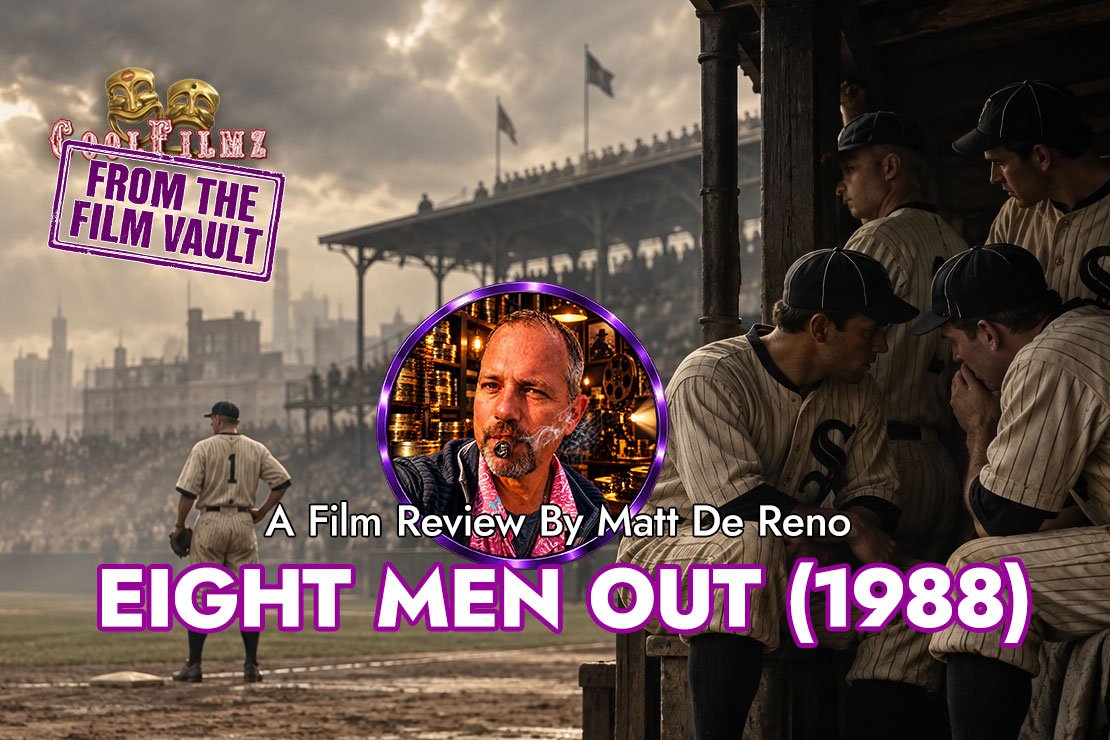
Throwing a baseball game sounds easy enough until you ask somebody who has spent his whole life trying to win to go out there and do it. That was what interested me most about Eight Men Out when I reviewed it for Cover-Ups.com on May 10, 2007. The gamblers, the money and the conspiracy got me in the door. Watching the players struggle with what they had agreed to do was what kept me watching.


The film gives us an owner, Charles Comiskey, who could make opening his wallet look like major surgery. Its story about pitcher Eddie Cicotte being denied a chance at a thirty-win bonus is particularly effective at making you understand the resentment. It also needs a qualification in this archive visit: baseball researchers have challenged that familiar story, so it belongs here as the movie’s version of events, not an established explanation for the scandal. Understanding the grudge in the drama is one thing. Treating every scene as a historical document is another.
Sayles takes his time introducing the players and the world around them. There are enough faces and competing interests that I suggested you might need a scorecard to keep track of everybody. Which, considering they are a baseball team, might not be such a bad idea. Familiarity with the game certainly helps. Even Shoeless Joe Jackson can feel like one more person you are trying to locate in the crowd.
I did not think the crowded story ruined the movie, although my old review managed to defend its focus and complain about it in practically the same breath. Then I tried to blame the movie for my own wandering review. What a cheap cop-out. The fairer version is that Eight Men Out attempts a great deal, and I found some of it considerably more compelling than the rest.
It comes alive when the players take the field. These men have trained themselves to hit the ball, make the play and beat the other guy. Now money has entered the picture, and suddenly they are supposed to turn those instincts off. In the film, nobody seems particularly eager to be the one who looks terrible doing it. Let the pitcher hang a curveball. Let somebody else make the embarrassing mistake. Agreeing to lose is apparently easier than volunteering to look like you cannot play.
That is the tension I kept coming back to. The mechanics of the betting scheme interested me less than the business of asking a competitive athlete to fight his own nature. The movie lets you see the difference between talking yourself into a bad decision and carrying it out in front of a ballpark full of people. There is still a ball coming toward you. Your hands and feet remember what they are supposed to do.
John Cusack’s Buck Weaver gives that conflict a particularly sympathetic face. In the film’s telling, he will not help throw the games, and he keeps playing hard while the scandal gathers around him. D. B. Sweeney’s Jackson also figured prominently in my original reaction: I was struck by the contrast between the conspiracy and the effort I saw on the field. Those impressions describe the characters as the movie presents them. A good performance in a game does not, by itself, settle every question about a player’s involvement.
The aftermath makes the distinction between legal judgment and baseball’s judgment painfully clear. The accused players were acquitted in court, but commissioner Kenesaw Mountain Landis barred the eight from the game. The old review blurred those two processes together. Keeping them separate makes the ending’s frustration easier to understand without pretending the historical arguments are all settled.
I gave Eight Men Out three UFOs back then: pretty freaking good. That becomes a Queen in the Cool Filmz deck. My favorite part of the movie was never the bookkeeping of who promised what to whom. It was watching men discover that losing on purpose could be harder than they had imagined. As I wrote in 2007, the film was at its best when the players were on the field. That is where the deal stopped being an idea and somebody actually had to let the ball go by.
About the Author
 Matt De Reno
Matt De Reno has been watching, quoting, debating, and occasionally overthinking movies for most of his life. His favorites include Star Wars, The Godfather, James Bond, and a deep bench of action movies, thrillers, comedies, and cinematic oddities worthy of the CoolFilmz card table. Matt is also the author of The Midas Files, a Pittsburgh-rooted sci-fi thriller book series about hidden history, ancient power, secret technology, and whether humanity can handle the truth. Maybe one day it will become a film — and if it does, may it get dealt an Ace. Reach Matt at