

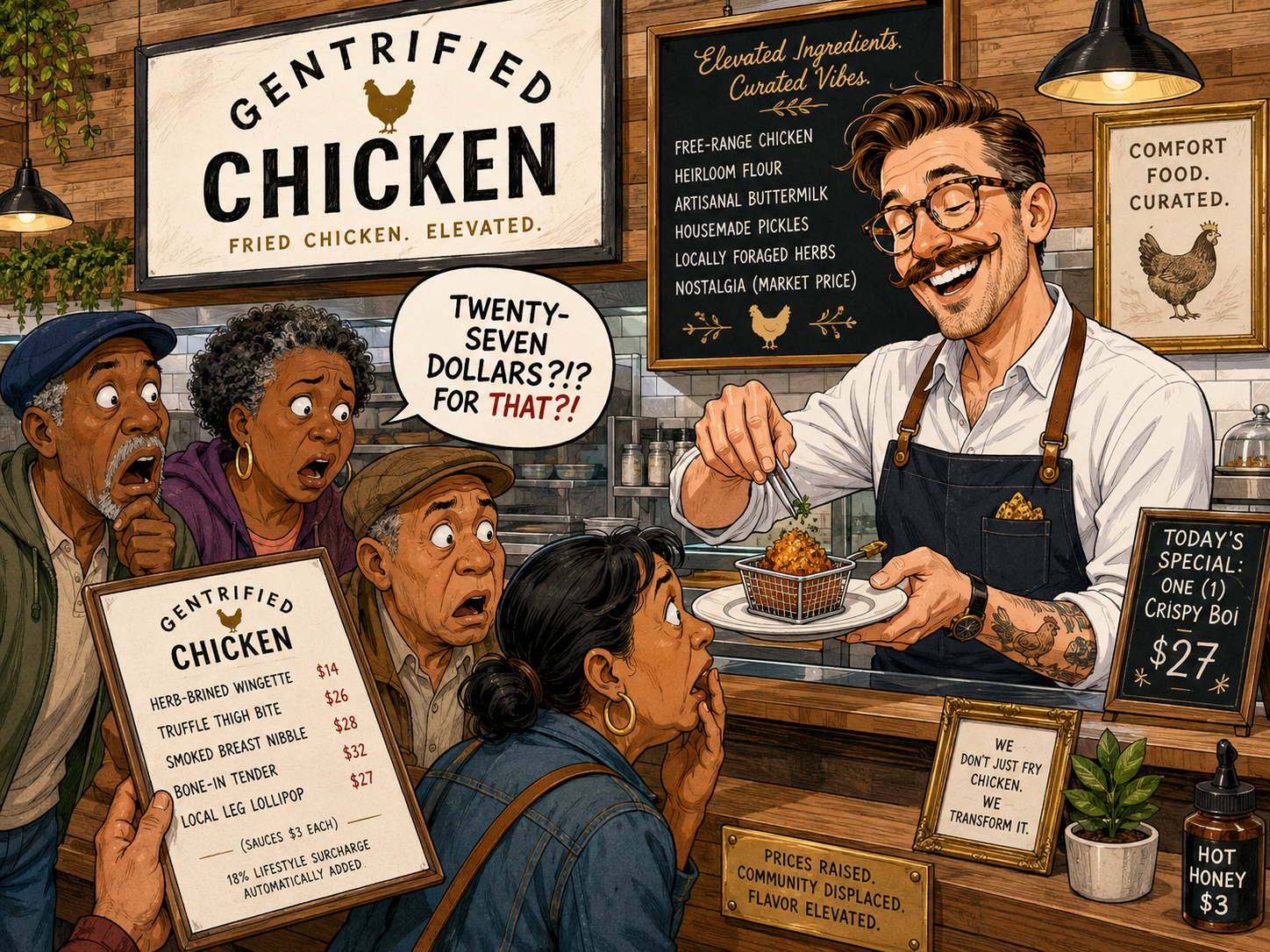
WILLIAMSBURG, N.Y. — Describing it as both a “personal calling” and “an enormous untapped market,” technology entrepreneur Preston Vale announced Monday that he is combating gentrification in Williamsburg with a new chain of luxury restaurants called Gentrifried Chicken.
Vale, the 39-year-old multimillionaire founder of the lifestyle-data startup Authenticly, said the restaurant will honor Williamsburg’s working-class history by selling fried chicken, macaroni and cheese, collard greens, and other traditional comfort foods at prices carefully calibrated to ensure that no working-class person can enter the building.
“This neighborhood gave me everything,” said Vale, who moved to Williamsburg from Connecticut four years ago after purchasing a converted pencil factory for $6.8 million. “The culture, the energy, the authenticity—it was all already here when I arrived. I felt a moral responsibility to preserve it, package it, trademark it, and roll it out across twelve markets.”
The restaurant’s signature entrée, the Heritage Three-Piece, includes one thigh, one wing, one “chef-selected ancestral cut,” and a small jar of reclaimed gravy for $34.
For an additional $11, customers can add a side of Displaced Greens, described on the menu as “locally disrupted collards finished with brown sugar, smoked paprika, and neighborhood memory.”
Vale said the concept is designed to solve two urgent problems at once: longtime residents can no longer afford to live in Williamsburg, while newer residents desperately want to feel as though they arrived before it became expensive.
“That’s where Gentrifried Chicken comes in,” Vale explained. “We’re creating a safe, curated environment where affluent customers can experience the emotional texture of a community without encountering anyone who might complicate that experience.”
According to Vale, the restaurant’s exposed brick walls, vintage cash register, mismatched chairs, and framed black-and-white photographs of unidentified neighborhood residents were all selected to evoke “the Williamsburg that existed before people like me discovered Williamsburg.”
One photograph depicts a family standing outside a corner grocery store in 1978. That grocery store is now a Scandinavian dog spa.
“I look at that picture every day,” Vale said. “It reminds me why our truffle biscuits cost $16.”
Giving Back by Taking Reservations
Vale emphasized that Gentrifried Chicken is not merely a restaurant. It is a “community-centered social impact platform” committed to making Williamsburg more affordable.
As part of that mission, the company will donate 0.5% of the proceeds from every $19 bourbon sweet tea to a nonprofit that helps longtime residents relocate to more affordable communities in Pennsylvania.
“We’re not just acknowledging displacement,” Vale said. “We’re providing moving boxes.”
The company will also reserve one table every Tuesday afternoon for “legacy neighborhood stakeholders,” provided they download the Gentrifried app, submit proof of residency dating back to 1995, agree to be photographed for promotional purposes, and purchase at least two entrées.
Vale called the program an important step toward “returning the community to the community.”
When asked why longtime residents could not simply receive discounted meals, Vale said such a policy would undermine the restaurant’s carefully cultivated sense of equality.
“We don’t see income,” he said. “We see customers and people standing outside looking at the menu.”
Authenticity You Can Taste
To ensure that Gentrifried Chicken remains faithful to the community’s roots, Vale assembled what he calls an “authenticity advisory board.”
The board consists of Vale, two venture capital executives, a food influencer from Los Angeles, a brand anthropologist, and a man named Curtis whom Vale met once while waiting for an Uber.
“Curtis told me his grandmother made fried chicken,” Vale said. “The moment he said that, I knew we had found our culinary north star.”
Curtis was later offered a consulting position paying $75 in restaurant credit.
The menu was developed by executive chef Théodore Blanc, whose previous restaurant served a single deconstructed clam inside a heated stone.
Blanc said the secret to Gentrifried Chicken is respecting traditional food while removing anything that might make customers feel heavy, uncomfortable, or insufficiently photographed.
“We have taken the essence of fried chicken and elevated it beyond chicken,” Blanc said. “Our birds are pasture-raised, emotionally supported, lightly massaged, and given the opportunity to review the seasoning blend before processing.”
Each order is served on a miniature aluminum tray lined with a reproduction of a 1986 eviction notice.
Customers may choose from several sauces, including Rent Stabilized Ranch, Hot Honey Equity, and Community Board Buffalo.
The restaurant does not accept cash.
Local Residents Welcome Restaurant’s Commitment to Local Residents
Reaction from longtime Williamsburg residents has been mixed, according to Vale, though he acknowledged that he has not personally spoken to any of them.
“I think there was initially some confusion,” he said. “A few people seemed upset when we replaced the laundromat. But once they understand that the laundromat’s original sign will remain inside the restaurant as décor, I think they’ll feel heard.”
The former owner of the laundromat, 68-year-old Elena Morales, confirmed that she had not been consulted about the project.
“I washed clothes there for thirty-two years,” Morales said. “Now they are selling a biscuit called ‘The Elena’ for twelve dollars.”
Vale said the menu item was intended as a tribute.
“We wanted Elena’s contribution to the neighborhood to live on,” he said. “And now it does, with whipped sorghum butter.”
Morales said she had not received any money from sales of the biscuit.
Vale responded that her compensation was “primarily cultural.”
Expansion Plans Already Underway
Following enthusiastic interest from investors, Gentrifried Chicken plans to open additional locations in Harlem, Bushwick, Bedford-Stuyvesant, Oakland, Portland, and any other neighborhood currently described by real estate agents as “emerging.”
Vale said each location will feature locally inspired menu items and a mural celebrating the people who previously occupied the building.
“We’re creating a scalable model for preserving neighborhood identity,” he said. “The faster a community changes, the more urgently we can monetize what disappeared.”
Authenticly recently closed a $140 million funding round to support the expansion. Investors reportedly valued Gentrifried Chicken at $800 million despite the company having sold only seventeen pieces of chicken.
Vale believes that valuation proves socially conscious capitalism can succeed.
“This really is a win-win,” he said. “We get to make an extraordinary amount of money, and our customers get to tell themselves they helped.”
At press time, Gentrifried Chicken had announced a new affordable housing initiative under which the company will convert four apartments above the restaurant into immersive, 48-hour “working-class Williamsburg experiences” available on Airbnb for $1,900 per night.