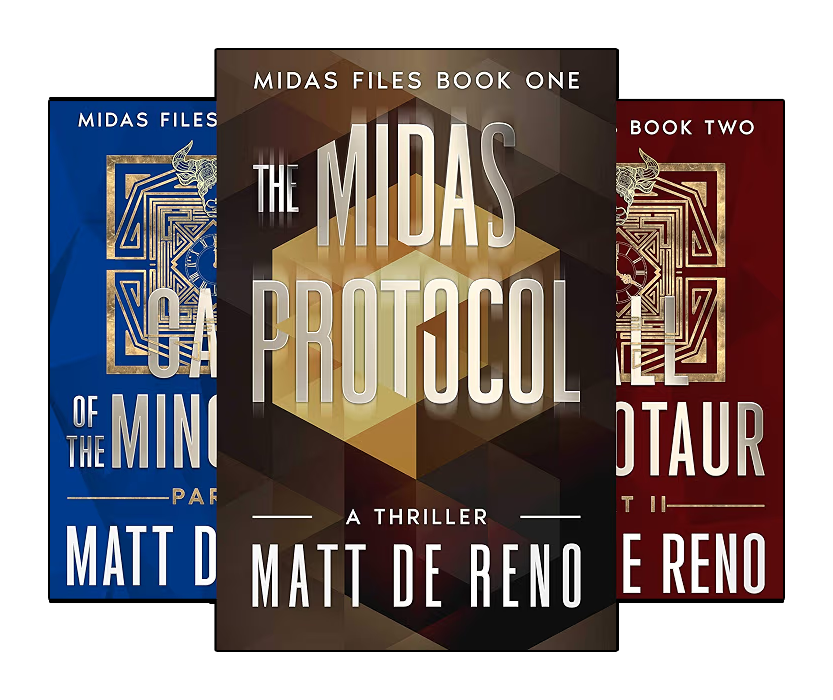

Before Lawrence Bingham built the Gold Box, before Malcolm Kane became one of the most consequential figures in the hidden history of The Midas Files, and before Eva Bingham became inseparable from Larry’s story, there was Berkeley.
In the 1960s, the University of California, Berkeley was the kind of place where a young person could reasonably believe the future was being invented in real time. Science, politics, philosophy, protest, technology, music, and social upheaval all seemed to be colliding in the same few square miles. Lecture halls and laboratories existed alongside demonstrations, ideological arguments, and a generation questioning institutions that had once seemed permanent. For young Lawrence Bingham, Eva, and Malcolm Kane, Berkeley was more than a university. It was the intellectual furnace in which three very different ideas about the future began to take shape.
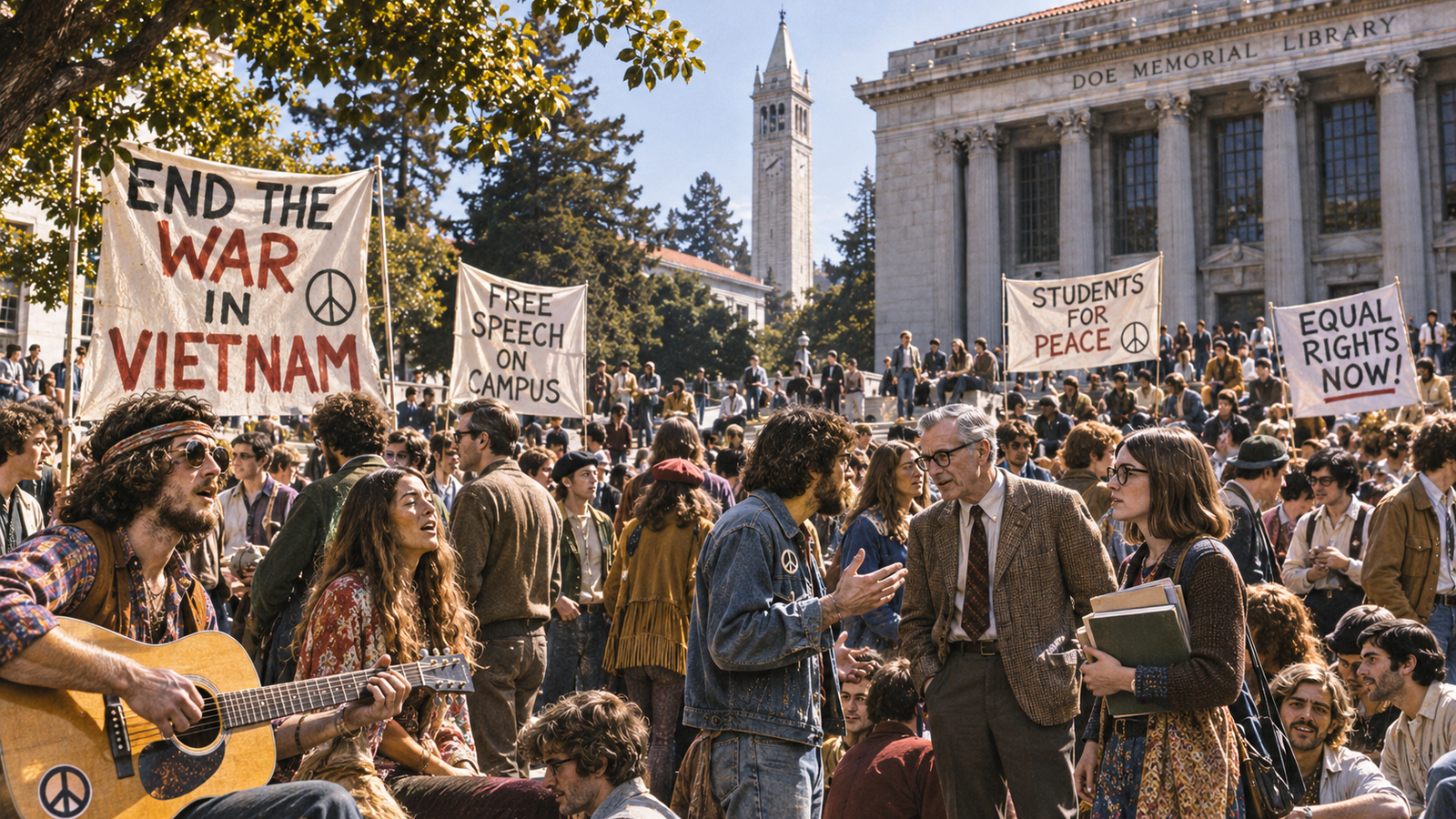
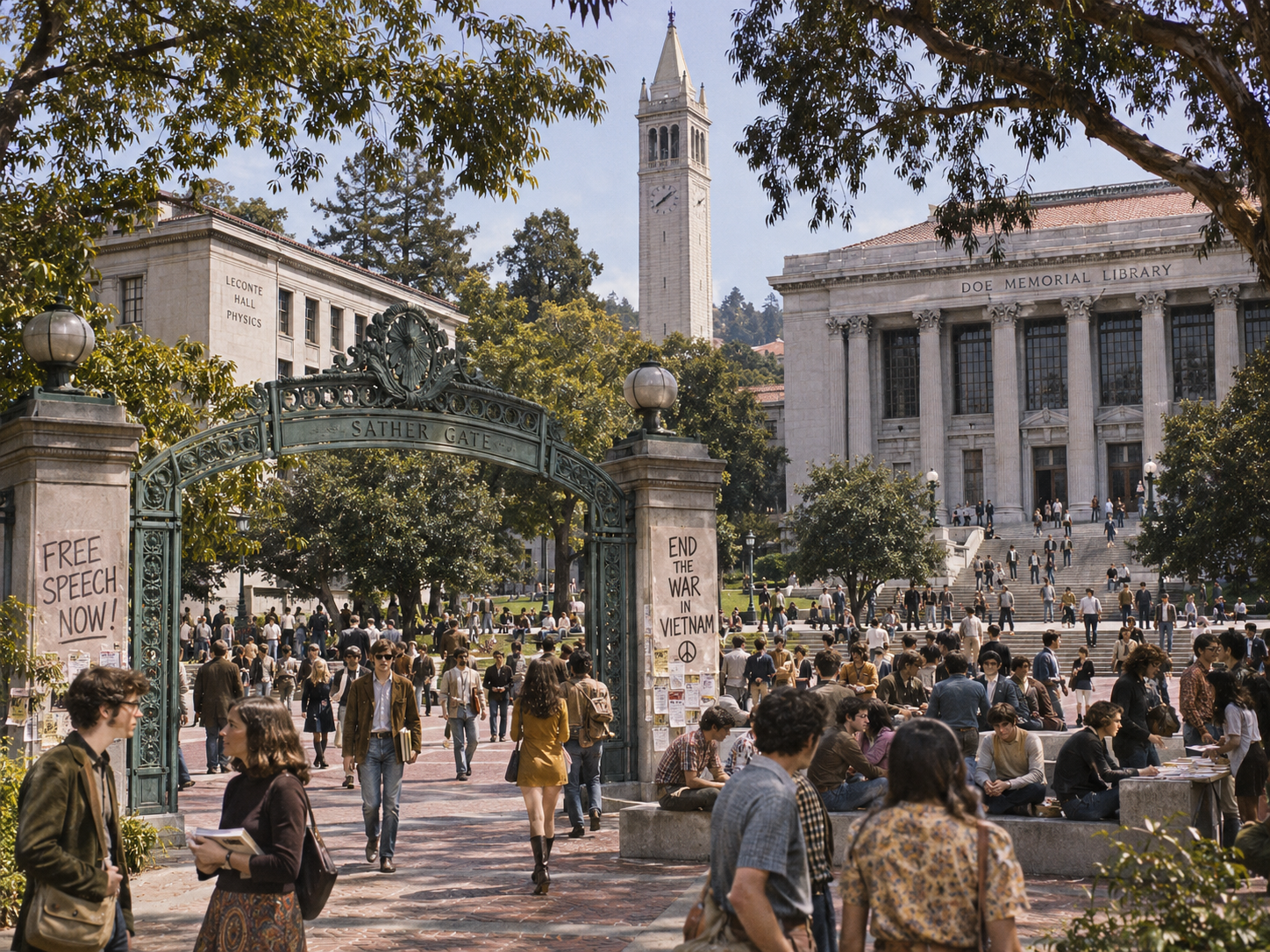
The images accompanying this entry visualize that formative world: Berkeley’s academic spaces, the crowded campus atmosphere of the 1960s, and younger versions of Larry, Eva, and Kane before history hardened them into the figures readers eventually encounter in The Midas Files.
Before Lawrence Bingham Became “Dr. Bingham”

It is difficult to look at the Lawrence Bingham of 1983 without seeing the weight he carries. By the opening chapter of The Midas Protocol, Larry is sixty-five, exhausted, gray, and deeply troubled by what he has created. Fifteen years of secret research have consumed him. His trust in the Majestic Twelve has eroded. His greatest scientific achievement frightens him almost as much as it inspires him.
The younger Larry Bingham is a very different man.
At Berkeley, Larry is still becoming the person capable of building the impossible. He is intellectually restless, intensely curious, and fascinated by the idea that apparently unrelated systems might fit together if viewed from the right angle. He does not yet carry the burden of the Gold Box because the Gold Box does not yet exist. What exists instead is possibility.
That distinction matters.
The older Bingham sees consequences everywhere. The younger Bingham sees connections.
He is the kind of student who can become absorbed by a problem long after everyone else has left the room, not because he is chasing a grade or a résumé line, but because something about the question refuses to leave him alone. Equations, materials, geometry, energy, machines—Larry is interested in the point where conventional understanding stops working. The intellectual temptation is not merely to learn what is known. It is to find the seam where the known world begins to come apart.
That instinct will eventually lead him toward Evium, higher-dimensional geometry, secret research, and the machine that comes to dominate his life. At Berkeley, however, it still looks like what it probably felt like to Larry himself: curiosity.
Eva Before the Mansion

Eva is easy to underestimate when looking backward through the events of The Midas Protocol because tragedy freezes her in a particular moment. Readers first encounter the consequences of her death before they have much opportunity to know the life that preceded it.
The Berkeley years offer another way to see her.
Eva belongs in this world not simply as the woman Larry will marry, but as a young person with her own intelligence, judgment, humor, and understanding of the people around her. Where Larry tends to disappear into questions, Eva notices the human beings asking them. She is able to appreciate Larry’s intellectual intensity without necessarily sharing his tendency to vanish inside it.
That quality becomes increasingly important as Larry’s ambitions grow.
The relationship between Larry and Eva is not interesting because one is brilliant and the other patiently waits for brilliance to finish. It is interesting because Eva becomes part of the emotional structure that allows Larry to function. She can admire the mind while recognizing the man attached to it. Years later, when she jokingly refers to Larry’s secret research as his “mistress,” the humor works because the competition is real. Larry’s work repeatedly asks for the attention that belongs to the rest of his life.
Berkeley represents the period before that competition became overwhelming.
In these earlier years, it is easier to imagine Larry and Eva walking across campus, arguing about an idea over coffee, watching a demonstration form near the university gates, or simply enjoying being young in a place overflowing with people convinced they were helping invent a different world.
The tragedy is not merely that Larry and Eva eventually die together.
It is that they once had decades ahead of them.
Malcolm Kane Before the Conspiracy

Then there is Malcolm Kane.
Kane may be the most interesting figure to revisit as a young man because later events make it tempting to assume that everything was always there—that the ambitions, ruthlessness, secrets, and desire for control must have been visible from the beginning.
Human beings are rarely that simple.
The younger Malcolm Kane is brilliant, charismatic, confident, and intellectually formidable. He belongs in Larry’s orbit because he can genuinely keep up with him. Their friendship is not built upon Larry being manipulated by someone obviously sinister. Kane has ideas. He has vision. He has the ability to look at a system and ask not only how it works, but what could be done with it.
That difference between Kane and Larry may be subtle at first.
Larry tends to ask: What can we discover?
Kane is more likely to ask: What can we do with what we discover?
Neither question is inherently sinister. In fact, great scientific and technological progress often requires both. Discovery without implementation can remain trapped in notebooks. Implementation without conscience, however, can turn discovery into something else entirely.
Berkeley gives Larry and Kane a place where those two instincts can coexist before circumstances force them apart.
They can be friends, collaborators, competitors, and intellectual equals. Kane can admire Larry without yet needing to possess what Larry knows. Larry can respect Kane’s drive without fully understanding where that drive might eventually lead.
The later history between them becomes more powerful if the relationship begins with genuine affection and genuine respect.
Betrayal means very little if trust never existed.
Three People, Three Ways of Seeing the Future
Looking at Larry, Eva, and Kane together, I have increasingly come to think of the Berkeley period as a triangle of worldviews.
Larry represents discovery. His instinct is to understand the hidden structure beneath things. He wants to know why the machine works, what the material is capable of doing, what geometry means when it moves beyond ordinary dimensions, and whether some impossible observation might actually be telling us something about reality.
Eva represents human scale. She understands that discoveries ultimately happen to people. Ambition changes relationships. Work consumes time. Secrets create distance. The grandest idea in the world still has to coexist with dinner, friendship, love, loyalty, and the person waiting for you to come home.
Kane represents power. He understands that ideas become consequential when somebody can organize resources around them. Institutions, funding, government access, influence, secrecy, logistics—these things do not necessarily inspire Larry, but Kane understands their importance instinctively.
Put those three perspectives together and something extraordinary can happen.
Pull them apart and something dangerous can happen.
Much of The Midas Files grows out of that tension.
Berkeley as More Than a Backdrop
The Berkeley setting matters because the university itself was living through questions not entirely different from those that eventually consume these characters.
Who controls knowledge?
When should institutions be challenged?
What obligations does an individual have when an institution acts against his or her conscience?
Does technical capability automatically justify action?
Who gets to decide what the future should look like?
Those questions were not confined to laboratories. Berkeley in the 1960s became nationally associated with student activism, free-speech battles, antiwar movements, changing social expectations, and a broader generational skepticism toward established authority.
That atmosphere makes it an especially fitting birthplace for the Bingham story.
Larry will eventually become a man secretly working with one of the most powerful hidden organizations imaginable while simultaneously questioning whether that organization can be trusted with what he has built. The seeds of that conflict belong naturally in an environment where authority itself is being debated in public.
Kane, meanwhile, sees institutions differently. Where Larry may eventually become suspicious of centralized power, Kane understands how institutions can be used. He is comfortable moving toward the machinery of influence rather than away from it.
Eva occupies the space between those instincts. She sees not only ideology but behavior. People can make noble arguments and still hurt one another. Institutions can claim great purposes while behaving badly. Brilliant men can convince themselves that neglect is sacrifice.
Berkeley provides fertile ground for all three perspectives.
The Academic World Behind the Mythology
One reason I enjoy visualizing this period is that The Midas Files mythology eventually becomes enormous. Cubes of Aurelia. Alien civilizations. Majestic Twelve. Axioms. Evium. Vanterpool. Ancient history. Time. The Moon. The mythology can become so large that it is easy to forget that much of it begins with people in classrooms.
That academic world is important to me.
Larry should look like he belongs among chalkboards, notebooks, laboratories, faculty offices, stacks of papers, and professors who can derail an afternoon with one provocative question. Kane should look equally comfortable there, but perhaps with slightly more awareness of who controls the department, where the money comes from, and which person in the room has influence beyond academia.
Eva should look as though she belongs in the story on her own terms, not merely because she happens to be standing beside Larry.
The university is where all of them are still close enough to ordinary life that their future seems negotiable.
They do not yet know which relationships will survive.
Neither does the reader.
The World Outside the Classroom
The campus images that accompany this article deliberately place academic Berkeley beside the unrest of the era.
Students move beneath Sather Gate. Demonstrators gather. Signs call for free speech, peace, and an end to war. Professors walk through crowds debating students who are increasingly unwilling to accept authority simply because authority insists upon itself.
Whether Larry, Eva, or Kane agrees with every cause matters less to me than the fact that they are surrounded by the argument.
They cannot live at Berkeley in this period without encountering the idea that systems should be questioned.
For Larry Bingham, that idea becomes almost prophetic.
Years later, he will discover that the secret organization financing his greatest work may not intend to honor the agreement that convinced him to undertake it. He will question the Majestic Twelve. He will remove the Gold Box from their control. He will decide that another person—Tony Laporte—must know the truth.
The older Larry eventually does something very Berkeley-like.
He challenges the institution.
Unfortunately, the institution challenges him back.
Before the Gold Box
The title of this entry is intentionally simple.
Before the Gold Box.
Because the Gold Box eventually becomes such a dominant object in Larry’s life that it can make everything before it feel like preamble. I do not think it should.
Larry Bingham had a life before the Cube.
He had friendships before Majestic Twelve.
He had ambitions before clandestine laboratories.
He had Eva before secrecy began competing with her for his attention.
And he had Malcolm Kane before whatever ultimately comes between them.
Those years matter because they remind us that mythology is built from ordinary human decisions long before anyone realizes those decisions are becoming mythology.
Nobody walks across a college campus thinking, This friendship will someday affect the fate of civilization.
Nobody sits beside someone in a lecture hall believing, One day I may have to decide whether I can trust this person with impossible technology.
Nobody falls in love while contemplating how history will remember the relationship.
They simply live.
The consequences come later.
A Visual Prologue to Bingham’s Notebook
These Berkeley images are also helping me visualize the world of the developing novel Bingham’s Notebook.
The novel gives me an opportunity to meet Lawrence Bingham before he becomes the older man standing beside a Mercedes in October 1983, holding the most dangerous machine he has ever created. It allows Malcolm Kane to exist before the reader knows where his ambitions ultimately lead. It gives Eva space to become more than the woman waiting inside Well House on the final night of her life.
That may be one of the things I find most compelling about going backward in this universe.
We already know where some of these people end.
Now we get to ask how they became the people capable of arriving there.
And somewhere among Berkeley’s lecture halls, protests, notebooks, laboratories, friendships, romances, arguments, and impossible ideas, Lawrence Bingham is beginning to take the first steps toward a golden cube that does not yet exist.
The future is still open.
For now.
Author’s Lore Note
The Berkeley years are part of the developing mythology being explored for Bingham’s Notebook: A Midas Files Story. The broad relationships and narrative direction are foundational to the story, while some details of this period may continue to evolve as the novel develops.
The images accompanying this article are cinematic visualizations of the characters and period rather than documentary representations of specific historical moments. They are intended to help establish the mood, personalities, and academic world surrounding young Lawrence Bingham, Eva, Malcolm Kane, and 1960s Berkeley.
Filed under: Character Files · Location Files · Hidden Lore
About the Author
 Matt De Reno
 is the author of The Midas Files, a Pittsburgh-rooted science-fiction thriller series exploring ancient power, impossible technology, hidden history, and the people caught in between. In Bingham’s Notebook, he opens the files behind the fiction—examining characters, artifacts, locations, chapter connections, and the evolving mythology of the series. Email him at