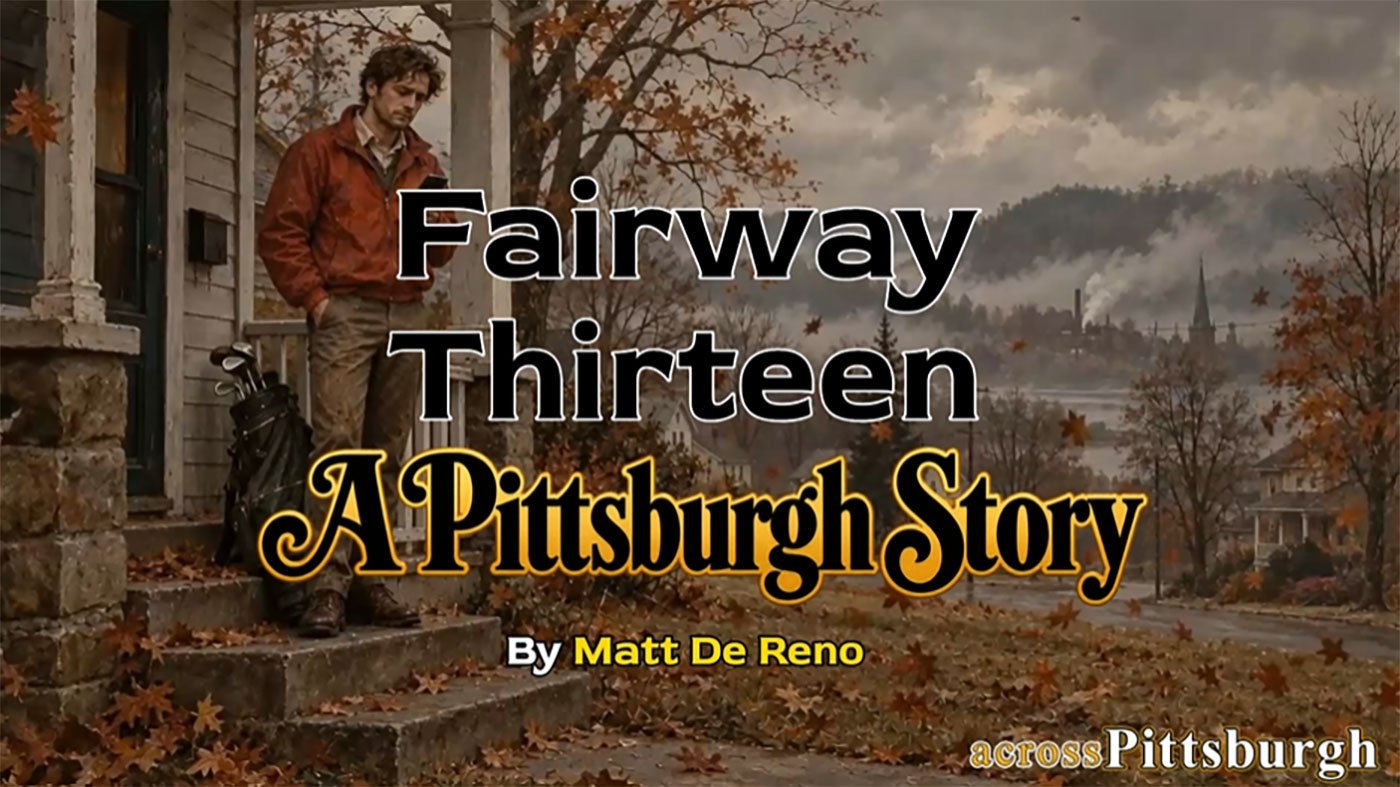
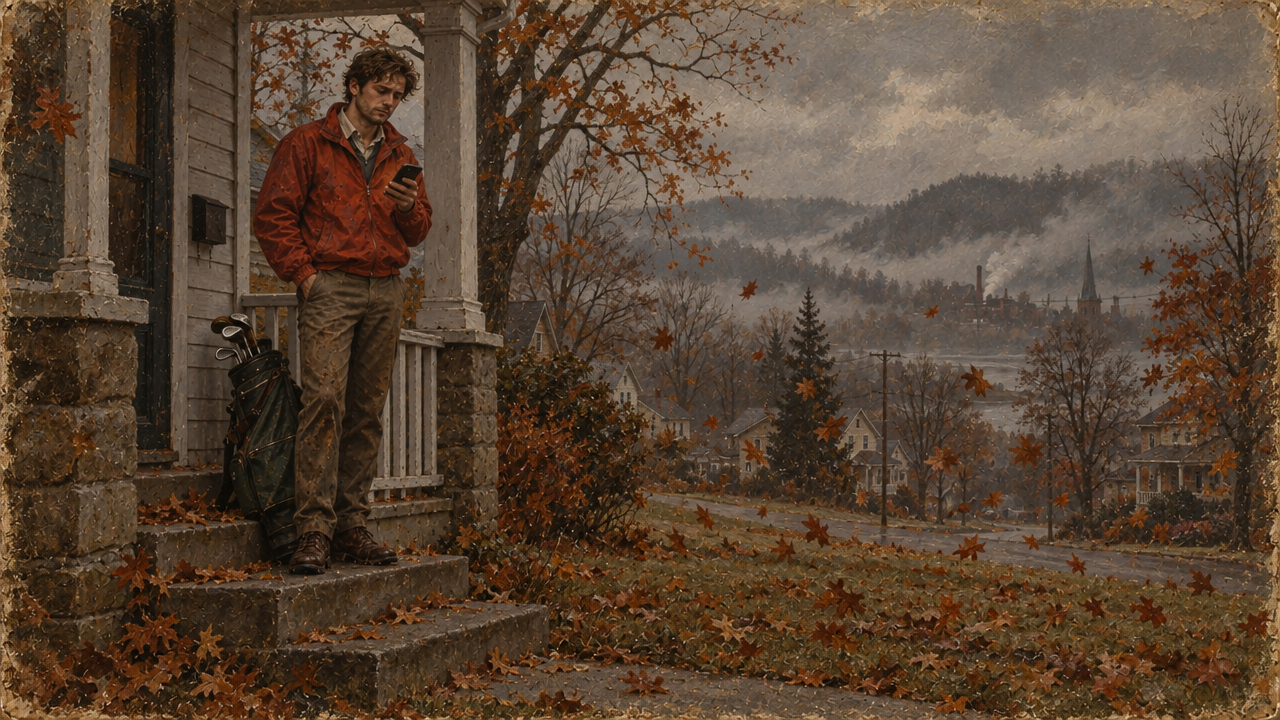
The weatherman was calling for good stuff today. Sunny, he had said. In the upper 70s. I was inclined, however, to believe the weatherman drank as much as my friends and I did the night before. After all, it was barely 50 degrees, gray, and overcast.
Watching the leaves blow across my front lawn, I wondered if any golf course would be clear enough for a complete round of golf—the last round of the year. Maybe one more, if we were lucky.
In Western Pennsylvania, fall was intended for gathering around campfires and toasting s’mores more than adding up numbers on golf cards in a way that would make a crooked accountant blush. At least this would be my final golf outing of the year. I was not so sure about the others.
All of us, married with kids, had our hall passes signed for an early morning round of golf, just in time for a 1:00 p.m. kickoff against the Cincinnati Bengals. Considering how late the gang was out the previous night, I was surprised none of those passes had been revoked by our better halves. It was a young married man’s weekend with his beer-drinking friends. What could be better than that?
I glanced at the little screen on my Motorola StarTAC: 7:33 a.m. They should have been here a half hour ago. With impatience, I snapped the phone shut and tucked it away in the pouch pocket of my red windbreaker, a garment that offered negligible protection against the biting morning chill. Where in the fuck were they? Where in the fuck was the sun?
A quarter hour faded.
Ride To North Park Golf Course
While completing a quick inventory of my golfing gear, a white BMW came to a quiet halt along Church Avenue. Red-eyed bobbleheads stared blankly from behind the Beemer’s passenger windows. My breath fogged as I hoisted my nylon golf bag over my sleep-rusty shoulders. The clubs rattled like a quiver of graphite arrows. My cold bones tingled.
After my underwhelming implements were stuffed into the sedan’s packed trunk, I likewise squirmed into the back seat next to Brian, who managed a Neanderthal-like utterance before proclaiming, “I fucking hate rum!” With that, we were off, leaving Ross Township behind.
“So where are we golfing today? Shannopin or Highland? How about Nemacolin?” I joked.
“Nemacolin? What kind of money are you making at Unalco? Yeah. Anyway... The Highland is closed today,” Mr. M said. “Muni-time. North Park.”
“Works for me,” I said, glad it was North Park, which was wide open and an easier play than the private clubs.
Hutch, head down, was lost in the Steelers’ injury update. Mr. M, Hutch’s dad, steered the white BMW lethargically.
Beyond the windshield, an early morning fog shrouded the hills of southwestern Pennsylvania suburbia. As we drove, we made small jokes, but talk soon gave way to a welcome silence. Hutch, sporting a Pittsburgh Pirates hat and crimson polo shirt, sipped from an aluminum coffee mug while reading his rumpled Post-Gazette.
Mr. M stole a look at the same sports page over Hutch’s shoulder, paying alarmingly little attention to Route 19. Brian lay in the back seat next to me, looking half in the grave. He let one rip but pretended he didn’t. Occasionally, he rubbed his short brown hair and moaned. All for the better; otherwise we might have thought him dead. Mercifully, the radio—talk radio at that—precluded meaningful conversation, which we had exhausted yesterday after the first round.
The broadcast concerned a girl who had been missing for several days in Ross Township. On any other Sunday, I might have dismissed the story as standard fodder. But the disappearance was the talk of the community. Although no one in the sedan mentioned it, with several fathers aboard I doubted any of us could ignore it. The story had hit close to home.
Lauren Ross Missing
“Lauren Ross, 8, was last seen playing at the bottom of her street near Sewickley Hollow. A neighbor said that Lauren had left her mother’s house about five-thirty that afternoon and was alarmed when she never…”
I slouched, fastening my seat belt, my interest in the story growing stronger. I listened closely:
“…Lauren Ross was often visited by Bellevue resident Wes MacMillan, a man described by neighbors as a loner. He would often play games with Lauren when not carrying out his handyman chores for which he was hired… FBI investigators have not ruled out the possibility of foul play. MacMillan previously served five years for…”
The broadcaster noted that this was the first time the community had been shaken since the grisly Bingham murders of the 1980s.
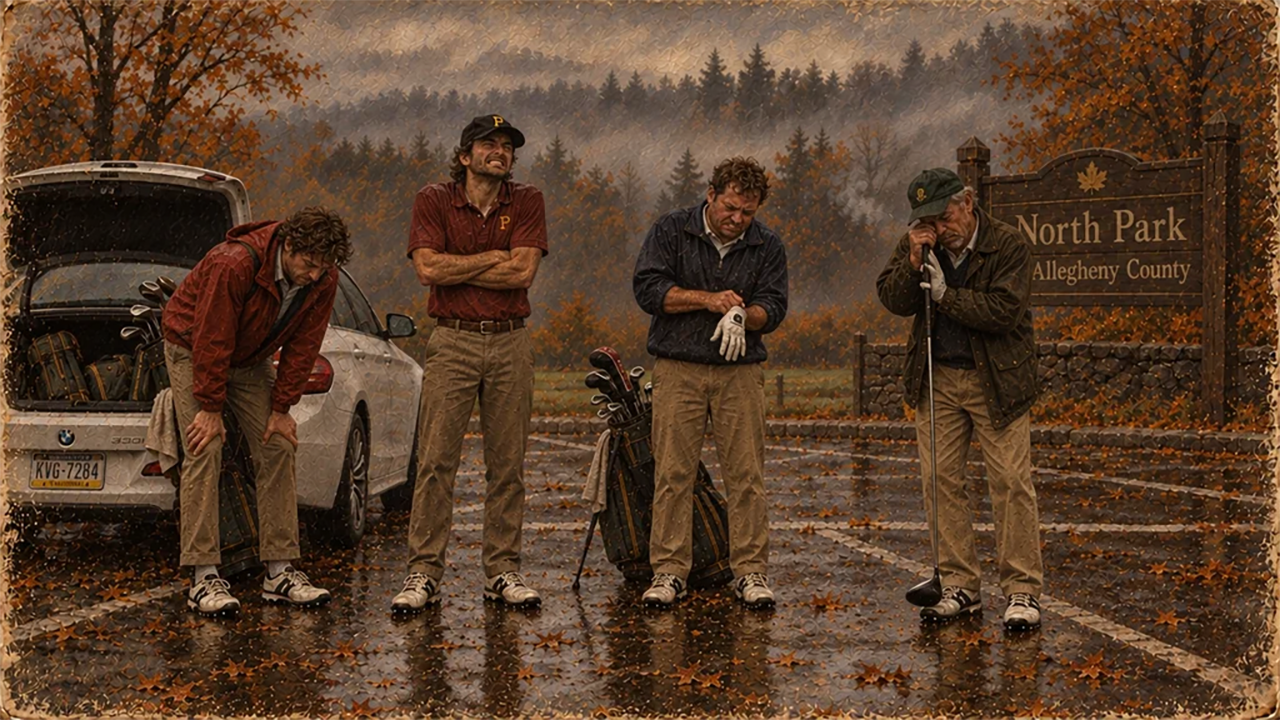
Twenty minutes later, the Beemer pulled into the parking lot of North Park Municipal Golf Course. It was nearly vacant. Most golfers had given up by now, but not us.
We traded tennis shoes for our golf spikes in the asphalt lot as our collective hangovers made room for the early morning pangs of recovery. While I stretched, Hutch went off to sign up our foursome. Brian rolled his shoulders. Mr. M smoked a cigarette. Although still misty and chilly, the day felt like it would heat up soon. I flipped open my cell phone again: 8:17 a.m.
Hard to imagine that only six hours ago, Brian held a beery karaoke microphone at a mostly empty Rochester Inn while I had gawked at the impressive drink tab our group had amassed. I can’t remember all the other bars we hit that night: Ozzy’s in West View, The Highland Bar for a beer or two, hell, even Barrie’s Bar and Grill. We did the West View crawl, and today we were paying the price.
Allegheny County's North Park Golf Course
North Park did not take tee times, so we had to arrive early to start our round at a reasonable hour. Today, however, waiting gave me time to think. My mind kept returning to the little girl Lauren Ross. Oddly, I felt guilty.
What had she done to deserve her fate? For that matter, what had I done to deserve mine—standing here with no greater worry than how well I might shape the path of a meaningless little white ball?
I could only imagine the pain the Ross family must be feeling right now. It seemed like a small eternity before the cackling loudspeaker announced: “McGarrity foursome to the tee.”
The Round of Golf
Although consistently last in the tee order, I was playing relatively well; I counted three strokes behind Hutch. Mr. M was in command, having rattled off three consecutive pars and a birdie on twelve. There was no hope of beating him.
Brian was a stroke ahead of Hutch, aside from a little luck from a fifteen-foot lag that “fell in the front door drunk”—much like Brian no doubt had done the night before.
Overall, a highly respectable effort on my part; in fact, give or take a meltdown by either Hutch or Brian, I might overtake one of them. Such was my standing amongst the others when, with little fanfare, we arrived at the divot-laden tee box on No. 13.
No. 13 was a grueling par-five dogleg left. As I pulled my hand cart over to the ball washer, I paused, recalling something immeasurably silly about Fairway Thirteen, which I had not thought about since my last round here the previous year.
For a couple of summers, I had heard strange, barely audible barking dogs when I teed off. The barking always appeared to come from the deep woods that ran along the left side of the fairway, just inside the bend where the hole doglegged sharply left.
Perhaps it was merely coincidental, but my game would usually blow up at this hole and any strides made up to that point were useless. I wondered if I would hear those same dogs again today, more than a year after my last round on this hole.
Perhaps to humor myself, as Mr. M completed his pre-swing ritual, I walked to the side of the tee box, pinning my ears for the dogs.
I didn’t hear a damn thing—a most favorable sign. Ah, I was thinking too much.
Mr. M hit a beauty—a gentle draw that followed the dogleg left and cut the corner perfectly. Clearly, there would be no letup in his game. We complimented him on the swing and strike.
Immediately, I painted a mental picture of my ball doing the same, but I doubted my mental painting would be colored within the lines. Brian placed his tee, then backed up about ten paces, and took a windmill-like practice stroke.
Wait a second.
Right then, the distant echo of howling dogs funneled into my straining ears.
“Well, I’ll be damned!” Still to the side of the tee box, I squinted toward the gloomy woods, hardly believing what I heard.
“Brian,” I said, “do you hear those dogs barking?”
“What dogs?” he said, screwing up his face at me, annoyed at the interruption.
“The dogs in the woods?” I stammered, pointing with a golf tee in my hand. “Over there… You don’t hear anything?”
“I don’t hear a darn thing,” he said, gyrating until he settled into a comfortable stance. “Do you mind if I hit my ball?”
“Go right ahead, Brian… By all means.”
Brian addressed his ball and swung. For all his brute technique, he nailed the sweet spot. A patch of sod flew into the air. We served up compliments like stiff drinks at Ozzy’s bar the night before.
Nonetheless, I would not let the subject of the dogs die. “You don’t find it strange that dogs always bark near hole thirteen?”
I removed a tasseled club cover from my nicked-up 3-wood—the one with the virginal sweet spot.
“Not really,” he said, shading his eyes with a gloved palm as he admired his distance off the tee. He smirked. “I’m sure people have plenty of dogs out this way, Matt.”
“You’re probably right. I bet those mansions we passed over that hill swing around back—huh? They are really building some nice places out here…” I laughed.
Hutch’s turn.
A healthy smack! His ball launched from the tee box with the power and grace of a 747. When it ran out of gas, it landed in the middle of the fairway. Like his dad’s and Brian’s shots, it earned our compliments. Then all eyes turned to me.
I positioned my ball, took aim, and tried to relax. The dogs barked. Annoyed, I turned to Brian, scowling as I waggled my club head over the ball. “Do you hear that?”
“Hear what, Matt?” he said, squinting at me.
Is he fucking deaf? “The dogs, man. What else do you think?”
“What the fuck are you talking about, Matt?”
I paused. “Are you kidding me? You can’t hear the dogs?”
Hutch looked at his watch. “Are you going to hit the ball or what? We don’t have all goddamn day. I’m catching the Steelers game later today…”
Mr. M, the only one riding in a cart, inched up the cart path toward the fairway, updating his scorecard. I waggled my club again. Screw it, I said to myself. I will hit anyway—dogs be damned!
I brought the club head back slowly… Whoosh!
At the critical instant when the club head should have met the ball, a high-pitched, screeching bark cut through my ears, throwing my timing hopelessly off.
Oh, for fuck’s sake! No. NOOO!
The ball whizzed like a plane not intended for flight—hooking horribly left, disappearing over the sloping bank into the woods on the inside of the dogleg! “The fuckin’ dogs did it again!”
Compounding matters, I felt a strain in my lower back. I hunched, cursing. I flung my 3-wood onto the turf in disgust. Brian chuckled. After rubbing my lower back, I stooped to retrieve it.
Mr. M flicked his cigarette butt, offering smarmy condolences: “It opens up down there—you might be okay?”
“My ass, it opens up down there. I suppose like Jefferson thought the Northwest Passage opened up down there, huh?”
“There you go again with the history stuff,” Hutch said. “Fountain of useless knowledge.”
“Right here, Hutch,” I said, grabbing my crotch.
Whenever one of us tanked a ball into the rough, someone would insist it “opened up over there”—always with a knowing smirk. I heard that reassurance more often than the others.
Today, however, it would open up down there—only in a way I could never have predicted.
The Woods On Fairway Thirteen
With unmerciful indifference, my golfing mates marched on without me. I undertook the walk of shame, veering left from the tee box toward the woods inside the dogleg.
I prayed that with a little luck, my ball would be found lying on the edge of the wood. All the while, the canine caterwauling continued unabated.
It was here that I took in a vibrant wall of fall foliage, its shades of red, yellow, brown, and green beautiful to behold. Yes, I was hung over, but I was walking into a postcard. I might have enjoyed it had my golf game not disgraced me—and had the dogs not been wailing so close yet strangely far away.
To my dismay, it appeared my golf ball had entered the woods much deeper than I had thought. Using my 3-wood as a rake, I stepped into the woods, probing the leafy, tangled floor.
Brush and debris grew particularly thick in this patch. A few minutes passed, and still the barking grew louder. Then a faint whisper floated past my left earlobe. Or perhaps it was a yellow maple leaf brushing my ear.
For a second, I thought Brian had snuck up on me, playing a joke. I turned sharply. Brian was nowhere to be seen.
“Who’s there?” I called. No answer.
Was my anxiety getting the best of me? I scanned the area. Then my luck appeared to change. At the bottom of a deep ravine, I spotted a small white object—what else could it be but a ball? I marched down into the woods.
Beneath the canopy, autumn’s beauty took on a darker cast. The trees stretched their craggy fingers above me, while their last outstretched palms of orange, red, and yellow drifted toward the ground. Was there ever a more palatable metaphor for death than a turning leaf floating toward its ultimate destiny?
I plodded down into the gloomy gully.
The white object lay deeper in the woods than I would have thought possible for my shot. Perhaps the ball had ricocheted off a tree. Meanwhile, the barking continued, more clearly now.
Arriving at the little white object, I was disappointed to discover it was merely the remnant of a windblown paper coffee cup. Only this and something more.
The dogs were closer now. I could feel it.
I looked back toward the hillside. The brush seemed thicker, and my earlier path was lost to me. Yet a certain resolve gripped me: I would not leave these woods until I found the damn howling dogs. Once and for all, I would put this mystery to rest—and give their owner a word or two about shutting them the fuck up.
Pressing deeper into the woods, I looked for a house, a yard, anything that might explain the dogs. To my astonishment, the deeper I went, the bleaker the woods became. How was that possible? There was a neighborhood back here somewhere. North Park was in the middle of Gibsonia, a place rife with suburban developments.
I kept walking. The dogs barked. I pushed branches aside. Surely I had to be approaching a yard.
Yet I went only deeper.
No yard appeared. The woods—impossibly, it seemed—went on.
The sloping floor led downward into a gradual valley.
Here, it was noticeably cooler. Every ten feet, I expected to find a backyard. Instead, I was overwhelmed by the sensation that someone stood behind me.
The hairs on my neck stood on end. A knot tightened in my stomach. Was I imagining this?
A tap on my shoulder.
I shuddered but refused to turn around. The air turned cold. Then came a whisper—the words undeniable: “Low-Ren ROSS!”
I didn’t even turn to see who was behind me. I ran.
I tore through the woods, dropping my club and leaping over fallen logs. My heart hammered. I made it perhaps forty yards before tripping in a rut.
I tumbled. I rolled.
With outstretched palms, I landed headfirst into a pile of debris that gave way into yet another, even steeper ravine. I somersaulted for what seemed like an eternity. Crack!
My head slammed into a jutting rock.
Blood trickled from a nasty wound in my brow, down over my face. I struggled to my feet.
Where in the fuck was I?
In front of me stood a shallow mound of freshly piled dirt. The rock slab that had split my brow served, to my horror, as a makeshift headstone.
A dreadful melancholy overcame me, even as my head throbbed and I fought to regain my composure.
All at once, a strange silence seemed to have crept over the woods. Where was the barking of dogs?
They were gone. A creek gurgled peaceably. The distant cawing of a raven. Only this and nothing more.
My breathing finally slowed. The ground was damp, and the air was repugnant with the odor of rot and mold.
Suddenly, the barking returned, as though someone had turned a stereo to full volume.
The dogs were blasting!
The howls were no longer mere barking but angry, tormented cries. Yet everywhere I turned, I saw no dogs. Twigs snapped somewhere in the woods.
What I saw next was impossible. I could only pray that the blow to my head had conjured it.
A cadaverous and ghostly Indian warrior appeared from the thicket!
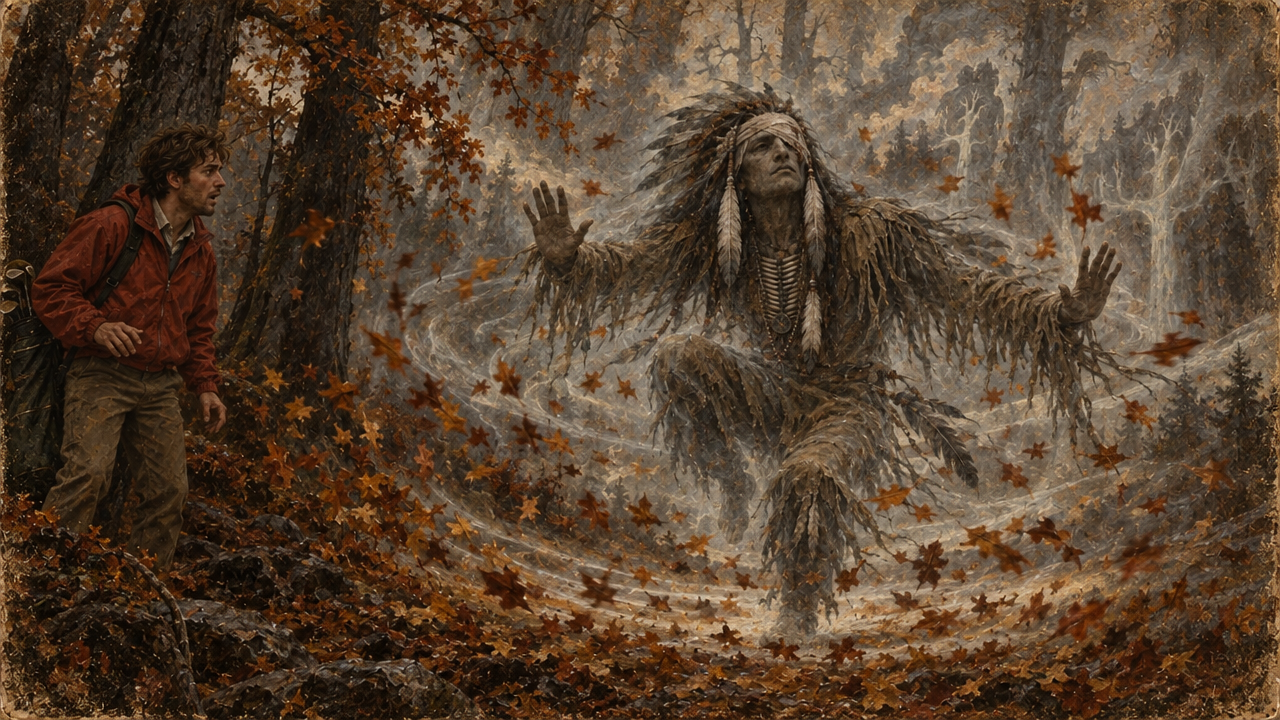
The muscular figure towered well over six feet, his stony face horribly disfigured. A hook had been wedged into the side of his skull.
It protruded through his hollow left eye socket. In his left hand, he wielded a bloody tomahawk. Dark-skinned and adorned in leathers, he wore a flowing headdress. Like the feathers of a great peacock, a brilliant array of greens, yellows, and reds jutted from his crown like a devil’s halo.
Two great white feathers sprouted from the back of that crown, pointing downward toward the depths of Hell, I reckoned. With his towering frame, he resembled a standing bull with one ghastly horn—the iron hook jutting from his ruined eye.
The barking took on a greater, evil urgency. Were the barking fiends his hellish pets?
I expected the unseen dogs to spring upon me, tearing the flesh from my quivering bones. Instead, the Indian stopped and regarded me curiously.
The Indian opened his mouth, his one good eye fixed upon me. From his wan lips, the words crept mournfully, yet unmistakably. His English was crude but discernible:
“Low-ren… Low-ren ROSS,” he whispered.
I froze. He raised his tomahawk. Then he threw it at me!
And so I expected a quick end would come to my poor golfing days.
But the weapon flew past my head and lodged in the shallow dirt pile beside the rock-slab headstone.
My mind told me to run, but fear and morbid enchantment held me fast before the unnatural figure I had taken for my executioner. He pointed a bony finger toward the mound. What did the ghostly Indian want from me?
He wanted me to inspect the mound.
Dropping to my knees, I scraped frantically, not knowing what I would find or what the Indian intended.
I dug. I scooped. I shoveled with my hands deep into the loosely packed dirt mound. Then I found her.
I screamed and fell back on my ass. I had unearthed a pale, purplish human leg. I turned toward my Indian master, trembling like a frightened child. His expression commanded me to continue.
I returned to the gruesome task.
I clawed the dirt away.
Soon I uncovered the body of a small child! Oh, God!
It was the missing girl—Lauren Ross! It had to be. She was about the same age as the radio broadcaster had described.
Lauren Ross: The Missing Girl
I could scarcely look at her battered body.
Her little neck had been slashed and torn apart; her head nearly severed.
Had the warrior done this? Had he taken her life?
The creature had been saying her name: Lauren. Had he buried her here? And why place a crude headstone over the dirt?
I turned toward the ghastly Indian. Was I to be his next victim? My stomach twisted; I dry-heaved. The Indian did nothing but watch me.
I reached for my cell phone, fearing this grisly scene would be my last memory before the Indian took my scalp as a war trophy and laid my axed carcass beside Lauren Ross.
I flipped open my StarTAC and punched 9-1-1 into its tiny keypad. As the call connected, the phone shook in my hands. The hellish chief did nothing but stare curiously while I mumbled to the operator.
“I would like to report a murder,” I said slowly to the emergency operator, not for a second removing my eye from the stoic Indian.
After I had given a disbelieving operator the best location I could—the woods to the left of North Park’s thirteenth fairway, somewhere down in a ravine—the Indian pushed me aside and retrieved his tomahawk from the dirt pile. For all I knew, the operator would suspect me of this hideous act, if I lived long enough for anyone to ask.
I braced for the blow. It never came.
Instead, the Indian began dancing and chanting.
Crouching down low, he stomped about the land, chanting, hooting, and hollering. He muffled the sounds of his chants with outstretched palms. He kicked his knees up high and looked, perhaps, for warrior brothers no longer in the company of mortals.
He looked up to the sky, then down to the ground. He danced in a circle, singing ancient runes in his native language.
A feeling like thick fog enveloped me. The air changed. The woods had changed.
All around me, the forest floor lay strewn with the bodies of slaughtered and mutilated Indians. Men in colonial attire ran amok. Blood stained the earth. I heard men shouting in what sounded like French.
Indian war shrieks echoed through the valley and musket fire ripped through the woods, splintering branches. War raged—and the sound of the dogs—the dogs barked like never before.
I moved about, but men ran past me. How was this possible?
Curiously, they paid me little attention. I was an apparition, a ghostly visitor from the future. Yet I was here. I was present. Was I dead already? Perhaps the Indian had cleaved my brains and doomed me to haunt these woods off Fairway Thirteen in a grim eternal sentence.
The smell of sulfur mingled with that of burned flesh. Then, in a moment, the scene faded, and I returned—somehow—to my own place on God’s continuum.
It was then I heard them. My foursome from Fairway Thirteen.
Hutch and Brian called from far off. The dogs sounded further away now.
Nonetheless, the body of Lauren Ross lay rotting at my feet. The one-eyed Indian had stopped his wild, savage dance, but was still as real as ever. He approached me slowly, walking past me into the woods.
After several paces, he stopped, turned and motioned for me to follow him. He wanted something from me still—but what? The Indian ghost held a hypnotic stranglehold on my will. So I followed.
We entered a small clearing in the woods. It looked as though it had once been an ideal place for a camp. A lone ray of sunlight filtered through the canopy onto a sprawling patch of crabgrass.
The one-eyed Indian paused at the trunk of a massive white birch tree. This forsaken timber seemed to tower over all the other trees in the forest. A tangible evil pervaded the clearing. I could hear the beasts but could not see them. The Indian braced himself.
Crouching down low, he stomped about the land, chanting, hooting, and hollering. He muffled the sounds of his chants with outstretched palms.
He looked up to the sky, then down to the ground, searching, perhaps, for warriors long since sent to their forefathers. He danced in a circle, singing ancient runes in his native language, moving in cryptic patterns, just like before. The steps, the cries, even the spaces between them were precisely the same.
Reality had transformed again. And I saw what had been heard yet unseen for years.
Against the gnarled tree around which the Indian circled, five wild dogs materialized.
Ropes held the beastly dogs to the trunk of the mighty birch.
The massive canines yelped, squealed and thrashed about. Their razor fangs snapped like bear traps. War raged throughout the woods. But what happened to the Indian?
I turned. He had vanished.
He soon returned.
The Indian and His Dogs
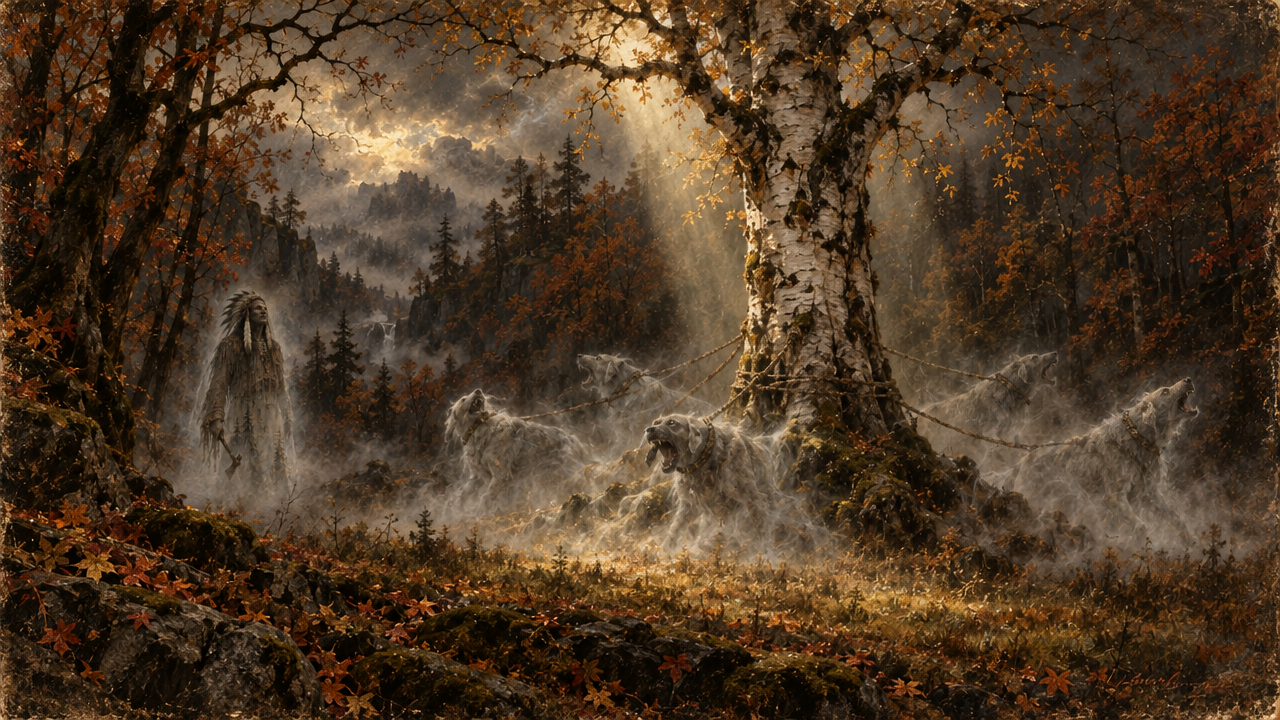
The Indian burst from the woods at a maddening pace, wielding his tomahawk and screaming as he raced toward the tethered dogs. He was different this time—he had both eyes!
His tomahawk was bloody and so too were his clothes. Behind him, horses thundered.
Brutish frontiersmen with long beards and rotten teeth galloped after him on massive horses.
A wicked man in the middle of the pack brandished a meat hook. The others wielded long muskets.
The Indian leapt toward the tethered dogs and raised his tomahawk to cut the rope. Before he could free them, he was struck down from behind with the barrel of a musket.
My jaw gaped. I watched helplessly as the men dismounted.
They beat the Indian mercilessly.
Meanwhile, the dogs thrashed wildly, powerless to aid their master. The men hauled the Indian to his feet, roped his arms behind his back, and forced him to his knees.
Muskets were leveled at the wailing dogs. The man with the hook, who seemed to lead the frontiersmen, twisted the Indian’s head until he could see his pets yelping to no avail. He gave the order. The muskets thundered.
The five dogs were turned into bloody rugs of claw, snout and fur.
The Indian wailed! The dastardly man, who held him in a viselike headlock, raised the rusty meat hook with his free hand. Its sharpened point glistened in a beam of sunlight. A terrible swoosh followed.
Crack!
Iron broke skull and man.
The frontiersman released his grip. The Indian fell forward in a heap, the hook piercing his skull, and lay dead at the boots of laughing frontiersmen. The scene transformed yet again.
The scene faded. The air changed. The times changed.
I returned to my natural point on God’s continuum—how I knew it, I cannot say, but the time felt right. Still, I trembled at what I had witnessed.
The Indian ghost stood beside the tree, the nasty hook glaring through his ruined eye socket. He seemed to contemplate this place where he and his dogs had been butchered.
The dogs wailed as loudly as ever. Sad. Tortured. Their haunted barking carried the weight of sins committed long ago.
Far off, I heard my friends call, no doubt wondering where I had gone. The Indian stared at me and I at him. Then I understood what he wanted.
He wanted me to free his dogs.
The brutalized warrior braced himself. Crouching down low, he stomped about the land, chanting, hooting, and hollering. He muffled the sounds of his chants with outstretched palms.
He looked up to the sky, then down to the ground, kicking his feet up high, perhaps, in honor of warrior brothers long since left for their forefathers. He danced in a circle, singing ancient runes in his native language, and commenced his haunting dance. The same motions, the same haunted cadence. I knew what would follow.
The air changed. The woods changed, and time with it. War returned to the valley!
I was back at precisely the time when the men seized the Indian.
I watched again as they lifted him up, roping his hands behind his back. Again, I witnessed the five dogs snapping, leaping, and dashing about the white birch tree, helpless to protect their master.
This time, I was determined the outcome would be different. I grabbed the fallen tomahawk and dashed toward the tethered dogs.
As the frontiersmen loaded their muskets, I cut the rope tethering the dogs to the tree. Invisible to the men, I delighted at the surprise on their callous faces when the rope snapped.
The dogs bolted into the woods. The frontiersmen stared at each other in dumb bewilderment. I turned toward the fallen Indian.
A knowing smile spread upon the Indian warrior’s dark lips.
He, unlike his captors, appeared to see me. His glory in that moment was profound but short-lived.
The hook rose. There was nothing I could do to save him. God’s will, it seemed, would have its way.
Like before, his twitching body stilled. The one-eyed Indian lay there dead, his skewered skull a grim sight to behold. However, this time the dogs had been freed and would bark across time no longer. I was sure of it.
The woods changed. Time changed. The ugly men, the dogs, and the Indian’s corpse all faded. I closed my eyes and opened them.
I was home again in the woods off Fairway Thirteen.
I heard my friends calling far away. The one-eyed Indian stood before me, merely a faded image compared with the solid presence he had possessed when I stood in his time.
I could see the trees through his ethereal body. A certain peace had settled upon his countenance—perhaps upon his spirit as well. He motioned for me to follow him again, and this time I did not fear him.
About thirty yards from the clearing, the ghostly Indian led me to another bloated corpse lying on the forest floor: a middle-aged man dressed in a blue workman’s uniform. A little girl’s clothing was scattered around his body.
I moved closer to the corpse, marking another grim discovery of the day in what had been a day of grim discoveries. The man he had led me to had been scalped. The name from the radio struck me: Wes MacMillan. The handyman. The loner. The blue uniform and the little girl’s scattered clothes brought the awful pieces together. I could not prove it, but I understood what the warrior wanted me to see. He had led me to Lauren not because he had killed her, but because someone needed to find her. And now he seemed to be showing me the man who had put her there.
The one-eyed Indian touched my shoulder. His moldy fingers were frigid.
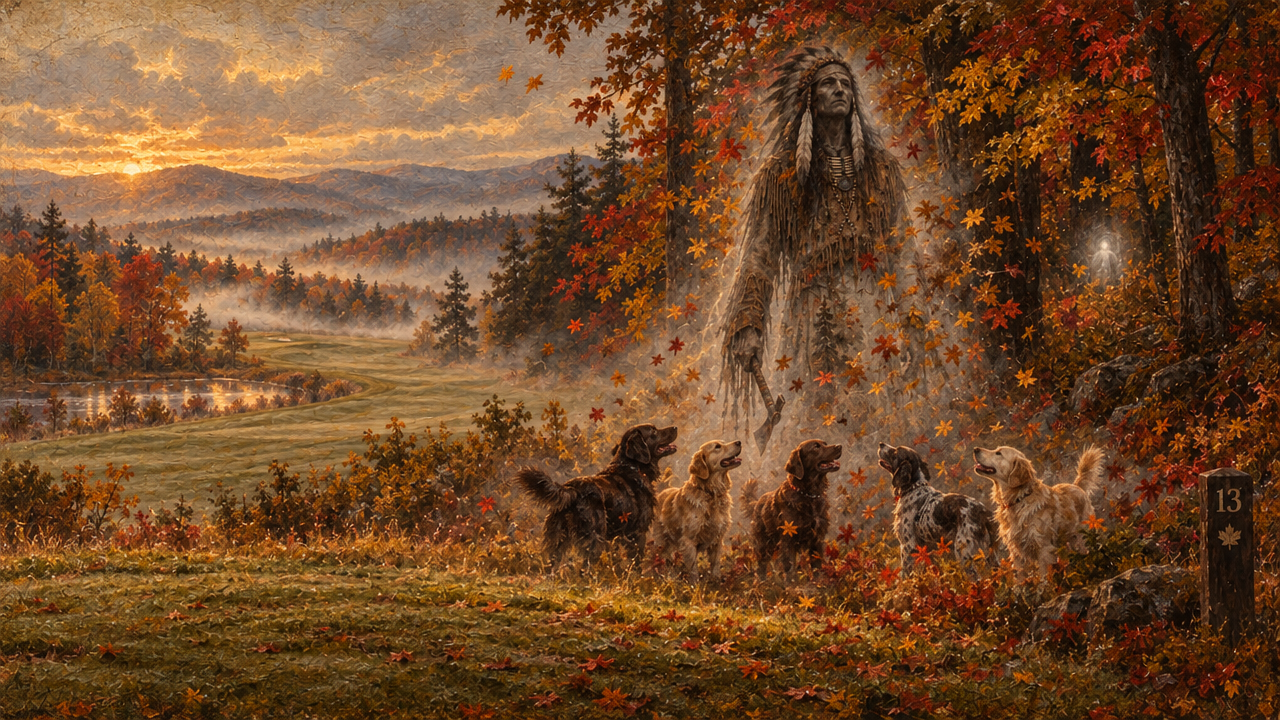
He nodded with forlorn resignation. It was as though the guilt of the ages was too much to bear. Here stood a ghostly witness to man’s never-ending cycle of murder, a spirit who wanted release from his own nightmare and had found some peace at last.
I followed him back through the woods to Fairway Thirteen, where my friends’ faraway calls grew closer. When we got to the edge of the woods, the Indian stopped. With a palm, he forbade me to go any further.
He slid his hand inside a deep fold of his ragged leather pouch. He slowly removed a closed fist.
With his other hand, he took hold of my wrist and gently placed something round in my clammy palm. The Indian’s touch was as cold as ice. For one appalling moment, I thought he had given me his missing eye.
I looked down: the Indian had found my lost white golf ball.
About the Author
 Matt De Reno
 is the author of The Midas Files, a Pittsburgh-rooted science-fiction thriller series exploring UFOs, secret histories, ancient technology, and the occasional problem caused by reality folding in on itself. In The Scratching Post, he writes about the creative life behind the books—storytelling, indie publishing, AI experiments, live readings, works in progress, and whatever strange idea has wandered into his notebook that week. Email him at